









Smart specialist trailer concepts
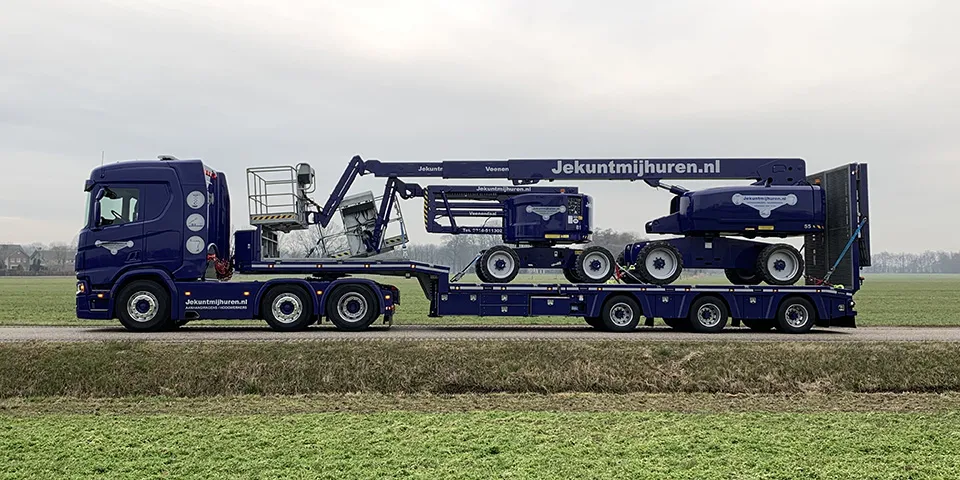
They are a versatile manufacturer of trailer concepts tailored to customers’ specific requirements. We are talking about Trias Trailers BV from Apeldoorn. Founded in 1959, the company initially produced the so-called ‘iron dogs’. It went on to make market and sales trailers, before moving into the production of heavier transport equipment. Today, it specialises in bespoke trailers, semi-trailers and truck bodies, all built to last.
Leo Oosterkamp, director of Trias Trailers, explains how the process works. “Every job essentially starts with a cup of coffee with the customer, followed by an in-depth discussion of their requirements. We look carefully at what they want to transport. We do not just listen, we also advise on what is feasible, taking account of RDW and government requirements and regulations. Together with the customer, we find the ideal vehicle configuration.” Trias Trailers handles all the engineering in-house, including the strength calculations. The 3D drawings give the customer a visual representation. Changes can be made on the basis of this design. This results in the final design, which can then go into production.
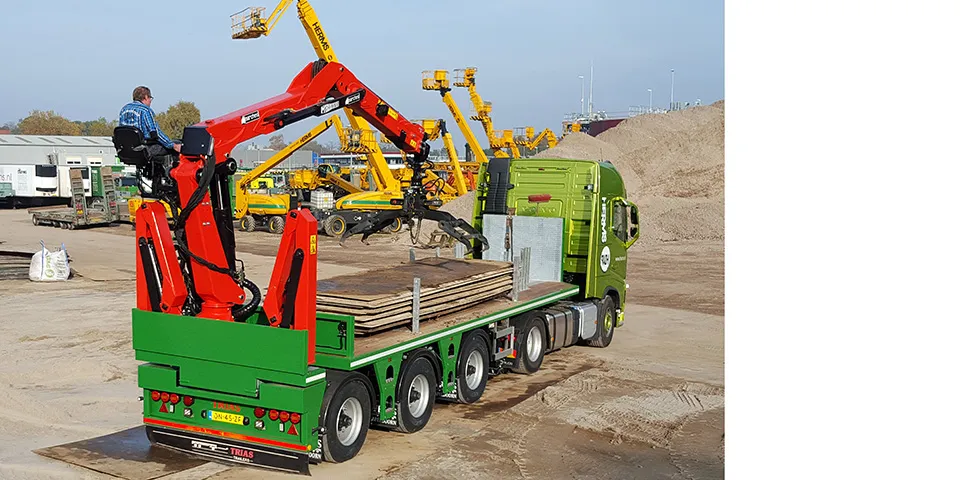
Three-axle, steered access mat trailer at work.
Well-protected chassis
The chassis and steel components made by Trias Trailers are hot-dip galvanised, with all parts immersed in a zinc bath at around 400 degrees. “This gets into every nook and cranny, unlike a coating or paint applied to a finished product. Take an extendable trailer, for example. All the closed box sections are galvanised inside and out. This prevents problems over time with extending the trailer and corrosion from the inside out, enabling us to guarantee a durable finish.” Trias Trailers has been using this technique since 1979. It started with small chassis, and once the company had built up considerable experience, moved on to larger and heavier products. After galvanising, the product is fitted out and, where necessary, inspected by the RDW or TÜV. Trias Trailers outsources the galvanising, as it does most machining work. Parts and semi-finished components are supplied formed and cut to size, after which Trias Trailers handles the welding and assembly. This is typical of the trailer manufacturer’s fast, efficient way of working.
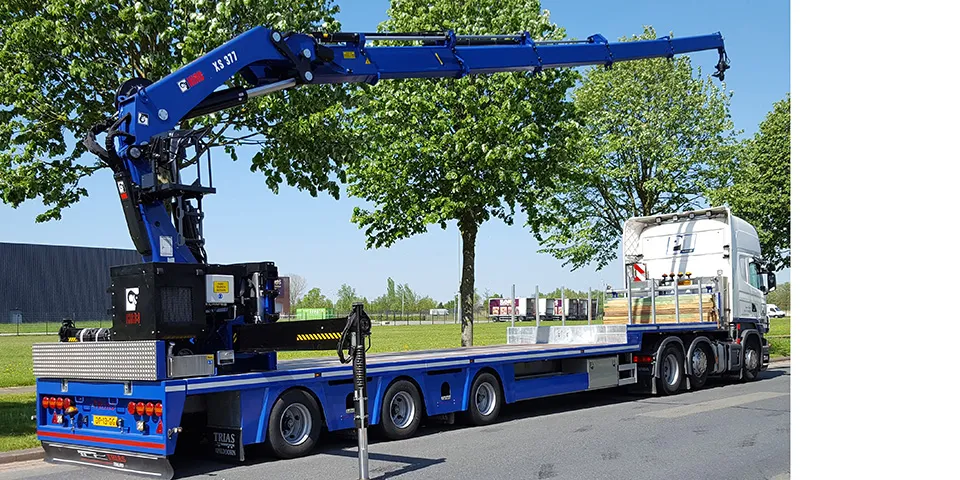
Three-axle, steered semi-trailer fitted with a 40-tonne crane that can travel along the full length of the low deck.
Specialist bespoke solutions
Specialist projects have become more common in recent years, ranging from heavy- and light-duty semi-trailers, extendable semi-trailers, mid-axle trailers and drawbar trailers to car and truck transporters and LZV combinations. “We also build truck bodies, market trailers, mobile brake test benches, stage trailers and other special vehicles. We even make semi-trailers with a 120 mm-thick neck that can accommodate a 60-tonne-metre roller crane. It was all on show at the Transport Compleet trade fair in Hardenberg. When I say that we also make chassis for mobile hospitals and for the flower and plant industry in the Westland region, I think it is fair to say that we can serve most of the market,” says Oosterkamp. Finally, he describes the semi-trailer made for Compactrent. “It is a three-axle semi-trailer with a very low deck height of 78 cm and a self-tracking rear axle. The rear section of the deck can be hydraulically articulated, allowing tracked vehicles to be loaded without ramps. The deck can also be widened by 50 cm for wide machinery, and has convenient storage for the widening beams, as well as integrated width boards. A heavy-duty lashing ring is fitted every 50 cm along the semi-trailer to secure the load. We have thought of absolutely everything, and that is our strength,” Oosterkamp concludes.
Question about this story? Ask your question
Keep following this
Get an email when a new story is published. No account needed.
- ThemeConstruction equipment and transport in motion
- SubjectBouwMat







