









Rapid pile testing gains popularity
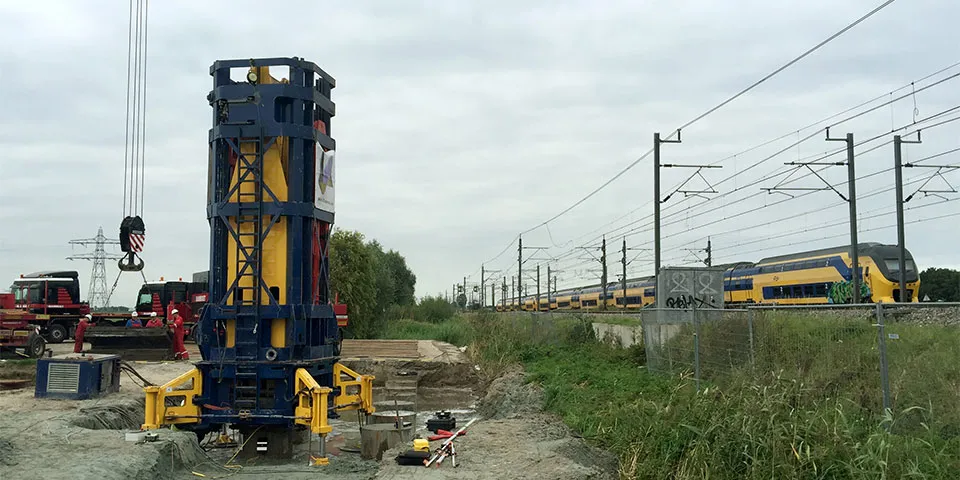
There is growing interest in carrying out load tests as part of foundation design. According to Rob van Dorp of Allnamics, significant savings can be achieved by designing foundations more efficiently than the prescribed standards require. The condition is that the design must be verified in accordance with NPR 7201 (Dutch Practice Guideline). Allnamics has developed a unique and efficient method for carrying out rapid pile tests, known as StatRapid.
Allnamics carries out pile tests to establish the quality and suitability of foundation piles. “These range from tests to determine load-bearing capacity to tests analysing pile-soil behaviour or checking the pile itself,” says Van Dorp. “In effect, we check whether what has been designed in theory has also been achieved in practice at that location.”
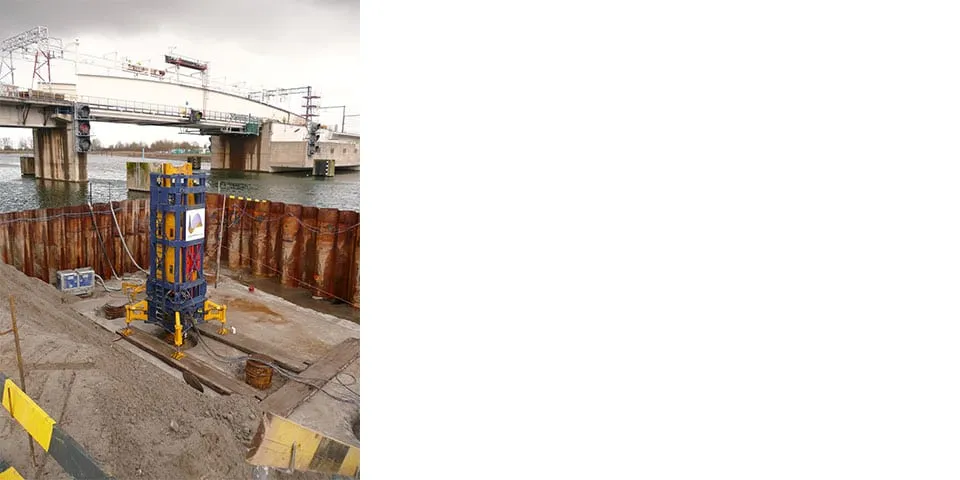
StatRapid load testing
“In addition to static load testing, so-called dynamic load testing was developed in the 1960s,” says Marcel Bielefeld of Allnamics. “At the time, it was used mainly to test large piles for offshore structures. It is now commonplace worldwide for all pile types. Dynamic load testing does, however, have a number of limitations and uncertainties. The Rapid Load Test is a quasi-static test that combines the advantages of both methods: the reliability of static load testing with the speed and cost savings of dynamic loading, with raw measurement results available directly on site. It is an efficient and scalable method for carrying out rapid pile tests. This testing method has since become accepted worldwide and is incorporated into many codes and standards, including Eurocode and ASTM.” Van Dorp adds: “A number of our StatRapid units are therefore based in Asia. An example of a project in the Netherlands is Spuikwartier in The Hague, and in Belgium this method of load testing was used during construction of the new road bridge in the port of Zeebrugge.”
NPR 7201 (Dutch Practice Guideline) specifies several classes of load test. “A Class A test was carried out in The Hague, meaning the pile was fitted with a load cell, displacement gauges and strain sensors,” Van Dorp explains. “This made it possible to determine the design factors and design the foundation structure considerably lighter than required by the standard. We tested four trial piles using our StatRapid and were able to demonstrate that the more refined design would work. This resulted in a foundation structure with fewer and shorter piles. The most common pile tests, however, are Type C and D, in which the pile’s behaviour is checked against the design, with or without StatRapid.”
Question about this story? Ask your question
Keep following this
Get an email when a new story is published. No account needed.
- ThemeUnderground construction
- SubjectBouwMat







