









Pioneering a water bath for crushers and screens
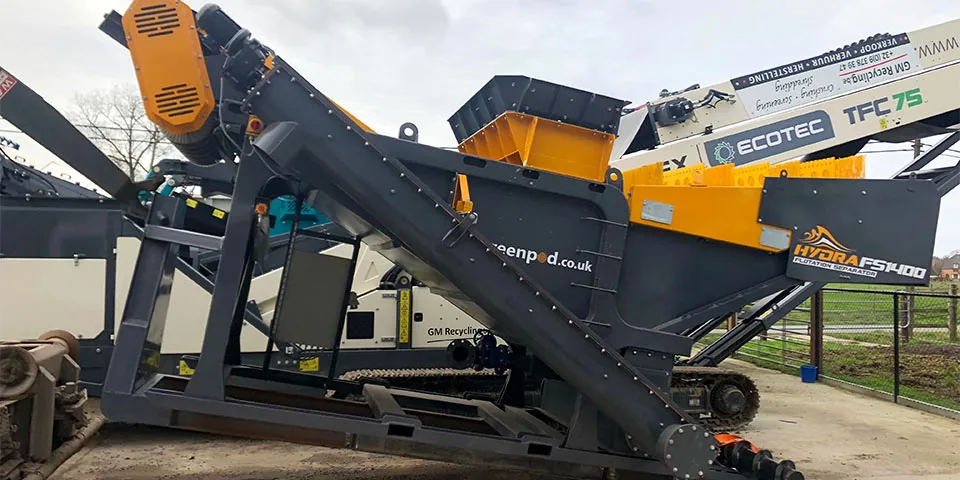
Quality always comes before capacity. This has long been the philosophy of GM recycling in Lembeke, which sells, hires out and repairs crushers, screening machines, shredders, picking stations and air separators from the Gipo, Powerscreen, Terex Ecotec, M&K, Screenpod, Trommall, Komplet and MDS brands. Driven by the pursuit of a high-quality end product, owner-manager Freddy Gillis devised an innovative system that washes rubble in a water bath. The result? Spotlessly clean aggregate.
Crushers and screening machines that use air displacement to clean aggregate are a familiar sight in the sector. But a water bath that washes aggregate to separate out silt and waste particles? That is new, according to Freddy Gillis of GM Recycling. “In the past, the focus was first on maximum output and capacity, with quality taking second place. Over the last two years, we have seen a shift, with quality now coming first. With that in mind, we devised the water-bath system with our Irish manufacturer,” says Gillis. The water-bath system is called Hydra FS 1400 and is available as a static unit, on a skid-container system or on tracks. There are currently two models, depending on the required capacity and size.
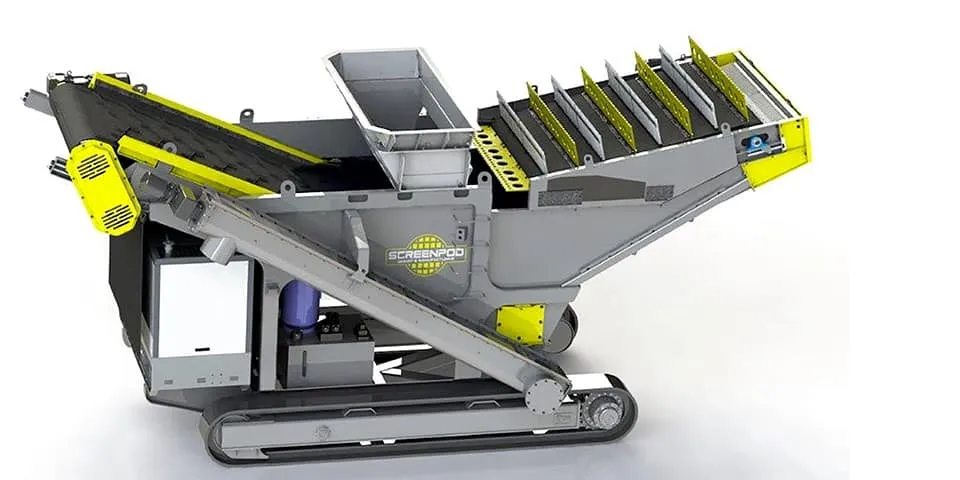
The water bath mounted on tracks.
An efficient system
The water bath can be combined with either a crusher or a screen to produce high-quality aggregate. But how exactly does it work? Gillis explains: “The water bath is fed, for example, with the midsize fraction from a crusher, with material in the 20/40 fraction. The bath has a float system that raises or lowers the water level as required. Brushes rotating gently over the water surface remove the waste particles. The waste removed, such as wood or plastic particles, is carried on a belt and ends up in a separate container. The stones are carried on another belt and washed, allowing us to discharge the silt from the machine into a separate container. A magnet removes small iron and metal particles. Finally, the rubble falls from the belt into a stockpile. It is a compact, technically simple but very efficient system,” says Gillis. “We use 2 to 3 cubic metres of water a day.”
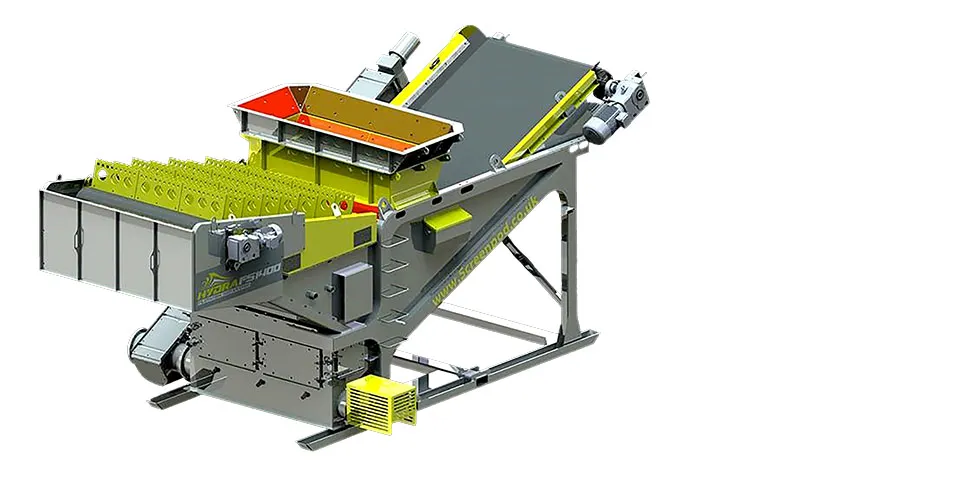
It took around a year to develop the water-bath system and get it operational.
Visual inspection
For the latest-generation Gipo and Powerscreen crushers, GM Recycling can supply integrated air separators to clean the second deck. The GM Recycling water bath is a solution for older machines with double-deck afterscreens, where no blower is fitted on the second deck, the 20/40 deck. “We often used a screw washer in the past, also known as a sand washer. The drawback of that system is its limited processing capacity, which means it quickly blocks up if overloaded. The screw is housed in a tube, so unblocking it often turns into a difficult and time-consuming job. Our water bath, by contrast, is an open system, so you can carry out visual inspections at all times. If it is overloaded, there will simply be a little more material on the belt, and the oversize can never block it,” explains Gillis.
80 tonnes per hour
“It took around a year to develop the water-bath system and get it operational,” says Gillis. “It took some thought and experimentation to determine the right flow. The conveyor belts must run slowly enough to clean the rubble, but at the same time fast enough to keep up with the crusher or screen, so that the system remains economically viable. We can currently wash and clean 70 to 80 tonnes of 20/40 rubble per hour.”
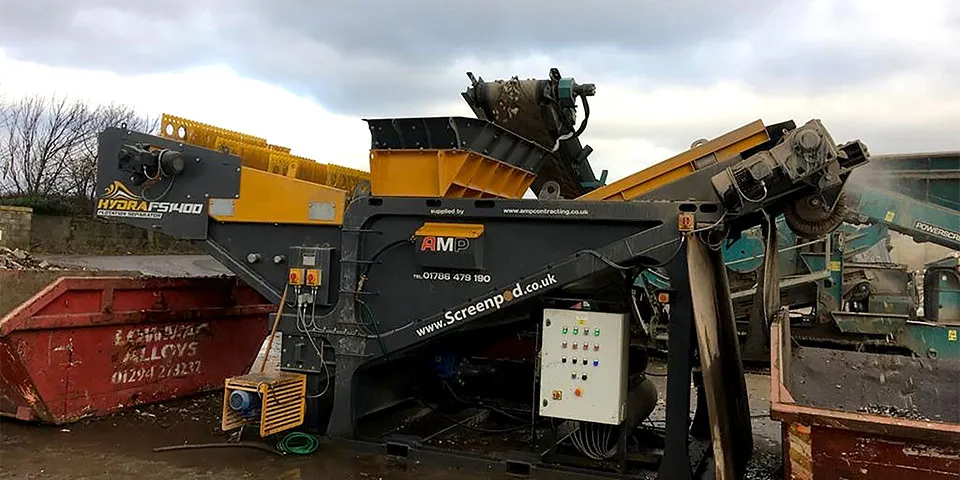
The water bath can be combined with either a crusher or a screen to produce high-quality aggregate.
Not just rubble
The system has already proved its worth on several sites, where it cleaned concrete and rubble. But that is not its only application. Gillis says: “The unit is currently at a customer’s site in Rochefort, where it is being used to clean compost. The hammers in the customer’s shredder were breaking because of stones and metal in the compost. Our water bath has solved the problem, extending the service life of the shredder hammers by 30%.” Other trials involved removing stones from shredded tree roots and separating ordinary rubble from Ytong porous stone. “In the latter case, we saw the importance of an open system and stepless adjustment of the discharge belts. Both discharge belts are the same width, so the amount of contaminated material fed in is not an issue. This is very important because the crusher or screen feeding the system delivers a constant flow,” says Gillis. The water bath can even be used for industrial applications. “We have also used it to clean insulation from shredded aluminium,” Gillis concludes.
A business enquiry for GM Recycling? Get in touch
Companies in this story
Keep following this
Get an email when a new story is published. No account needed.
- ThemeLower emissions and more reuse
- SubjectBouwMat
- CompanyGM Recycling







