









Noordzij achieves >95% reuse of bitumen joints alongside tram tracks.
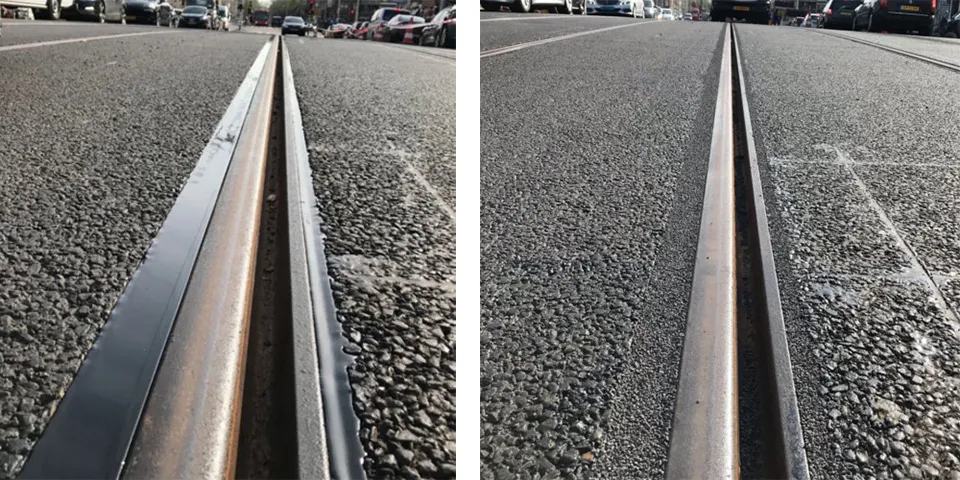
Noordzij Bitumenverwerking BV, based in Gorinchem, has developed a process that enables more than 95% of bitumen joints alongside tram tracks to be reused. These joints are currently still treated as waste and disposed of by incineration. Noordzij wants to raise awareness among local authorities and the tram and road construction sectors of this opportunity for circular construction and for reducing CO2 emissions by reusing bitumen joints alongside tram tracks.
Reuse is essential
The Paris Agreement established the need for a waste-free economy. It set the target of making the Netherlands 100% circular by 2050. Resources must be used more efficiently. The cabinet has made € 80 million available for projects that contribute to the transition to a circular economy and to the CO2 reduction target. This underlines the urgency of doing business in a circular way.
Noordzij recognises the importance of reducing CO2 emissions and wants to contribute to a circular economy. “Bitumen joints alongside tram tracks are only a small part of an infrastructure project, but processing bitumen accounts for 100% of our business,” says Marion Noordzij, co-owner of A. Noordzij Bitumenverwerking BV. “I realise that we work with a material that is a by-product of petroleum. Unfortunately, there are still no good, sustainable alternatives to bitumen in road construction. That makes it all the more important to use bitumen sparingly and avoid waste.”
Reducing CO2 emissions
Bitumen joints alongside tram tracks are currently treated as waste and disposed of by incineration. New bitumen must then be extracted and processed for use in new joints. Exact figures are not available, but the Emission Factors List on www.CO2emissiefactoren.nl provides a consistent set of key figures for CO2 emissions. The list states that incinerating bitumen produces 3,381 kg of CO2 per kg of bitumen. This is in addition to the emissions from extracting and processing bitumen. Recycling bitumen is not entirely CO2 neutral either, but it significantly reduces CO2 emissions compared with current practice.
Responsibility for local authorities, tram operators and contractors
Every recycling process for bitumen joints alongside tram tracks starts with a renovation or new-build requirement from a local authority or tram operator. The asphalt alongside the tram tracks needs replacing, or the tramway needs to be renewed or renovated. “Many clients and contractors are still unaware of the options for reusing bitumen joints alongside tracks,” Marion Noordzij continues. “Ultimately, they decide whether a bitumen joint becomes waste or is recycled. We hope to inspire them to choose reuse for future projects.”
Approved process
Noordzij begins the recycling process by gouging out the bitumen joints alongside the tram tracks. The bitumen is then collected and transported to the recycling site. It is melted, screened and stored again. More than 95% is suitable for reuse. The remaining material (<5%) is sent to a waste processing company. A legal opinion from the Ministry of Infrastructure and Water Management has recognised Noordzij’s method of gouging out and recycling bitumen as “continued use”. The gouged-out bitumen is therefore no longer classified as “waste”.
“We are still investigating a number of issues, such as how many times bitumen can be recycled. We want to continue to professionalise bitumen recycling,” Marion Noordzij concludes.
About Noordzij
Noordzij Bitumenverwerking BV has more than 30 years’ experience in applying bitumen on infrastructure projects. It is the market leader in creating joints alongside tram tracks and uses unique rail joint sawing machines for this work. Noordzij’s team developed these machines to order, drawing on practical experience. Noordzij is known in the industry as an experienced contractor. It is an innovative family business whose team works on each project with great pride and commitment. In addition to rail joints, Noordzij also installs flexigoot, repairs asphalt cracks and carries out other bitumen jointing work. For more information, visit www.noordzij.eu.
Question about this story? Ask your question
Keep following this
Get an email when a new story is published. No account needed.
- ThemeLower emissions and more reuse
- SubjectBouwMat







