









No two machines are the same, but they always get the job done
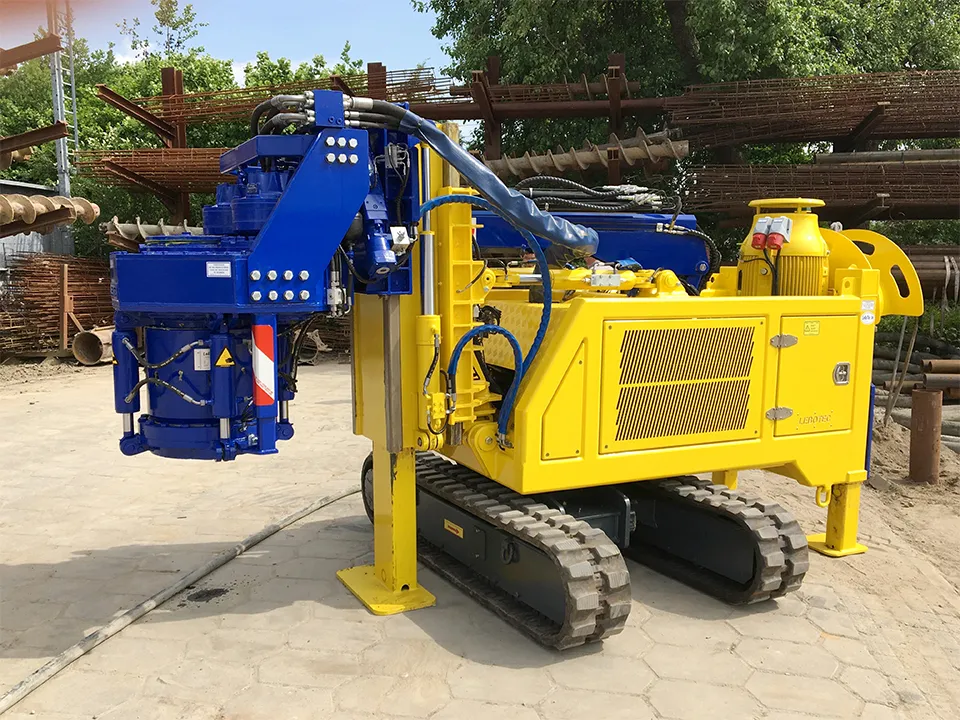
More than 150 foundation machines have already rolled out of the workshop of Wijchen-based Lebotec. At least 100 of them are entirely unique, custom-made machines.
And not one machine has ever been returned or broken down before the end of its service life. If, against all expectations, something does not work quite as it should, Lebotec’s service team is ready 24/7 to resolve the problem.
“Our machines generally last around 15 to 20 years. Some have even clocked up as many as 63,000 operating hours,” says Lebotec owner Jacques Bouten, with no little pride. Much of the machines’ reliability is down to the fact that Bouten looks at every machine built in Wijchen “as if he himself were going to operate it”, adds sales manager Wil Zwartjes. “I suppose I am a bit of a perfectionist when it comes to my trade,” Bouten smiles.
No two Lebotec foundation machines are the same because every customer has their own requirements and working methods. “We once produced a batch of eight of our mini piling rigs,” says Bouten. “But customers ask for different mast lengths, stabilisers in all shapes and sizes, different track widths, you name it. That can make our work difficult, because if you change one thing, the whole drawing has to be revised. But above all, we find it fun and challenging. It never gets boring.”
Data logging
Lebotec is keen to work with customers to meet their specific requirements. This not only gives the machine builder a healthy order book, but also helps it build strong relationships with highly loyal customers. “Almost every foundation job is different in our small country,” says Zwartjes. That is why we also maintain a sophisticated pile logging system for our customers. What exactly is going into the ground? At what drilling pressure? What mix of concrete or grout is being used? How much water, and in what mix ratio? We record all of this and store it on our servers for 10 years. Customers can retrieve the data at any time, for example if Building and Housing Supervision asks for it.
Lebotec would prefer to sell not just the foundation machines themselves, but the entire process. “From the drilling rig to the concrete or grout pumps. The whole chain, from supply through to actually installing the piles,” says Bouten. “Because for a process to run smoothly, it is best to have one party manage the entire chain,” Zwartjes adds. “And that is what we do well.”
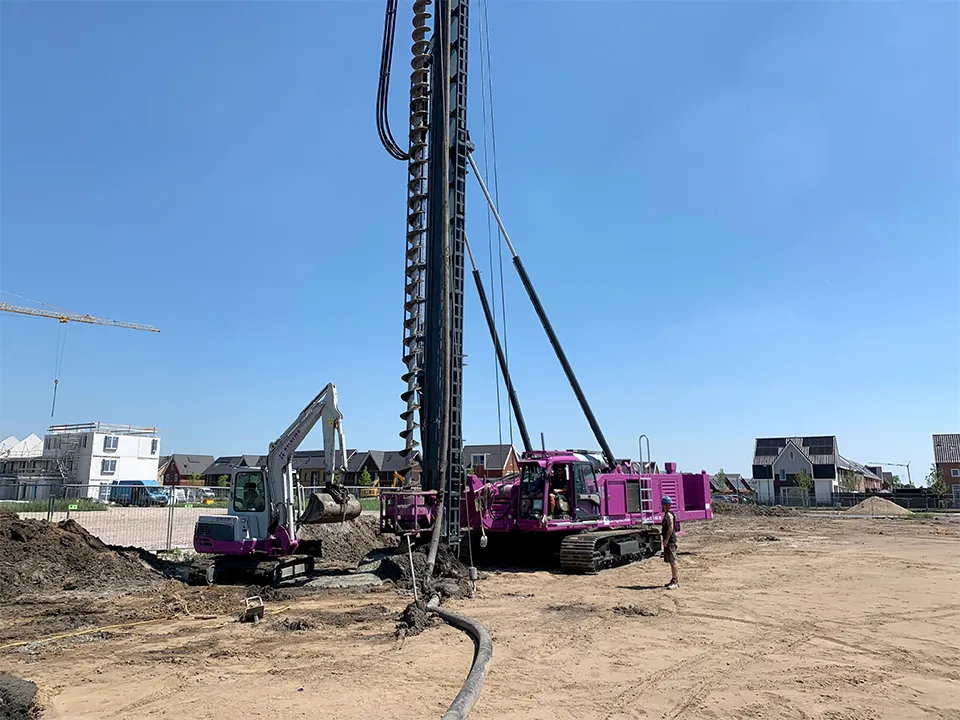
Managing these complex processes requires ever more electronic systems to communicate with one another. Lebotec makes that happen. For example, it designed an automated process for producing piles on site. Bouten explains: “Imagine a concrete mixer, a concrete pump and a concrete screw pile machine on a construction site. The screw is then automatically driven to the required depth, the concrete pump starts automatically, the concrete thickness is measured, the concrete is injected and the auger is withdrawn. We can do this with both concrete screw piles and Mini Vibropiles. This is where we really stand out.”
Zero-emission
Bouten and Zwartjes expect the increasingly common requirement to work emission-free to drive more foundation machines to be replaced in the coming years. Lebotec is responding by electrifying its foundation machines. “Speed and power are essential in our work, so you need a lot of power. It is technically feasible, but we cannot do it without our partners who supply the motors and battery packs, and above all without a government that provides the right infrastructure. So we are also investing in cleaner diesel engines,” Zwartjes concludes.
Question about this story? Ask your question
Keep following this
Get an email when a new story is published. No account needed.
- ThemeUnderground construction
- SubjectBouwMat







