









Land subsidence a serious problem in low-lying peat areas
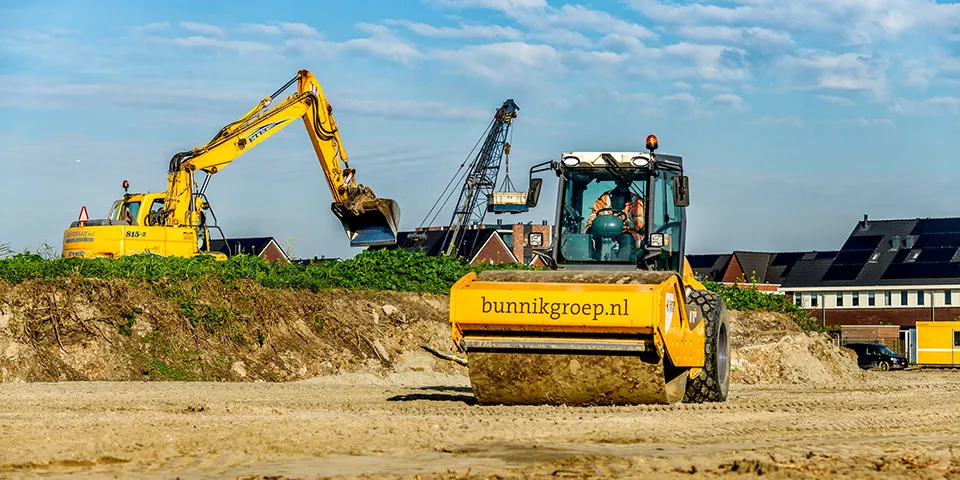
For years, the Netherlands’ low-lying peat areas have been grappling with severe flooding caused by land subsidence. After heavy rainfall, streets flood and homes fill with water. As a specialist in areas with weak soils, Bunnik Groep is playing an important role in making neighbourhoods and villages in peat areas climate-resilient. We join Luuk Tamminga to visit a ‘weak soil’ renewal project in Kockengen and De Kanis.
According to Tamminga, climate adaptation is a hot issue in the Netherlands’ low-lying peat areas. “The combination of increasingly intense downpours and subsiding ground means that streets in these areas are increasingly likely to end up under water, with all the consequences that entails. It is a serious problem. The municipalities in this area have joined forces in Platform Slappe Bodem to tackle land subsidence. In the former municipality of Reeuwijk, we were already the ‘house contractor’ for weak soil renewal before the municipal reorganisation that created Bodegraven, Reeuwijk. Reeuwijk is among the ten worst areas in terms of weak soils. The ground here is really poor.”

As a specialist in areas with weak soils, Bunnik Groep is playing an important role in making neighbourhoods and villages in peat areas climate-resilient.
Unique characteristics
Bunnik Groep is based in the Groene Hart, right in the middle of an area with weak soils. “Since we were founded more than fifty years ago, we have focused on managing public spaces,” Tamminga continues. “We work across four disciplines, and are seeing growing market interest in sustainable renewal in areas with weak soils. Every village, neighbourhood and street has its own unique characteristics and calls for an individual approach. Our approach in Kockengen, for example, is completely different from the one in De Kanis, a village centre in the municipality of Woerden.” Kockengen, another nearby village centre, but in the municipality of Stichtse Vecht, is being made fully climate-resilient over a period of ten years. The project has been under way since 2014 and is being delivered in phases (ten in total). Of the five phases awarded so far, Bunnik Groep has been commissioned to carry out four. One of these phases involved 125 homes and had a contract sum of €3 million. By comparison, the project in De Kanis also affects 125 homes, but has a contract sum of more than €10 million.
Sustainable methods
De Kanis is experiencing severe settlement due to its soft peat soil. Tamminga says: “In some places, public spaces have subsided by more than 60 centimetres. Here, we use a unique method to build a settlement-free, piled concrete structure beneath the streets. We lay a sand bed on top for the utility services, and then build the public space above it. This structure may require a high initial investment, but it guarantees a service life of 100 years. In Kockengen, we are also replacing the existing pavement structure, including the tar-containing asphalt, with lightweight foundation material. The utility services are then laid on top, and the paving is reinstated. We also raise the level of public green spaces and residents’ gardens.”
Bunnik Groep has all the knowledge and expertise in-house to handle peat-area ground improvement projects entirely in-house, from A to Z. “We are regularly asked to carry out the work as part of a construction team. But we are also seeing these contracts increasingly take the form of UAV-GC contracts. As a specialist in areas with weak soils, we are exceptionally well equipped to deliver this kind of work,” Tamminga concludes.
Question about this story? Ask your question
Keep following this
Get an email when a new story is published. No account needed.
- ThemeFlood protection and climate-resilient water management
- SubjectBouwMat







