









Jan De Nul Group 2018: investing sustainably in the future
As expected, 2018 continued the challenging market conditions of 2017. International dredging activities have been…
Key figures
- Stable turnover of EUR 1,708 million
- EBITDA margin of 16%, or EBITDA of EUR 277 million, in line with the sector average
- Net profit of EUR 31 million
- Exceptionally high solvency ratio of 73%, thanks to continuous retention of profits
- Net debt-free for the fifth consecutive year
- Order book up 27% compared with the end of 2017 (EUR 3.3 billion)
- Continued high level of investment, particularly in the offshore renewable energy sector, and with a focus on the climate
Continuing to invest in the future with an exceptionally strong balance sheet
As expected, 2018 continued the challenging market conditions of 2017. For several years in a row, international dredging activities have faced a tight market due to a lack of public and private investment. In addition, the offshore sector has yet to see a significant recovery in the oil and gas market. However, in recent years Jan De Nul Group has focused strongly on the offshore renewable energy market, resulting in increased activity both in and outside Europe, including in Asia. The group’s civil engineering activities are holding up well, supported by a strong property market combined with the traditional infrastructure market. The environmental division, Jan De Nul Group’s smallest business, remains stable.
Jan De Nul Group achieved turnover of EUR 1,708 million in 2018. EBITDA was EUR 277 million, or 16.22% of turnover, in line with the sector average. Jan De Nul Group continues to stand out for its exceptionally strong balance sheet, with equity of more than EUR 2.8 billion and a solvency ratio of no less than 73%. The group also has a consistently strong liquidity position, with a net cash surplus of EUR 376 million.
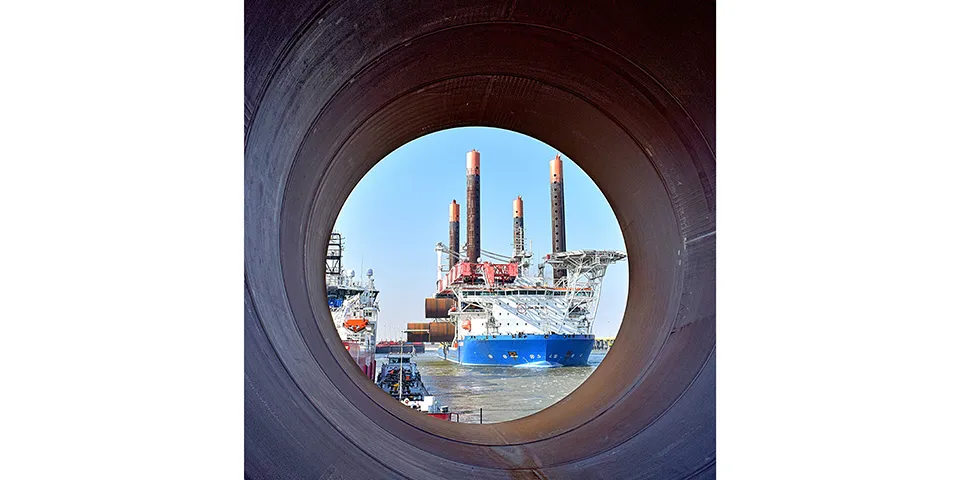
Jan De Nul Group continues to invest in its future, even in more challenging market conditions: the total value of ongoing investments in new dredging vessels stood at EUR 400 million at the end of 2018. In July 2018, the offshore jack-up installation vessel Taillevent was acquired to immediately increase capacity for the group’s offshore wind activities. Jan De Nul’s confidence in the future of this market is further confirmed by the order placed earlier this year for Voltaire, a next-generation installation vessel. The vessel is due for delivery in early 2022 and will be capable of installing wind turbines up to 270 metres high, a first for the market.
Jan De Nul Group therefore looks to the future with confidence. The group can make a difference even if volatile market conditions persist. This is reflected in its growing order book, which stands at EUR 3.3 billion, up no less than 27% compared with the end of 2017.
Activities in 2018
In 2018, the bulk of Jan De Nul Group’s activities were again in the maritime dredging and offshore sectors, which generated 75% of the group’s total turnover.
In 2018, Jan De Nul Group worked on major coastal protection projects, including one on the Dutch island of Texel, where Jan De Nul built a sustainable dike in the form of dunes and a nature area behind them to protect the island from the effects of the sea.
Jan De Nul was also involved in the construction of several offshore wind farms, including Trianel Windpark, Borkum Riffgrund 2, Race Bank and Kriegers Flak. Following Jan De Nul Group’s successful completion of entire offshore wind farms (Nobelwind Offshore Wind Farm in Belgium and Tahkoluoto Offshore Wind Farm in Finland), Jan De Nul significantly expanded its portfolio. In 2018, Jan De Nul Group was awarded the contract to build the Northwester 2 offshore wind farm in Belgium, and secured its first contracts in 2018 to build wind farms outside Europe: the design and installation of offshore wind farms at Changhua and Formosa 1 Phase 2 in Taiwan, as well as the installation of offshore wind turbines in the United States.
The 2018 financial year once again confirmed the ongoing importance of civil engineering activities to Jan De Nul Group, accounting for 21% of the group’s total turnover. In 2018, Jan De Nul carried out a range of civil engineering construction and maintenance projects, including residential buildings, school facilities, healthcare institutions, road infrastructure, viaducts, quay walls and locks. Jan De Nul Group is also increasingly targeting the private market. The group is continuing its targeted expansion in the civil engineering market in the Netherlands and Luxembourg, particularly in complex infrastructure works.
Envisan, the environmental division of Jan De Nul Group, focuses on environmental technology solutions. Its activities remain stable at 4% of total turnover. To support these environmental activities, the group owns and operates six treatment and resource recovery centres in Belgium and France. As in previous years, the environmental division works closely with the maritime and civil engineering divisions, particularly with brownfield developer PSR Brownfield Developers.
High solvency and no net debt
Jan De Nul Group maintained its high solvency position in the 2018 financial year, with a ratio of 73% (75% in 2017). Equity increased from EUR 2,823 million in 2017 to EUR 2,859 million in 2018.
Jan De Nul Group has had no net debt since the 2014 financial year. This is particularly notable given the group’s significant and necessary investment requirements. Its net cash position even increased in 2018, reaching EUR 376 million (EUR 345 million in 2017). This solid balance sheet is a major asset for Jan De Nul when it comes to future investments in, among other things, its fleet, or when important opportunities arise.
Turnover by geography
Jan De Nul Group has a strong presence in Europe. 56% of its 2018 turnover was generated on the European continent, an increase of 10% compared with the previous year. This growth is mainly due to Jan De Nul Group increasing its share of the European offshore renewable energy market. In 2018, Jan De Nul Group was also active in Asia and the Middle East (19%), the Americas (17%) and Africa (7%), and had limited activity in Australia (1%).
Order book grows by 27%
2018 ended with an order book of EUR 3.3 billion, up 27% compared with the end of 2017. Jan De Nul Group’s order book includes the following major projects:
- In Ecuador, Jan De Nul Group signed the concession for the deepening and maintenance of the 95-km-long channel to the port of Guayaquil. Jan De Nul Group will not only deepen the existing access channel, but will also maintain and operate it for 25 years after the deepening works.
- Jan De Nul Group signed the contract to build Northwester 2, the seventh wind farm off the Belgian coast. This marks the third time Jan De Nul has partnered with wind farm developer Parkwind. The Northwester 2 wind farm is located 48 kilometres offshore and will feature the largest and most powerful wind turbines currently available on the market. Installation works are due to start in June 2019. Jan De Nul will be responsible for designing the foundations, procuring and installing them, and installing the cables and wind turbines.
- Luxembourg’s Ministry of Sustainable Development and Infrastructure awarded Jan De Nul Group the contract to widen the ‘La Passerelle’ viaduct. This nineteenth-century bridge is a UNESCO World Heritage Site and forms the southern entrance to the centre of Luxembourg City and its railway station. Jan De Nul has been tasked with widening the bridge deck.
- In 2018, Benin’s Ministry of the Living Environment and Sustainable Development selected Jan De Nul Group’s in-house-developed concept to build an offshore submerged breakwater to protect the coastline from the effects of the Atlantic Ocean. The breakwater will dissipate the force of the Atlantic waves before they reach the coast. This will create a sheltered area between the breakwater and the coast. As a result, the impact on the beaches will be significantly reduced, limiting sand movement and reducing erosion. Once the submerged breakwater has been built, Jan De Nul Group’s trailing suction hopper dredgers will replenish the eroded beaches with new dredged sand. The works are expected to be completed in 2021.
Sustainable investment for the future
Jan De Nul Group continues to invest in the future, even in the current tight market conditions:
- In March 2019, Keppel Singmarine’s shipyard in Nantong, China, delivered the first of three 3,500 m³ trailing suction hopper dredgers, Afonso de Albuquerque. Her sister ships Diogo Cão and Tristão da Cunha followed in April 2019.
- Construction of the two 6,000 m³ trailing suction hopper dredgers Sanderus and Ortelius progressed at the Keppel Offshore & Marine shipyard in Singapore. The vessels are due for delivery by the end of 2019.
- During 2018, the COSCO shipyard in Dalian, China, refined the design of the 18,000 m³ trailing suction hopper dredger and purchased the necessary components. Hull steelwork began in January 2019. Construction is proceeding entirely according to plan. The vessel is due for delivery in 2020.
- In 2018, Jan De Nul Group purchased three offshore supply vessels. They are being converted into water injection dredgers (WIDs). These vessels are used to level or deepen the seabed using a water injection system that suspends and displaces the seabed material. The diesel-electric vessels, equipped with dynamic positioning (DP), will be named Giovanni Venturi, Henry Darcy and Henri Pitot.
- In early April 2019, Jan De Nul Group ordered a large offshore jack-up installation vessel from the COSCO Shipping Heavy Industry shipyard in China. The jack-up vessel will be fitted with a main crane with a capacity of more than 3,000 tonnes and will be able to operate in water depths of more than 80 metres. It will be capable of installing the new generation of very large offshore wind turbines.
In a world facing climate change and growing global environmental awareness, Jan De Nul Group has chosen to equip its latest generation of vessels with an ingenious, in-house-developed filter system to eliminate toxic substances from exhaust gases. Vessels fitted with these filters meet the strictest emissions requirements under European inland waterway regulations (Stage V), which are more stringent than the current IMO regulations for seagoing vessels. Jan De Nul Group is the first in its sector to put vessels into service that meet the strictest European emissions standards. The vessels have been awarded a ULEv (Ultra-Low Emission vessel) notation by the independent, world-renowned inspection and classification organisation Bureau Veritas.
2018 Annual Report online
The full activity and financial report of Jan De Nul Group is available at annualreport.jandenul.com. We are also pleased to present some of Jan De Nul Group’s flagship projects from 2018.
Question about this story? Ask your question
Keep following this
Get an email when a new story is published. No account needed.
- ThemeFlood protection and climate-resilient water management
- SubjectBouwMat







