









Jan De Nul announces ambitious CO2 reduction targets
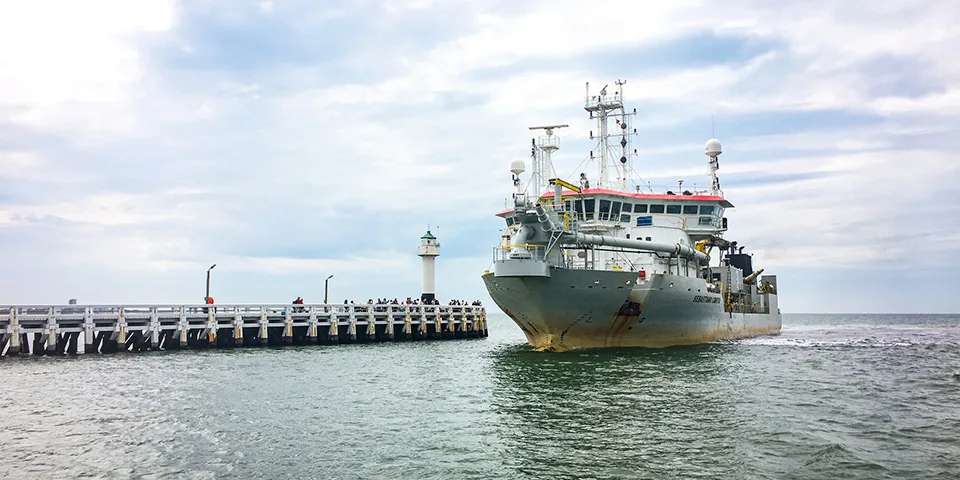
Jan De Nul Group has pledged to cut annual CO₂ emissions by 15% on maintenance dredging works in the coastal marina at Nieuwpoort. It is the first dredging company in the world to target a reduction of this scale on a commercial project. By 2022, the company also aims to work with the Flemish government to introduce a requirement for a minimum 15% CO₂ reduction in 80% of maintenance dredging contracts in Flanders.
For the tender for maintenance dredging works in the coastal marina at Nieuwpoort, the Flemish government’s Agency for Maritime and Coastal Services gave the market every opportunity to use innovation to reduce CO₂ emissions. Jan De Nul Group won the contract after pledging to cut annual CO₂ emissions by 15%. This is unprecedented in the sector. No dredging company has ever targeted a CO₂ reduction of this scale on a commercial project.
Drop-in biofuel
Jan De Nul Group is using drop-in biofuel, among other measures, to meet its ambitious CO₂ reduction target. This is a high-grade fuel and a sustainable replacement for fossil diesel, made from vegetable oils or waste streams. “Drop-in” means that engines do not need to be modified to use it. It also significantly reduces particulate emissions as well as CO₂ emissions. It burns far more efficiently than conventional diesel. Since drop-in biofuel uses waste streams as feedstock, it also contributes to the circular economy. Finally, as an exceptionally clean fuel, it is ideally suited to high-performance engines
The Agency for Maritime and Coastal Services (MDK), part of the Department of Mobility and Public Works, is showing through this approach and its choice of Jan De Nul how it is taking the lead within the Flemish government in meeting Belgium’s emissions reduction targets. Under the Paris Climate Agreement, Belgium committed to cut its CO₂ emissions by 15% by 2020 compared with 2005.
Nathalie Balcaen, Director-General of the MDK agency: “As a maritime government partner within the Flemish government, we want to do everything we can to reduce our environmental footprint. We therefore give particular attention to green criteria in the specifications for the contracts we put out to tender. This is already delivering tangible CO₂ reductions, including through a focus on carrying out dredging works in an environmentally friendly way and on the contractors we work with.”
“The MDK agency does not only focus on climate requirements when drawing up tender contracts,” Nathalie Balcaen added. “We also take responsibility for our own operations. We are greening our own vessels to reduce our CO₂ emissions. For example, we are building an electric ferry.”
Reducing CO₂ across the sector
For Jan De Nul, the project also fits with its ambition to take a leading role and roll out a CO₂ emissions reduction programme across the sector. The dredging company aims to have a requirement for a minimum 15% CO₂ reduction included in 80% of maintenance dredging contracts in Flanders by 2022. “We want to make every effort and inspire other companies in our sector to adopt promising energy or CO₂ reduction measures,” says Bart Praet, Head of Dredging Works Benelux at Jan De Nul Group. “We are keen to engage in dialogue with the Flemish government and Vlaamse Waterbouwers VZW, and are working closely with Zero Emission Solutions and the advanced sustainable fuels sector.”
The announcement of the targets comes shortly after the Flemish government decided to approve a three-year pilot project to test the CO₂ Performance Ladder in public procurement. Developed in the Netherlands in 2009 as a tool and certification scheme to encourage CO₂ reduction, the ladder has proved a great success there. The Flemish pilot project starts in September 2019 and runs until September 2022. It is intended to ensure that contractors are awarded contracts when they offer maximum quality, minimum CO₂ emissions and a fair price.
“We are convinced that Jan De Nul can play a leading role here,” Bart Praet added. “As one of the first contractors, we want to make a significant contribution to the Flemish pilot project and achieve actual CO₂ reductions on a project.”
Bart Praet: “Our project in Nieuwpoort is a practical example that we hope will get a dialogue on reduction requirements under way. We want to encourage our fellow companies in the sector to respond quickly and decisively with innovative, promising energy and CO₂ reduction measures.”
Question about this story? Ask your question
Keep following this
Get an email when a new story is published. No account needed.
- ThemeLower emissions and more reuse
- SubjectBouwMat







