









Huge CO2 reduction and a very low ECI
through the use of sustainable, circular cement-free concrete
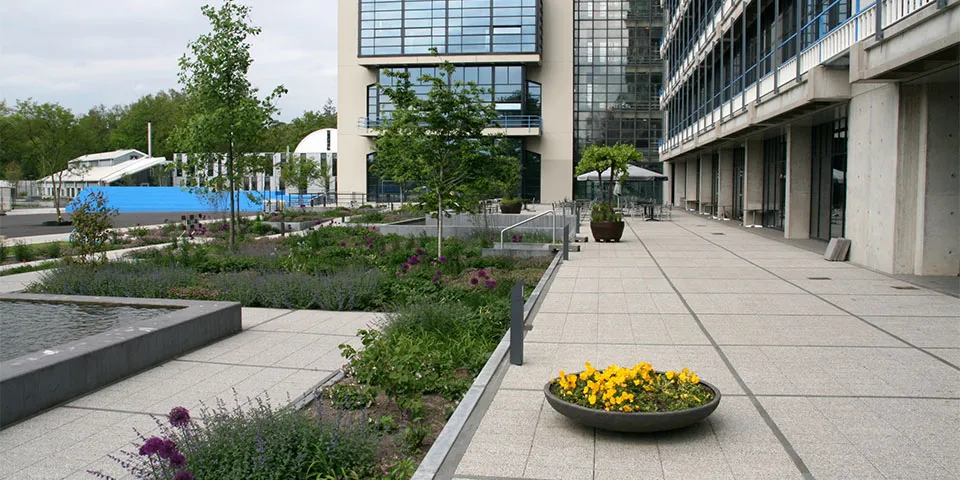
The De Hogekamp renovation project, a faculty building at the University of Twente, has saved no less than 50 tonnes of CO2 . That is equivalent to the annual consumption of around five households. This substantial saving was achieved by using approximately 17,000 cement-free kerbs and concrete paving blocks. On a green campus like this one, the University of Twente chose this sustainable solution from v.d. Bosch Beton, a producer of paving materials for the professional market.
“With the delivery of the very first cement-free Reduton® products, v.d. Bosch Beton achieved a European first on a project for the province of Overijssel involving grass grid pavers, followed later by the first paving blocks in Rotterdam and various products on the University of Twente campus in Enschede,” says Berry Mullink, head of sales at v.d. Bosch Beton. “This has demonstrably delivered significant sustainability gains.”
Sustainability
The cement industry is responsible for around 8-10% of global CO2 emissions. This is why v.d. Bosch Beton, with innovative sustainability as a key pillar of its business, has further developed its Reduton® cement-free concrete for use in a range of products. These are increasingly being used in projects where the aim is to achieve a low ECI (Environmental Cost Indicator) score. Mullink says: “The government’s 2030 targets are clear, but far from everyone is responding to them. But in ten years’ time, they will be a reality.” Mullink says the company has been in business for 106 years and has always been at the forefront of meeting market demands and needs. “We are not afraid to stick our necks out. Precisely because we know what is happening in the market and have many contacts with government bodies, we are getting to work to supply the market with the right products.”
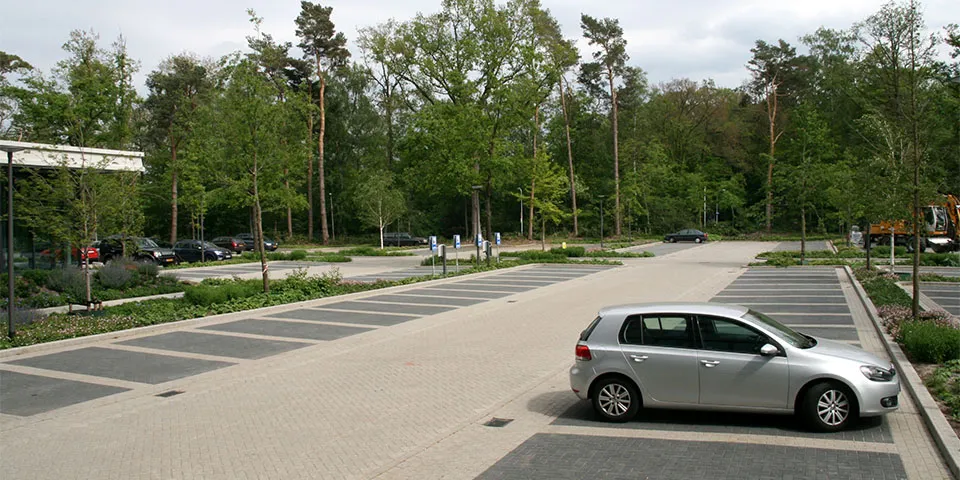
Approximately 17,000 cement-free paving units were used by v.d. Bosch Beton as the sustainable solution for the green campus.
A technical feat
And that is how Reduton® came about. “Concrete was discussed at a high technical level at Eindhoven University of Technology, and that is where the right people came together. One had an idea, and we had the factory.” SQAPE Geopolymer Technology and v.d. Bosch Beton tested the product and further developed it into the Reduton® we have today. It is used in products such as paving blocks, kerbs and edging restraints, grass grid pavers and slabs. “Expertise, trust and good collaboration can lead to sustainable choices, as this once again demonstrates.”
Geopolymerisation
The sustainability lies in the fact that no cement is used in this concrete, but geopolymers are used as an organic binder. In addition, it is made largely from recycled raw materials. “Reduton® is of the same quality as conventional cement concrete,” says Mullink. “All our products are certified, and we also provide a verified and audited ECI calculation.” He concludes: “To keep the circular economy truly moving and prevent concrete from becoming society’s waste bin, with all sorts of things simply being put into it, it is now important not only to supply circular products but also to demolish carefully and ensure that concrete is no longer used for other purposes, but is returned to concrete production. Only then will we be circular, make the greatest possible contribution to the environment, make infrastructure more sustainable and improve road safety.”
Een zakelijke vraag aan v.d. Bosch Beton b.v.? Get in touch
Companies in this story
Keep following this
Get an email when a new story is published. No account needed.
- ThemeLower emissions and more reuse
- SubjectBouwMat
- Companyv.d. Bosch Beton b.v.
- CompanyBosch Beton







