









First fully electric piling rig delivered
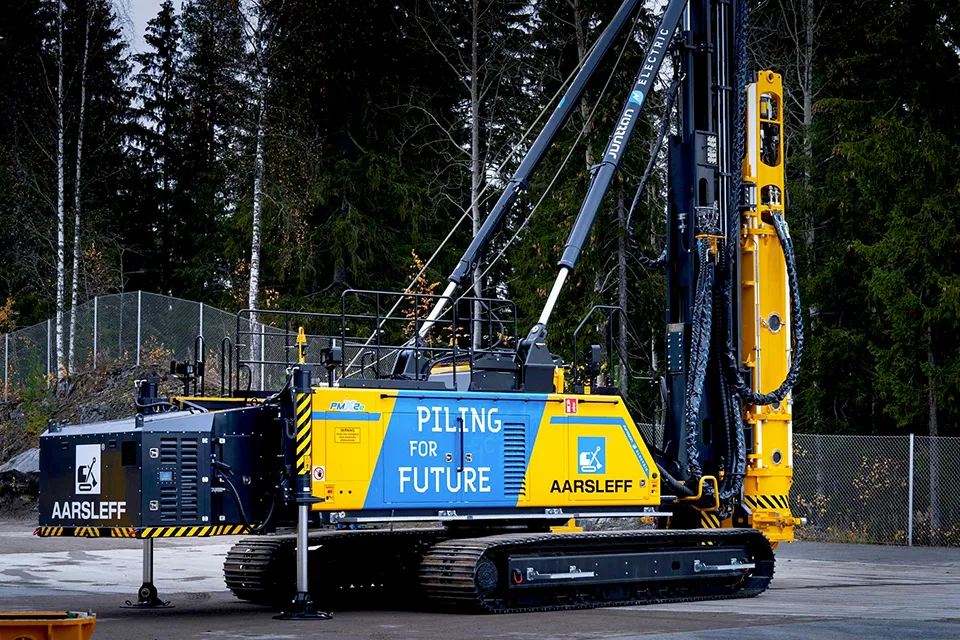
H. Van Dieren Hei- en Waterwerken and Boer B.V. are both taking delivery this year of a fully electric piling rig from Finnish manufacturer Junttan. A third Junttan will be delivered in the Netherlands next year, says Michiel van Es, managing director of Junttan BV. According to Van Es, the move towards emissions-free piling is inevitable, particularly now that substantial purchase subsidies are available for emissions-free equipment.
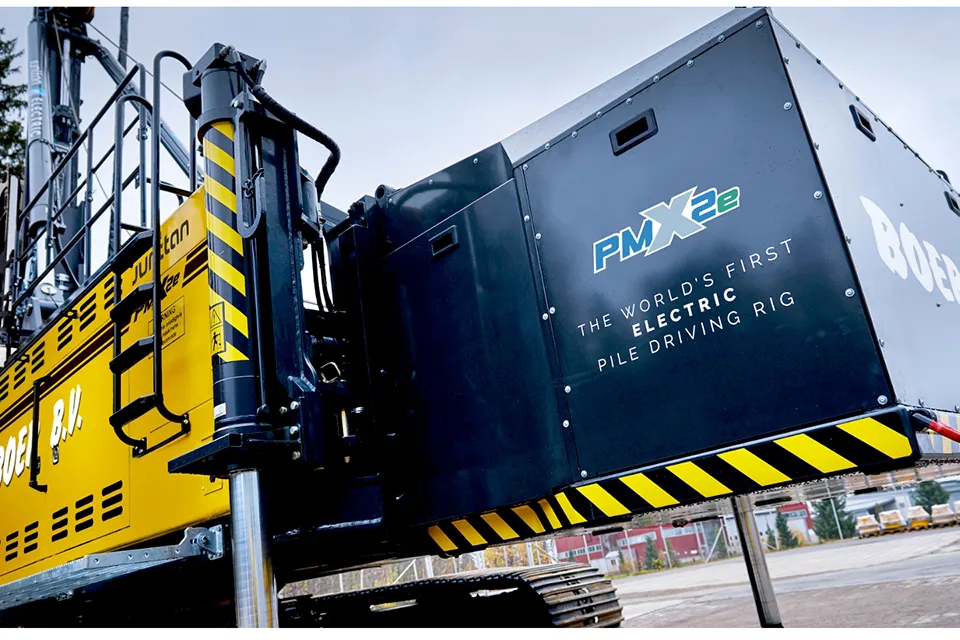
Although the number of electric piling rigs in the Netherlands is still low, Junttan now has extensive experience with the PMx2e, launched in 2021. The very first electric piling rig has now been operating for more than a year at Swedish contractor Aarsleff Ground Engineering AB, where it has been very well received. “Dutch operators who have had the chance to try it out are also very impressed with its performance,” says Van Es. “The PMx2e is designed to match the operating performance of a diesel-powered rig as closely as possible, even in the toughest working conditions. The result is a machine that offers the same robust construction and efficiency as a traditional piling rig. The footprint of projects and companies is significantly lower because the machine is emissions-free and therefore produces no harmful substances such as nitrogen or CO2. This makes it ideally suited to work near Natura-2000 areas.”
From the outset, Junttan was aware that the success of existing diesel machines had to be matched as closely as possible by an electric version, as did their ease of use. The high torque delivered by the electric motor makes it possible to operate several functions at once.
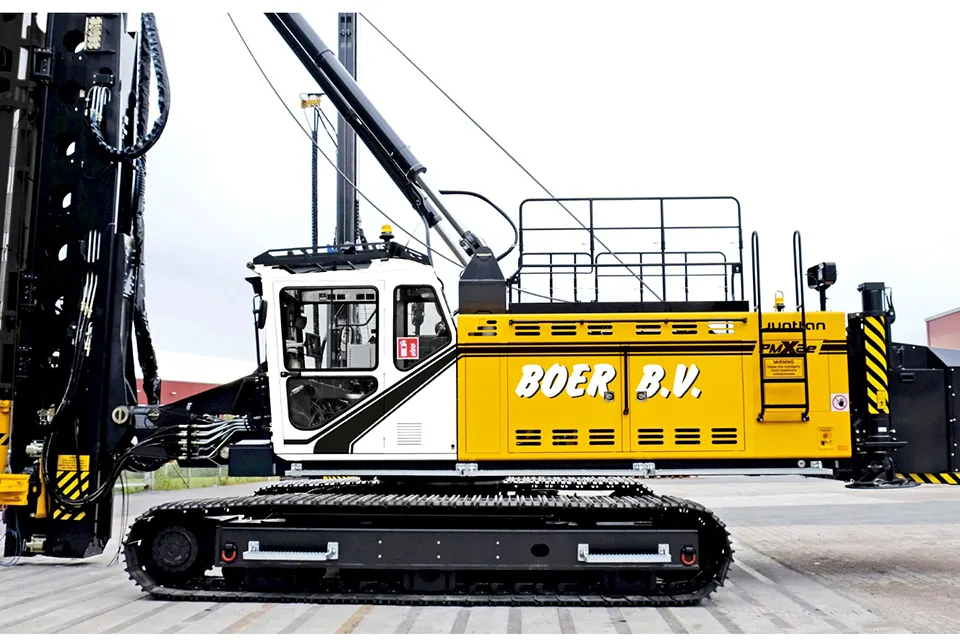
Instead of a diesel engine, Junttan now uses an electric motor to drive the hydraulic system. The motor draws power from a battery pack at the rear of the machine, which also serves as a counterweight. This allowed the company to develop a solution that is reliable, easy to use and just as effective as a conventional diesel-powered Junttan. To make work on site easier, it chose a solution in which the machine is powered by a 396 kWh battery pack that can be swapped during the day if necessary. By opting for a removable system with two batteries rather than one larger fixed battery, charging is possible via a standard 63A connection, and each battery takes around 9 hours to charge. They can therefore be fully charged overnight.
The state-of-the-art CCS DC-DC fast charger can charge the battery packs at up to 250 kWh, allowing greater flexibility in the future, including with a single battery pack. Van Es: “The PMx2e comes as standard with two removable battery packs. Together, they allow the machine to operate for 13 hours at an average workload. If there are sufficient charging facilities on site, the packs can also be recharged there. With a view to a vehicle-to-grid solution, other equipment can also be charged. The PMx2e can optionally be supplied with an integrated 33 kWh battery, which allows the machine to be moved without being connected to an external battery. ‘It is possible to charge the machine while working if required, but it is designed to run for a full working day without being connected to the site power supply,’ says Van Es.
For companies that do not want to invest in a new machine, Junttan also offers the option of converting an existing diesel machine to an electric version. “Subsidies are available for that too,” Van Es explains. “We are happy to help customers with their applications to make the switch to electric possible…”
Subsidies
Although the latest subsidy round, which closed on 9 May, is now oversubscribed, the subsidy fund for emissions-free construction equipment remains well stocked through to 2030. A total of €270 million is available. Through the Clean and Emissions-free Construction Equipment Subsidy Scheme (SSEB), the government aims to encourage construction companies to switch to clean equipment and thereby help reduce nitrogen emissions. The total SSEB budget for 2023 is €60 million, three times the 2022 budget. In addition to subsidies for purchasing new emissions-free construction machinery, it is also possible to apply for subsidies to convert and modify construction machinery and vessels already in use to make them low-emission or emissions-free. Under the purchase scheme (‘SSEB Aanschaf’), applicants must use the machines themselves or offer them to other companies through leasing or hire. The subsidy for purchasing new emissions-free construction machinery and vehicles is 40 per cent of the additional cost compared with a construction machine with an internal combustion engine, rising to a maximum of 50 per cent for small and medium-sized enterprises. The SSEB conversion scheme (‘SSEB Retrofit’) has the same subsidy percentages, calculated on the net investment cost of each conversion.
Question about this story? Ask your question
Keep following this
Get an email when a new story is published. No account needed.
- ThemeUnderground construction
- SubjectBouwMat







