









Electric mini excavator helps restore quay wall
Text and images Hitachi
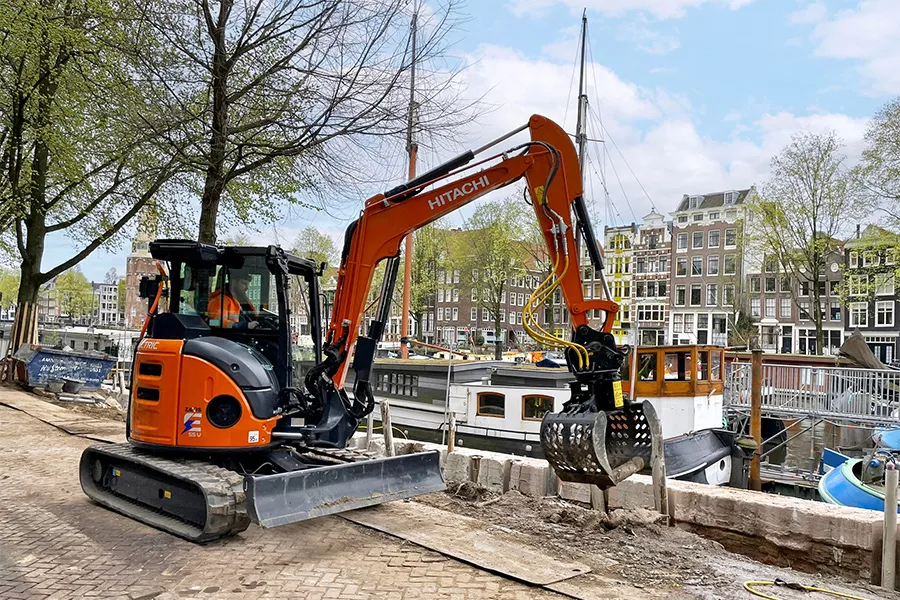
Zero-emission work in the capital
Amsterdam needs to replace around 200 kilometres of quay wall, some sections of which are hundreds of years old. This involves a number of challenges. Tree roots, for example, often spread widely across the work site. In addition, working space is limited and houseboats line the quay in many places. H. van Steenwijk B.V. has developed a method that minimises these challenges. The electric Hitachi ZX55U-6EB is being used to carry out the work with zero emissions.
The mini excavator has recently become available in the Netherlands, and this first machine is being hired for the project through the Hitachi Premium Rental programme. The current project involves a section of the Waalseilandsgracht. A 50-metre stretch of quay wall here was in such poor condition that the municipality of Amsterdam removed traffic from the quay to minimise the load on it. Work was needed to make the quay safe to carry normal loads again. Given the limited space, the houseboats in the canal and the trees on the quay, implementing measures is no easy task./a
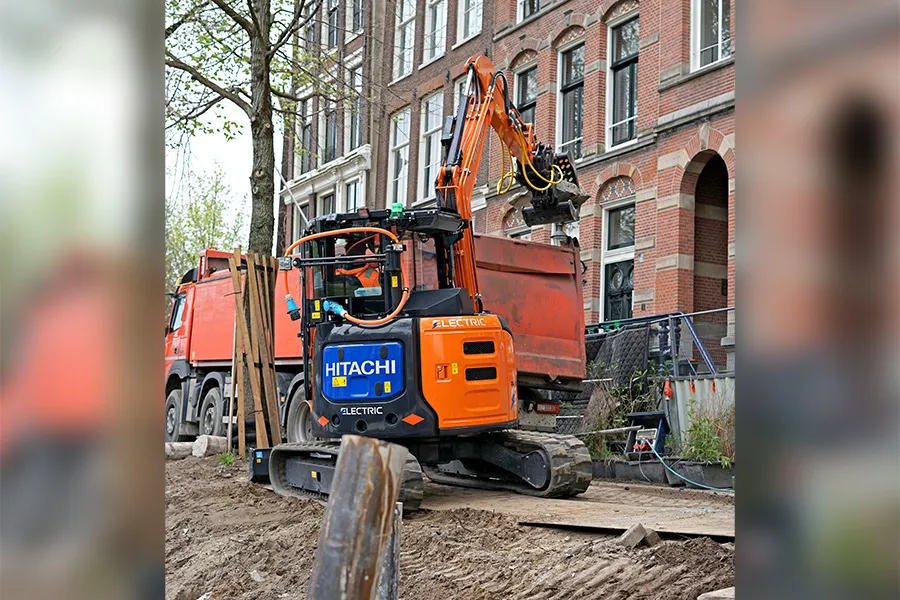
Major benefits
Contractor H. van Steenwijk has been in business for 193 years and has replaced or reinforced many kilometres of quay wall over the years. The municipality of Amsterdam has a total of 600 kilometres of quay, and a substantial proportion of it will need attention in the coming years. Much of it is in the historic city centre, making the task complex and potentially costly. That is why the contractor developed the Steenwijk method in 2021, successfully applying it for the first time that same year on the Prinsengracht.
The Steenwijk method addresses several issues relating to quay walls, with a strong focus on minimising disruption to the surrounding area and keeping costs down. Replacing part of the existing quay while retaining the rest extends the quay wall’s service life. The new section forms the quay wall’s new foundation, which is designed for a service life of 100 years.
This approach combines new grout-injection piles with a concrete ground beam to reinforce the existing quay wall. In addition, a seepage cut-off screen along the quay eliminates the risk of soil erosion and washout behind it. A wooden screen with a service life of 30 years was specifically designed for the Waalseilandsgracht. The use of small equipment means that houseboats can largely remain in place, pedestrian and cycle traffic can continue, and the trees on the quay are protected.
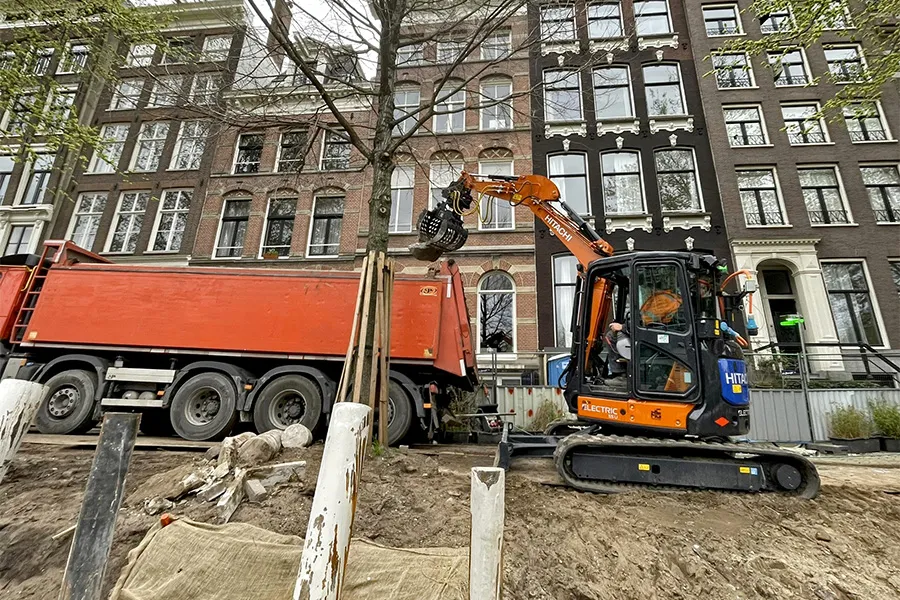
Zero-emission operations
Another major benefit of this method is the use of small, electric equipment. Alongside the drilling rig, the Hitachi ZX55U-6EB is being used on this project. The 5-tonne mini excavator has the same dimensions as the diesel version and features a compact zero-tail-swing design. This makes it ideal for a range of tasks on the project. The Hitachi was used for earthworks in January, and in March the machine spent several weeks demolishing the quay wall. The demolition work also used expansive cement instead of a hydraulic breaker. Combined with electric operation, this kept noise to a minimum and limited disruption to the surrounding area.
During drilling, a 20-foot battery container was used to charge both the drilling rig and the mini excavator. Once this work was complete, a power point provided by the municipality of Amsterdam was always available. This meant the machine could be topped up during the lunch break, making it possible to carry out the day’s work entirely electrically.
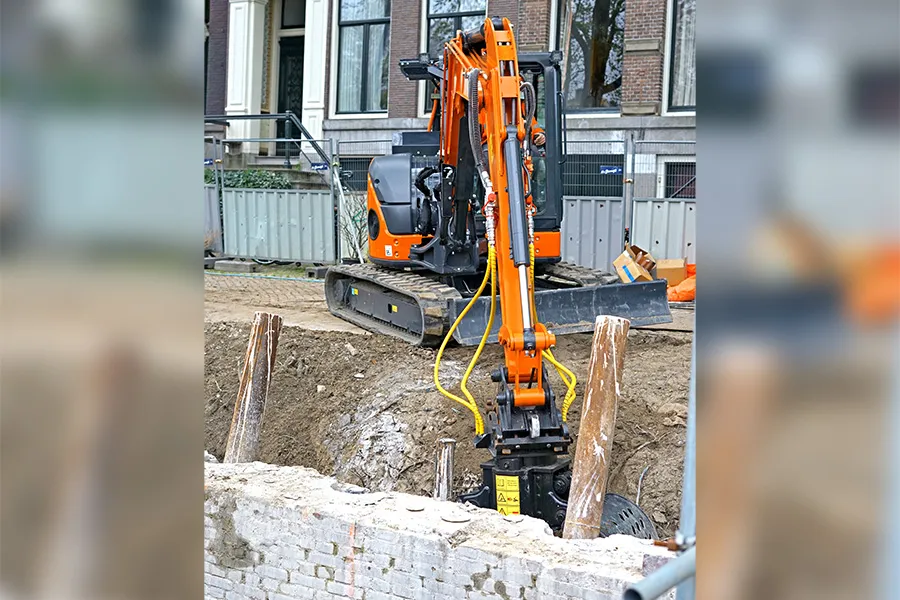
Made in Japan
The ZX55U-6EB was developed and built entirely in Japan and has recently become available in the Netherlands. H. van Steenwijk is hiring the mini excavator for the work on the Waalseilandsgracht through the Hitachi Premium Rental programme. Under this programme, Hitachi Nederland offers a wide range of the brand’s excavators and wheel loaders for hire for both short and long periods. One major benefit of the electric machine is that it can run either on its 39 kWh lithium-ion battery or while connected to a cable.
Een zakelijke vraag aan Hitachi Construction Machinery Nederland? Get in touch
Who worked on it
Waalseilandsgracht in Amsterdam
- electric mini excavator
 Hitachi
- contractorH. van Steenwijk B.V.
Keep following this
Get an email when a new story is published. No account needed.
- ProjectWaalseilandsgracht
- ThemeLower emissions and more reuse
- SubjectBouwMat
- CompanyHitachi Construction Machinery Nederland
- CompanyH. van Steenwijk B.V.







