









Daimler Trucks launches extensive testing of fuel cell truck
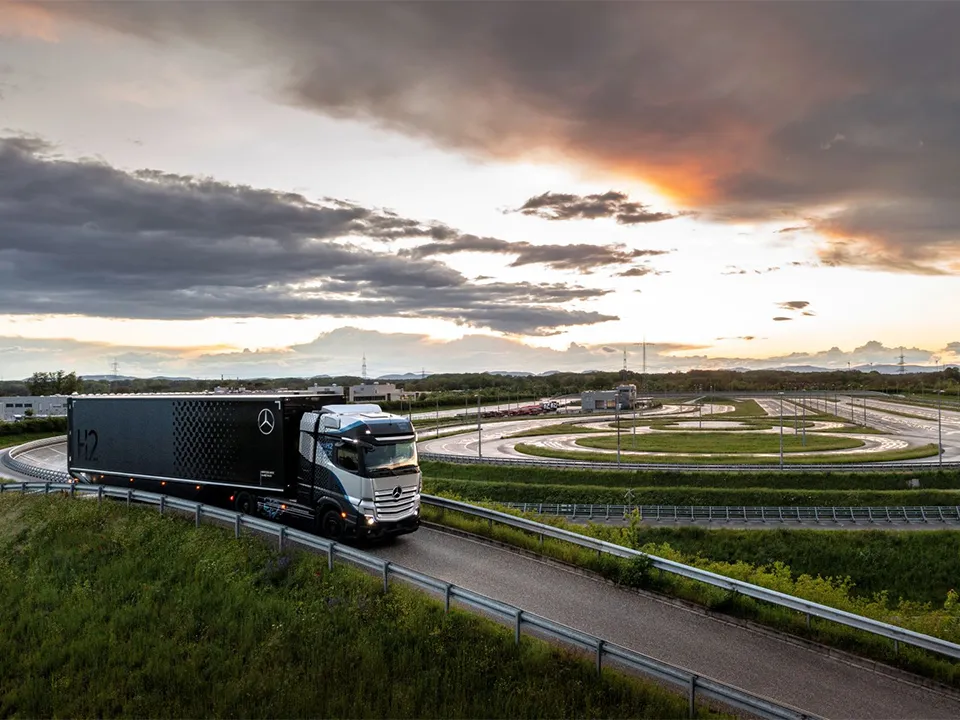
Daimler Trucks is focusing on hydrogen-powered fuel cells as it electrifies its heavy-duty trucks for long-haul transport.
The aim is to achieve a range of more than 1,000 kilometres on a single tank of fuel. At the end of April, Daimler Trucks began intensive testing of the first new, further-developed prototype of its Mercedes-Benz GenH2 Truck, unveiled in 2020, marking an important milestone on the road to series production. Daimler Trucks’ developers are putting the fuel cell truck through its paces. The extensive test programme, which places extreme demands on the vehicle and its components, focuses on factors including continuous operation, a wide range of weather and road conditions, and various driving manoeuvres.
Daimler Trucks expects to begin public-road testing before the end of this year. Customer testing is planned to start in 2023, and series-production trucks will be ready for delivery to customers a few years later.
Martin Daum, Chairman of the Board of Management of Daimler Truck AG and member of the Board of Management of Daimler AG: “We are consistently pursuing our technology strategy for the electrification of our trucks. Our goal is to offer our customers the best locally CO2-neutral truck, powered by batteries or hydrogen fuel cells depending on the application. We are right on schedule, and I am delighted that intensive testing of the GenH2 has got off to a good start. Hydrogen fuel cell technology will be indispensable for CO2-neutral transport in the future. This is also confirmed by our many partners, with whom we are working at full speed to bring this technology to the roads. In addition, the clear commitment of national and European regulators to the use of hydrogen in road freight transport is providing a significant boost. Political support plays an important role in fostering the development of green hydrogen infrastructure and making fuel cell trucks commercially viable for our customers.”
Demanding tests to clock up 1.2 million kilometres
Daimler Trucks’ engineers have designed the GenH2 so that the truck and its components meet the same durability requirements as a comparable conventional Mercedes-Benz Actros. That means 1.2 million kilometres over a period of ten years and a total of 25,000 operating hours. To meet these requirements, the GenH2 must pass extremely demanding tests, just like every new Actros generation. In the first few weeks of testing alone, the vehicle has covered hundreds of kilometres under continuous load on a rolling road test bench and faced numerous extreme real-world scenarios on the test track, including emergency braking and driving over kerbs.
Entirely new vehicle concept and components
The GenH2 is an entirely new truck design with completely new components, which are receiving the full attention of the developers during testing. These include the fuel cell system, the all-electric drivetrain and all associated systems, such as the special cooling system. The individual weight of the new components and their respective positions in the vehicle also affect the truck’s handling. As a result, vibrations caused by bumpy roads, and especially by extreme situations, subject the fuel cell truck to different forces from those experienced by conventional vehicles. To build up a comprehensive understanding at an early stage, the current prototype is also being tested with a payload of up to 25 tonnes and a GVW of around 40 tonnes, as planned for the production version of the GenH2.
Liquid hydrogen offers many advantages
Daimler Trucks favours liquid hydrogen because, in this state, the energy carrier has a significantly higher energy density than gaseous hydrogen. This means that liquid hydrogen tanks are much smaller and, thanks to their lower pressure, considerably lighter. The result is more cargo space and a higher payload. At the same time, more hydrogen can be refuelled, substantially increasing the range. Like conventional diesel trucks, the GenH2 is therefore suitable for long-haul journeys lasting several days and difficult to plan.
Following a predefined development plan, Daimler Trucks’ experts are continuously working on developing refuelling technologies for liquid hydrogen. The engineers expect to have sufficiently developed the prototype of the new tank system by the end of the year to continue the ongoing intensive tests with the GenH2. From that point on, vehicle tests will be carried out exclusively with liquid hydrogen tank systems until series production begins. Until then, a gaseous hydrogen tank system will be used as an interim solution for the intensive testing of the GenH2.
Question about this story? Ask your question
Keep following this
Get an email when a new story is published. No account needed.
- ThemeLower emissions and more reuse
- SubjectBouwMat







