









Daimler Trucks begins extensive testing of fuel cell truck
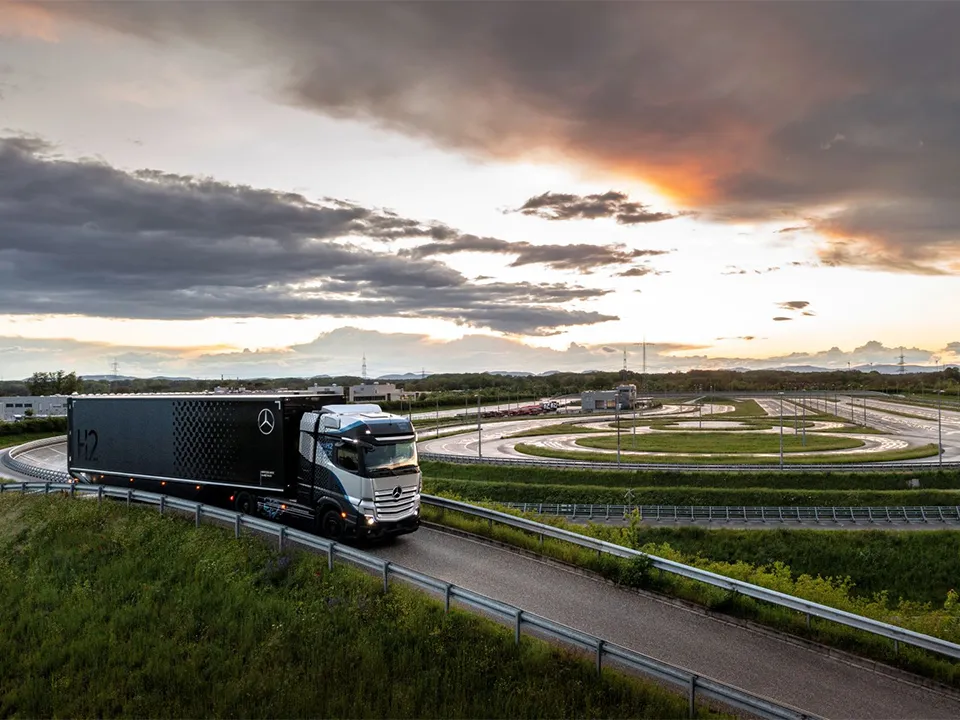
Daimler Trucks is focusing on hydrogen-powered fuel cells as it electrifies its heavy-duty trucks for long-haul transport.
The aim is to achieve a range of more than 1,000 kilometres on a single tank of fuel. At the end of April, Daimler Trucks began intensive testing of the first new, further-developed prototype of its Mercedes-Benz GenH2 Truck, unveiled in 2020. This marks an important milestone on the road to series production. Daimler Trucks’ developers are putting the fuel cell truck through its paces. The extensive test programme, which is extremely demanding for both the vehicle and its components, focuses on factors including continuous operation, a range of weather and road conditions, and various driving manoeuvres.
Daimler Trucks expects to begin testing on public roads before the end of this year. Customer trials are planned to start in 2023, and the series-production trucks will be ready for delivery to customers a few years later.
Martin Daum, Chairman of the Board of Management of Daimler Truck AG and a member of the Board of Management of Daimler AG: “We are consistently pursuing our technology strategy as we electrify our trucks. Our aim is to offer our customers the best locally CO2-neutral truck, powered by batteries or hydrogen-powered fuel cells depending on the application. We are right on schedule, and I am pleased that intensive testing of the GenH2 has got off to a good start. Hydrogen fuel cell technology will be indispensable for CO2-neutral transport in the future. This is also confirmed by the many partners with whom we are working at full speed to bring this technology to the road. In addition, the clear commitment of national and European regulators to the use of hydrogen in road freight transport is providing an important boost. Political support plays a key role in promoting the development of green hydrogen infrastructure and making fuel cell trucks commercially viable for our customers.”
Demanding tests to cover 1.2 million kilometres
Daimler Trucks’ engineers are designing the GenH2 to ensure that the truck and its components meet the same durability requirements as a comparable conventional Mercedes-Benz Actros. This means covering 1.2 million kilometres over a period of ten years and a total of 25,000 operating hours. To meet these requirements, the GenH2 must pass extremely demanding tests, just like every new Actros generation. In the first few weeks of testing alone, the vehicle covered hundreds of kilometres under continuous load on a rolling road test bench and was put through numerous extreme real-world scenarios on the test track, such as emergency braking and driving over kerbs.
All-new vehicle concept and components
The GenH2 is an entirely new truck design with completely new components, all of which are receiving close attention from the developers during testing. These include the fuel cell system, the all-electric powertrain and all associated systems, such as the special cooling system. The individual weight of the new components and their respective positions in the vehicle also affect the truck’s handling. As a result, vibrations caused by, for example, uneven roads and, in particular, extreme conditions subject the fuel cell truck to different forces from those experienced by conventional vehicles. To build up extensive knowledge at an early stage, the current prototype is also being tested with a payload of up to 25 tonnes and a gross vehicle weight of around 40 tonnes, as planned for the production version of the GenH2.
Liquid hydrogen offers many advantages
Daimler Trucks prefers liquid hydrogen because, in this state, the energy carrier has a significantly higher energy density than gaseous hydrogen. This means that liquid hydrogen tanks are much smaller and, thanks to the lower pressure, considerably lighter. This results in more cargo space and a higher payload. At the same time, more hydrogen can be refuelled, significantly extending the range. Like conventional diesel trucks, the GenH2 is therefore suitable for long-haul journeys lasting several days that are difficult to plan.
Following a predefined development plan, Daimler Trucks’ experts are continuously developing refuelling technologies for liquid hydrogen. By the end of the year, the engineers expect to have developed the prototype of the new tank system sufficiently to continue the ongoing intensive testing of the GenH2. From that point on, vehicle testing will use only tank systems for liquid hydrogen, through to series production. Until then, a gaseous hydrogen tank system will be used as an interim solution for intensive testing of the GenH2.
Question about this story? Ask your question
Keep following this
Get an email when a new story is published. No account needed.
- ThemeLower emissions and more reuse
- SubjectBouwMat







