









Colt International in Cuijk develops tunnel systems to ensure fire safety at Station Delft
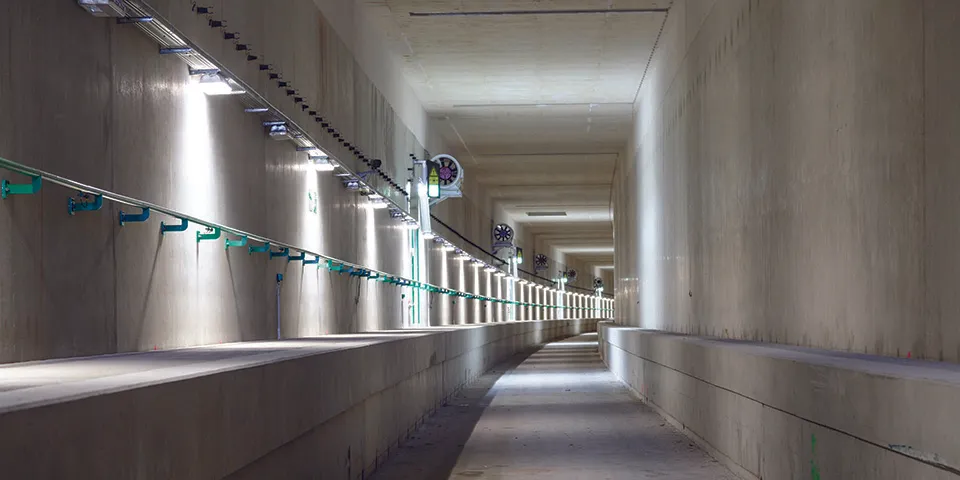
Vialis B.V. and Van Hattum en Blankenvoort B.V., both part of Koninklijke VolkerWessels, are carrying out the fit-out and installing the tunnel systems at Tunnel Delft, the second phase of the NS station in Delft. In 2025, the entire Tunnel Delft (phases 1 and 2) will open to rail traffic between The Hague and Rotterdam. Passenger safety at Delft station is paramount, especially in the event of a fire. Colt International in Cuijk is closely involved in delivering the station’s smoke control system, the tunnel ventilation system and the pressurisation systems for the emergency stairwells, to ensure fire safety in the tunnels and station.
Koninklijke VolkerWessels starts fit-out of second phase of Station Delft
The work on the The Hague-Rotterdam rail corridor is part of the Programme for High-Frequency Rail Transport (PHS), through which ProRail is gradually adapting the busiest rail corridors in the Netherlands to accommodate more trains. By doubling the track between Rijswijk and Delft Zuid and making infrastructure and signalling changes between Delft Zuid and Rotterdam, from 2025 the route will be able to carry eight intercity trains and six local trains per hour in each direction. Passengers will be able to catch a train between Rotterdam and The Hague every five minutes. The first tunnels, with tracks 1 and 2, came into use in 2015. The fit-out and installation of tunnel systems in the third and fourth tunnels began in mid-2019. VolkerWessels is also continuing work on the underground platform, which lies between the four tunnels. This second phase of the project is due to be completed by the end of 2024, ready for high-frequency rail services. An estimated 40,000 passengers will then board and alight in Delft on an average working day.
Stan Veldpaus is a fire safety project consultant at Colt International in Cuijk, a manufacturer of smoke control systems, climate control systems and solar shading. Colt specialises in developing smoke control systems such as smoke and heat exhaust ventilation systems (SHEVS), pressurisation systems and impulse ventilation systems for both above-ground and underground buildings and tunnels. For Tunnel Delft, Colt designed the smoke control systems for the station, tunnels and emergency stairwells, and will maintain them in full after handover. “Installing ventilation in the four tunnels and the station is fairly complex, because they are all interconnected and need to operate together. The ventilation systems must work together in such a way that, in the event of a fire anywhere, both the station, including its platforms, and the tunnels are kept sufficiently clear of smoke,” says Veldpaus. “This requires impulse fans in the tunnels and mechanical smoke extract fans in the station. The systems must ventilate smoke and heat as effectively as possible,” Veldpaus explains.
For both phases, the installation designs for the systems mentioned above were optimised using CFD models (computational fluid dynamics). “The simulations were produced in-house by Colt’s fluid dynamics specialists,” says Veldpaus. “They predict the effect of airflows in a tunnel and the station in the event of a fire. In other words, the computer shows how airflow affects visibility and heat development.” In the event of a fire, smoke and heat must be extracted quickly. Smoke and heat are removed by the SHEVS serving the platforms and concourse, together with the impulse fans in the tunnels. This keeps visibility sufficient for passengers and staff to escape quickly and safely. The systems also enable the fire brigade to locate and extinguish the fire quickly. They therefore control the greatest danger immediately after a fire breaks out, giving passengers and staff considerably more time to escape,” says Veldpaus.
Colt is also responsible for the pressurisation systems in the emergency stairwells located along the tunnels. By creating a strong airflow from the stairwell towards the tunnel, smoke is prevented from entering the stairwell. In addition, the pressure differential prevents smoke from entering when the door is closed. Because the stairwells have different designs, several types of pressurisation system are used on this project. The system for each stairwell was designed, installed and tested individually.
Koninklijke VolkerWessels companies Vialis and Van Hattum en Blankevoort are responsible for installing the tunnel systems and completing the fit-out of the second phase of Station Delft. As in phase 1, Colt’s smoke and heat control systems will also be installed in phase 2. Marcel van Stek is a project buyer at Vialis and is involved in the tunnel systems. In addition to installing the ventilation, Vialis, as systems integrator, must ensure that the fire safety systems and installations are interconnected. “Vialis will install 19 impulse fans in each of tunnels 3 and 4. Tunnels 1 and 2 have 38 identical fans. Ultimately, all 76 impulse fans in the four tunnels will be interconnected, and linked to the SHEVS on the platforms and in the concourse,” says van Stek. These systems draw in air and propel it in one direction with a specified force. The number of impulse fans depends on the tunnel geometry. “The force is sufficient to push air, when smoke and heat develop, towards one end of the tunnel and out in the direction of travel. This prevents smoke and heat from reaching the platforms and central areas,” he explains. The four emergency stairwells leading from the tunnels to ground level are equipped with standalone pressurisation systems. “Tunnels 3 and 4 will also have four additional emergency stairwells, where Vialis will install the same standalone pressurisation systems from Colt. These systems keep smoke and heat out of the stairwells and blow it back into the tunnel. They ensure passengers can leave the tunnels as quickly as possible in an emergency,” says van Stek.
Fire ventilation is one of the most important aspects of Tunnel Delft. “It is a major advantage that Colt also designed and supplied the tunnel systems for the first phase,” says van Stek. Using technical information and computer simulation data, Colt has developed and optimised the smoke control and smoke and heat exhaust systems with great precision. “The close involvement and solution-focused approach demonstrated make Colt a strong and reliable supply chain partner on complex projects such as Tunnel Delft,” says van Stek.
Question about this story? Ask your question
Who worked on Station Delft Zuid
- smoke control systemsColt InternationalIn this story
- tunnel systemsVialis B.V.In this story
- finishingVan Hattum en Blankenvoort B.V.In this story
Keep following this
Get an email when a new story is published. No account needed.
- ProjectDelft Zuid station
- ThemeUnderground construction
- SubjectBouwMat
- CompanyColt International
- CompanyVialis B.V.
- CompanyVan Hattum en Blankenvoort B.V.







