









Colt International from Cuijk develops tunnel systems to ensure fire safety at Station Delft
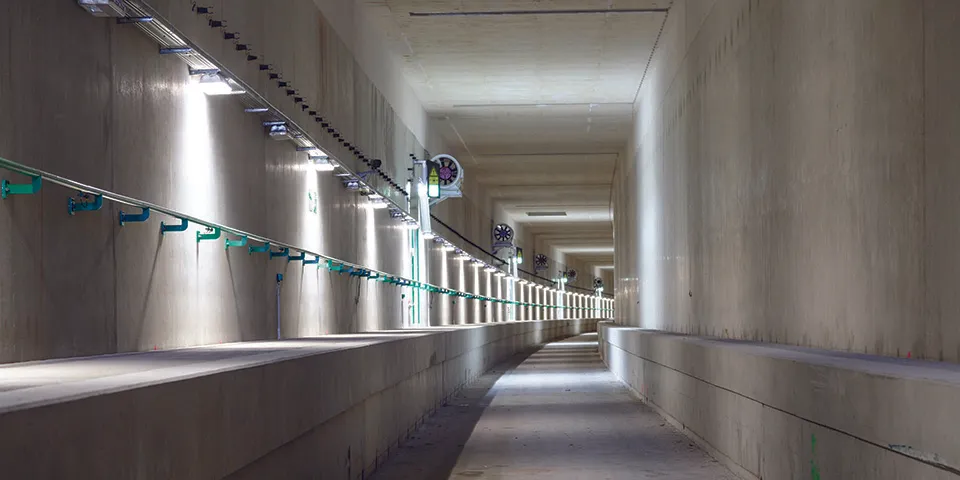
Vialis B.V. and Van Hattum en Blankenvoort B.V., both part of Koninklijke VolkerWessels, are carrying out the fit-out and installing the tunnel systems for Tunnel Delft, the second phase of the NS station in Delft. In 2025, the entire Tunnel Delft, phases 1 and 2, will open to rail traffic between The Hague and Rotterdam. Passenger safety at Delft station is paramount, particularly in the event of a fire. Colt International, based in Cuijk, is closely involved in delivering the smoke control system at the station, the ventilation system in the tunnels and the pressurisation systems in the emergency stairwells to ensure fire safety in the tunnels and station.
Koninklijke VolkerWessels starts fit-out of second phase of Station Delft
The work on the The Hague-Rotterdam rail corridor is part of the Programme for High-Frequency Rail Transport (PHS), through which ProRail is gradually upgrading the busiest rail routes in the Netherlands to accommodate more train services. Doubling the track between Rijswijk and Delft Zuid, along with infrastructure and signalling upgrades between Delft Zuid and Rotterdam, will allow eight intercity trains and six stopping trains to run in each direction every hour on this route in 2025. This will enable passengers to catch a train between Rotterdam and The Hague every five minutes. The first tunnels, with tracks 1 and 2, entered service in 2015. Work on the fit-out and tunnel systems for the third and fourth tunnels began in mid-2019. VolkerWessels is also continuing work on the underground platform, which lies between the four tunnels. This second phase of the project will be completed by the end of 2024, ready for high-frequency rail services. An estimated 40,000 passengers will then board and alight at Delft on an average working day.
Stan Veldpaus is a fire safety project adviser at Colt International in Cuijk, a manufacturer of smoke control systems, climate control systems and solar shading. One of Colt’s areas of expertise is developing smoke control systems, such as Smoke and Heat Exhaust Ventilation Systems (SHEVS), pressurisation systems and jet fan ventilation systems for both above-ground and underground buildings and tunnels. For Tunnel Delft, Colt developed smoke control systems for the station, tunnels and emergency stairwells, and will maintain them in full after handover. “Delivering the ventilation systems for the four tunnels and the station is quite complex, because they are all interconnected and need to operate together. The ventilation systems must work in such a way that, in the event of a fire anywhere, both the station, including its platforms, and the tunnels are kept sufficiently clear of smoke,” says Veldpaus. “This requires jet fans in the tunnels and mechanical smoke extract fans in the station. The system as a whole must extract smoke and heat as effectively as possible,” Veldpaus explains.
For both phases, the design of the installations for the systems described above was optimised using CFD models (computational fluid dynamics). “The simulations were produced in-house at Colt by specialists in fluid dynamics,” says Veldpaus. “They predict the effect of airflows in a tunnel and the station in the event of a fire. In other words, the computer shows how airflow affects visibility and heat build-up.” In the event of a fire, smoke and heat must be removed quickly. Smoke and heat are extracted by the SHEVS on the platforms and in the concourse, together with the jet fans in the tunnels. This maintains sufficient visibility for passengers and staff to escape quickly and safely. The systems also enable the fire service to locate and extinguish the fire quickly. They therefore control the greatest danger immediately after a fire breaks out, giving passengers and staff significantly more time to escape,” says Veldpaus.
Colt is also responsible for the pressurisation systems in the emergency stairwells located along the tunnels. By creating a strong airflow from the stairwell towards the tunnel, smoke is prevented from entering the stairwell. In addition, the pressure differential prevents smoke from entering when the door is closed. The different designs of the stairwells mean that several types of pressurisation system are used on this project. The system in each stairwell was designed, installed and tested individually.
Koninklijke VolkerWessels companies Vialis and Van Hattum en Blankevoort are responsible for delivering the tunnel systems and fit-out for the second phase of Station Delft. As in the first phase, Colt’s smoke and heat control systems will also be installed in the second phase. Marcel van Stek is a project buyer at Vialis and is involved in the tunnel systems. In addition to installing the ventilation, Vialis must also act as system integrator, ensuring that the fire safety systems and installations are connected to one another. “Vialis will install 19 jet fans in each of tunnels 3 and 4. Tunnels 1 and 2 have 38 identical fans. Ultimately, all 76 jet fans in the four tunnels will be interconnected, and linked to the SHEVS on the platforms and in the concourse,” says van Stek. These installations draw in air and propel it in one direction with a certain force. The number of jet fans depends on the geometry of the tunnel. “The force is strong enough to push air, in the event of smoke and heat build-up, towards one end of the tunnel and out in the direction of travel. This prevents smoke and heat from reaching the platforms and concourse areas,” he explains. The four emergency stairwells leading from the tunnels to ground level are equipped with standalone pressurisation systems. “Tunnels 3 and 4 will also have four additional emergency stairwells, where Vialis will install the same standalone pressurisation systems from Colt. These systems keep smoke and heat out of the stairwells and blow them back into the tunnel. They ensure that passengers can get out of the tunnels as quickly as possible in an emergency,” says van Stek.
Fire ventilation is one of the most important aspects of Tunnel Delft. “It is a major advantage that Colt also designed and supplied the tunnel systems for the first phase,” says van Stek. Using the technical information and computer simulation data, Colt developed and optimised the smoke control and Smoke and Heat Exhaust Systems in great detail. “The close involvement and solution-focused approach demonstrated here show that Colt is a strong and reliable partner in the supply chain for complex projects such as Tunnel Delft,” says van Stek.
Question about this story? Ask your question
Who worked on Station Delft Zuid
- smoke control systemsColt InternationalMentioned in Colt International in Cuijk develops tunnel systems to ensure fire safety at Station Delft
- tunnel systemsVialis B.V.Mentioned in Colt International in Cuijk develops tunnel systems to ensure fire safety at Station Delft
- finishingVan Hattum en Blankenvoort B.V.Mentioned in Colt International in Cuijk develops tunnel systems to ensure fire safety at Station Delft
Keep following this
Get an email when a new story is published. No account needed.
- ProjectDelft Zuid station
- ThemeUnderground construction
- SubjectBouwMat







