









Collaboration as a pillar of success
The fact that the purchase subsidy for zero-emission construction equipment under the SSEB scheme attracted almost twice as many applications in one day as the €36 million available for this year makes it clear that the equipment sector is keen to innovate. This article rounds up the latest developments.
Developments in zero-emission construction are moving at a rapid pace
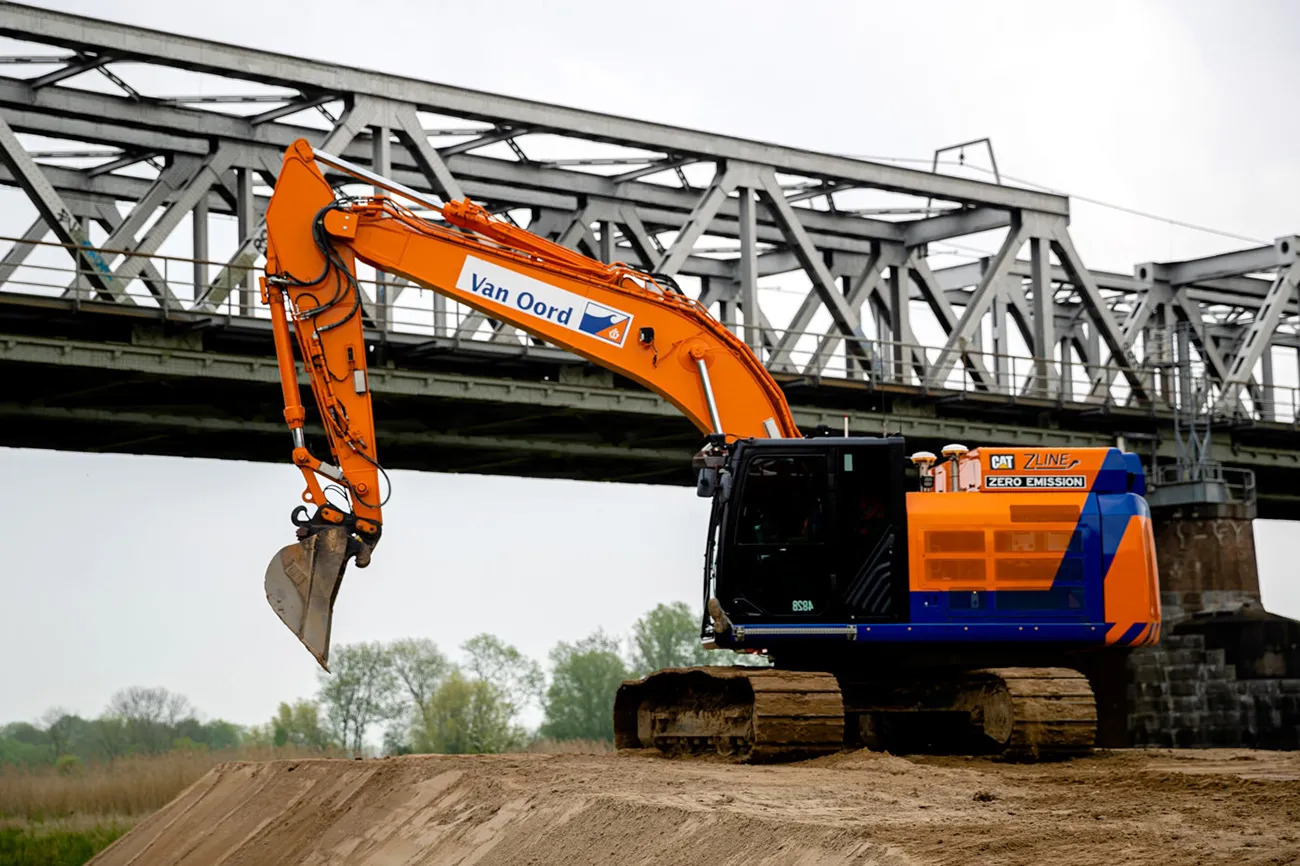
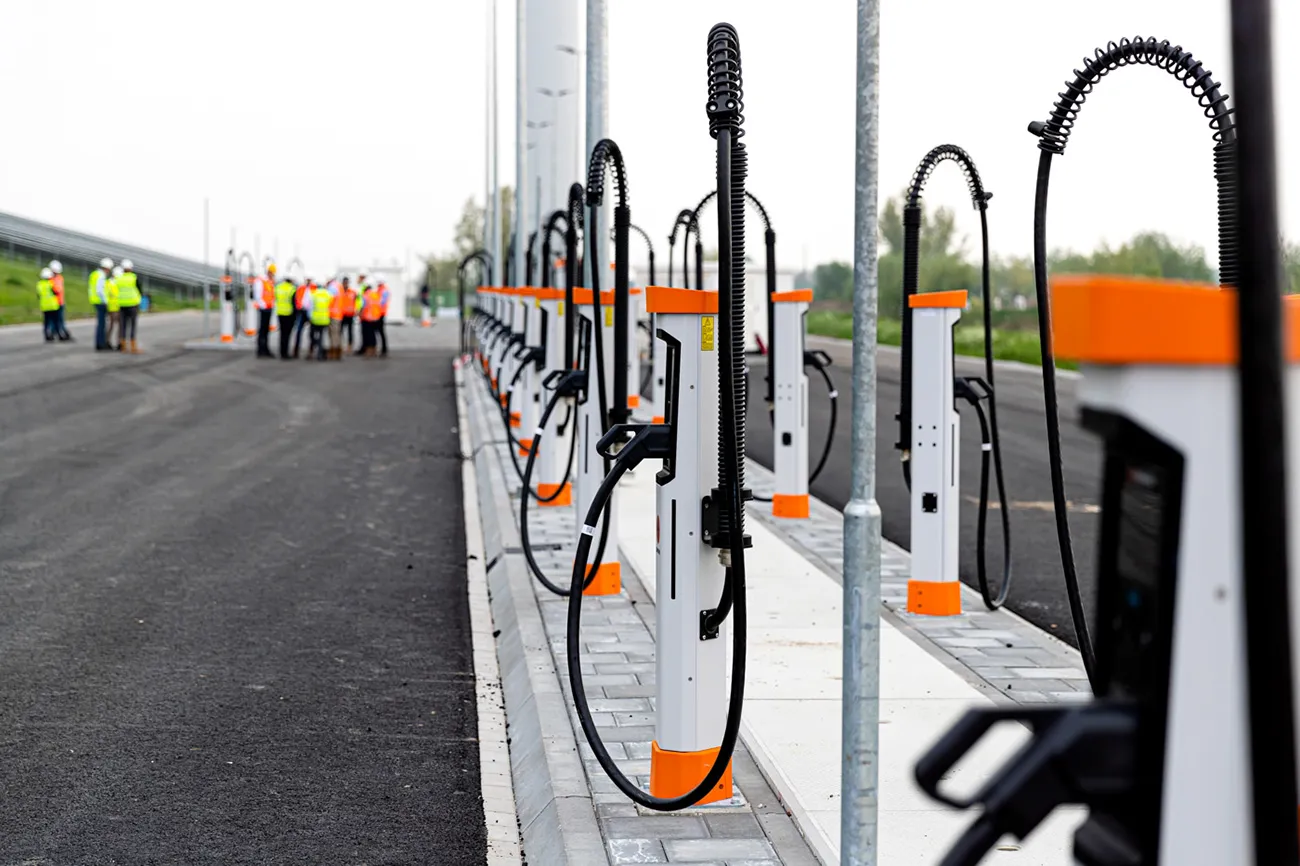
On 9 May, Van Oord, Caterpillar and Pon signed a memorandum of understanding to pool knowledge, gain experience and enable digitalisation and innovation. The collaboration can help the parties deliver the world’s largest off-grid, zero-emission project using heavy earthmoving equipment. As part of the Mekante Diek consortium, Van Oord is involved in the zero-emission Tiel-Waardenburg dike reinforcement project, which will use around forty large electric machines. An innovative fast-charging site, called Watt-Hub, has been built to charge all this equipment. It is the world’s first semi-public charging site designed specifically for trucks and heavy equipment.
Caterpillar first
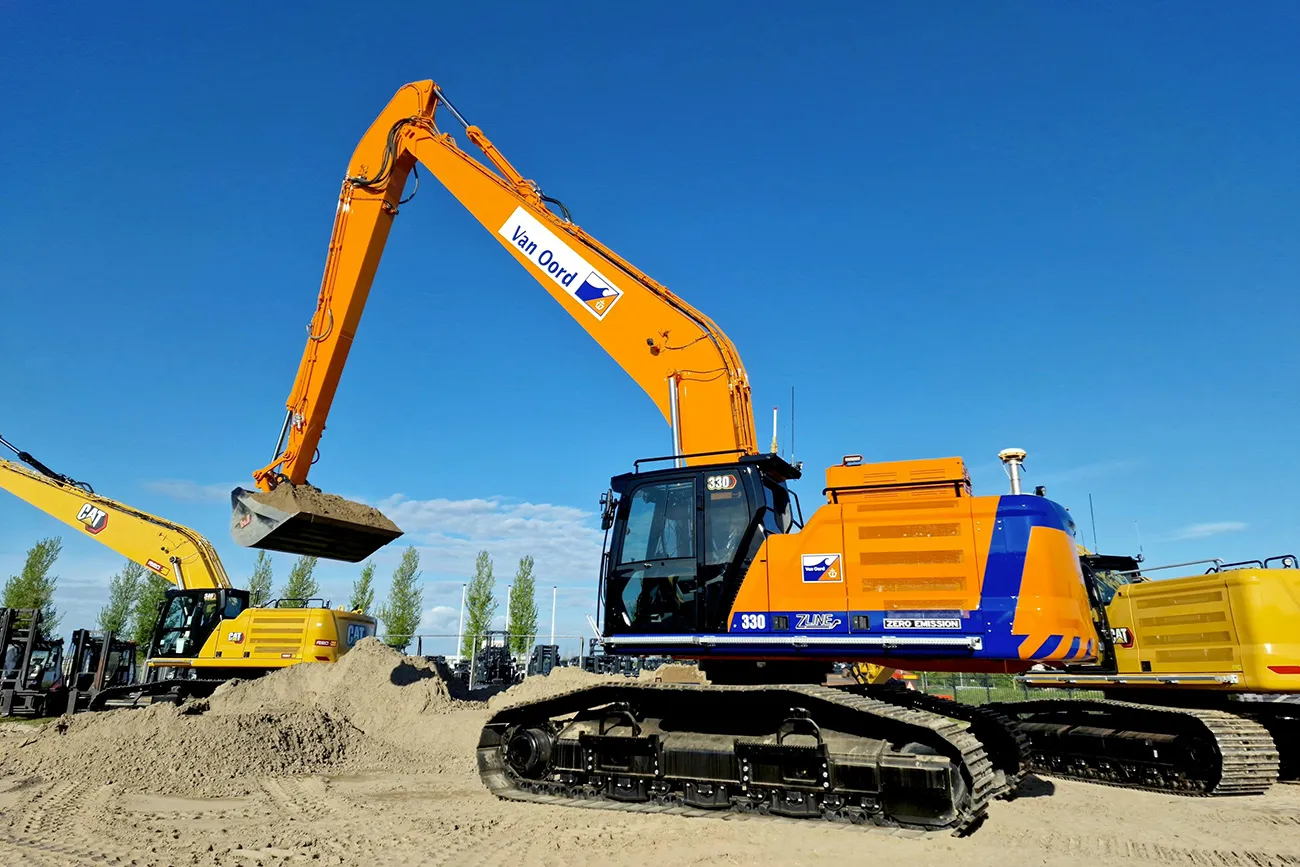
Van Oord will deploy the first CAT 330 LRE Z-line crawler excavator on this project. In 2020, Pon Equipment delivered the country’s first electric 20-tonne Caterpillar excavator to Van Oord, followed by a second the year after. Following the success of these machines, Van Oord has decided to purchase four more battery-electric models. The CAT 330 LRE Z-line weighs 35.5 tonnes and has a net battery capacity of 422 kWh. The machines will be delivered this year and deployed on the Tiel-Waardenburg project. Pieter van Oord, CEO of Van Oord: “Ingenious solutions are needed to realise our sustainability ambitions. Van Oord attaches great importance to sharing knowledge. Collaboration and innovation are the key to tackling the world’s current challenges.”
Van Oord looks forward to closer ties with Caterpillar and Pon Equipment and is convinced that “the specialist knowledge and expertise are there to make this partnership a success.” Marc de Groen, CEO of Pon Equipment and Pon Power, adds: “In our ongoing quest for sustainable solutions, reducing emissions has become a necessity. At Pon, we see this collaboration as an opportunity to learn and further develop solutions through electrification, the use of renewable energy sources and greater energy efficiency. We are proud to work with Van Oord and Caterpillar to further reduce CO2 emissions, on the way to a better world. In short, a great collaboration between three strong partners.”
Innovative approach
Major strides are also being made in the energy transition in Brabant, with the Brainport Eindhoven region serving as an important source of inspiration. The Netherlands’ first zero-emission, circular demolition project began in Breda on Monday 15 May. Commissioned by housing association Alwel, demolition contractor Van der Zanden of Moergestel is demolishing various buildings on Stationslaan, including the former Harley-Davidson showroom. All demolition machinery, generators and construction vehicles at the Harley site are electric and run entirely on battery-powered electric motors. This innovative approach means there is no need for noisy, fuel-smelling cranes and generators. It not only makes an important contribution to a cleaner environment and healthier living conditions, but also reduces disruption for local residents, particularly in the heart of Breda.
The equipment includes a brand-new Doosan DX355LC-7 Electric crawler excavator, delivered by Staad Groep of Veghel at the end of April. Van der Zanden has also put the world’s largest mobile battery system into service through DENS, based at the Automotive Campus Helmond. The so-called Powerhub Plateau Container supplies no less than 2.32 MWh of electricity and can easily be picked up or set down using a hooklift system. By investing in this world first developed in the Netherlands, two Brabant-based companies are taking the lead in the energy transition. Boomrooierij Weijtmans of Udenhout has also chosen DENS’ Powerhub as a reliable and safe energy storage solution.
Solar panels generate surplus energy at both company sites, while project sites are often short of power. By storing the energy directly in the Powerhub, it can be transported to a project site and used later.
Every detail considered
Energy storage is an important issue in the sector in any case. Without suitable charging infrastructure, carrying out projects entirely without emissions is a non-starter. Those who choose to do so must also consider charging batteries overnight. Ideally this would be done on site, but electricity for construction is by no means always available, particularly near nature reserves. Ahlmann Nederland now offers a tailored solution with the BouwPower. This compact power box, with a gross capacity of 102 kWh, provides power anywhere in no time. Safe, robust and sustainable: these are the hallmarks of the BouwPower BP100. Every detail has been carefully considered, from safety and ease of use to design. The power box stands out for its sturdy construction, with the battery pack and electrical cabinet fully waterproof (IP66).
With a pallet frame beneath the battery pack and a central lifting eye on top, the 1,850 kg box can easily be lifted onto a trailer and transported by pick-up or van to any location. Compared with a diesel generator, the box provides a power supply that is not only more robust, but also significantly smoother and more stable. The BouwPower supplies power not only to recharge electric machines and hand tools, but also to light the work area and run a fridge, coffee machine, laptop or phones in the site cabin. The BP100 can even be fitted with an inverter and powered by 12 or 24 solar panels. Connecting several battery boxes in parallel provides enough kWh to recharge larger machines overnight in one go.
Pooling experience
At a workshop on 13 April, more than thirty parties from the infrastructure sector came together at the initiative of Emissieloos Netwerk Infra (ENI) to pool their experience of working without emissions. In a unique gathering, industry pioneers and forward-thinking clients worked hard to answer frequently asked questions about “procuring zero-emission work”. The focus was on practical answers to questions being raised across the sector. ENI wanted to complement, rather than repeat, work by the government, such as the SEB roadmap, and the ZE Buyergroup’s guidance document, “Procuring zero-emission construction equipment”. The aim is to help as many government bodies and clients as possible, as well as market players, navigate the complex challenge of building without emissions.
One question that is very much on contractors’ minds is how much budget is needed to build without emissions. There is no clear-cut answer at present. The market is currently in a phase of pilots and experiments, so costs vary widely. So far, the construction costs of infrastructure projects using zero-emission equipment appear to increase by around 5 to 18%. The increases are lower for projects that are only partly zero-emission. The main reason for the differences is the wide variation in the one-off costs of charging infrastructure. The type of equipment also makes a difference. With small machines, up to 56 kW, zero-emission working is possible at comparable cost. Medium-sized and large equipment is not only much more expensive to purchase, the additional project costs are also considerably higher.
Volvo Trucks leads the way
Although the use of electric trucks is often left out of tenders for zero-emission construction because they spend relatively little time on projects, following in the footsteps of major logistics providers, many construction companies are also showing interest in heavy battery-electric trucks. After the first quarter of 2023, Volvo Trucks leads the market for heavy electric trucks in both Europe and North America. The Swedish brand has sold almost 5,000 electric trucks in around 40 countries. The logical next step is to make its electric product range available in the markets of Asia, Latin America and Africa. In Q1, a total of 600 electric trucks weighing 16 tonnes or more were registered in Europe, four times as many as in the same period in 2022. Volvo Trucks has the largest market share, at 50%.
Battery technology is advancing at a rapid pace, particularly in the transport sector. Whereas the first generation had a range of 200 km, today 300 to 400 km is the norm, and there is already cautious speculation about ranges of 500 or even 700 km. Chinese battery manufacturer CATL, a partner of Tesla and Sany, among others, is aiming even higher. The global market leader recently unveiled the third generation of its cell-to-pack (CTP) battery technology, which the company says easily delivers a range of 1,000 km and can be recharged in ten minutes. Those are some impressive figures! According to CATL, the new Qilin battery has a previously unattained volume efficiency of 72% and an energy density of up to 255 Wh/kg. The manufacturer describes it as a breakthrough in power (+13%), efficiency and materials.
A business enquiry for Ahlmann Nederland bv? Get in touch
Companies in this story


Keep following this
Get an email when a new story is published. No account needed.
- ThemeConstruction equipment and transport in motion
- SubjectBouwMat
- CompanyAhlmann Nederland bv
- CompanyVan Oord
- CompanyPon Equipment BV
- CompanyStaad BV







