









CO2-saving biofuel with a low environmental cost indicator (MKI)
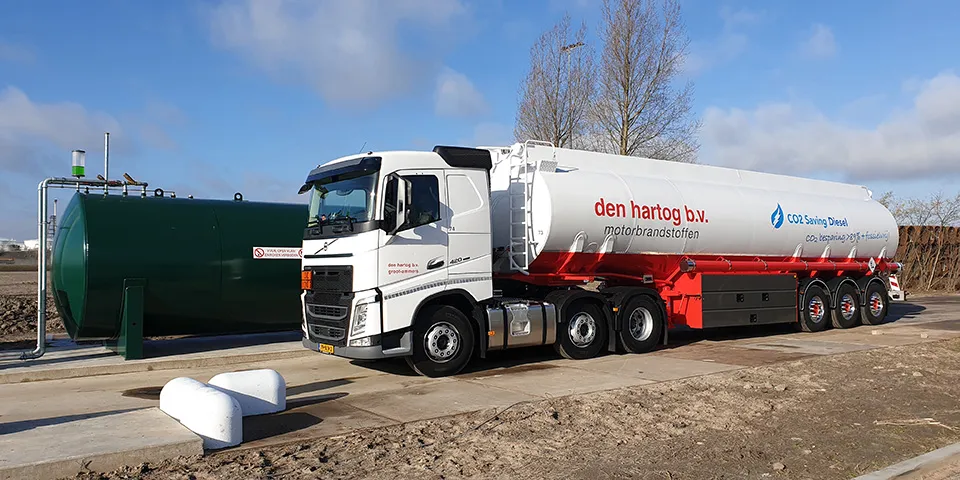
The main sources of air pollution and CO2 emissions in the Netherlands are industry and road traffic, due to the large-scale burning of fossil fuels. In 2015, the Paris climate agreement was reached to address this, including commitments to tackle global warming, transition to non-fossil fuels and reduce CO2 emissions. The civil engineering, roads and hydraulic engineering sector is also seeing CO2 emissions and MKI values (environmental cost indicator) play an increasingly important role. Companies are increasingly looking for solutions, such as using alternative fuels in their vehicle fleets and machinery, to reduce their environmental footprint.
One of the companies working hard on this is Den Hartog BV. It supplies top-quality products, including Mobil lubricants, as well as fuels. Den Hartog holds large stocks of fuel at its own depot on the Lek in Groot-Ammers, with a capacity of no less than 23 million litres. With transport and drivers also managed in-house, Den Hartog can guarantee a rapid response and fast delivery of fuels and lubricants. Den Hartog is a member of the Platform Duurzame Biobrandstoffen, which aims to put the Netherlands at the forefront of decarbonising fuels across various transport sectors.

The Den Hartog tank farm can store 23 million litres. Of this, 4 million litres is CO2 Saving Diesel.
Minimising environmental impact
“We are a major stockholding supplier, ensuring reliable delivery and consistently controlled quality. Quality is a top priority for us. The government is placing considerable emphasis on CO2 reduction. Our CO2 Saving Diesel is our response to this.” Niek Roessink, business development manager at Den Hartog, explains: “Conventional biodiesel has limitations in terms of blending percentages, and its quality can sometimes be inferior to diesel. It has a reputation for clogging fuel filters and damaging fuel systems. Biomass to Liquid (BTL) biofuel does not have this drawback.”
More than 89% CO2 reduction with CO2 Saving Diesel
CO2 Saving Diesel contains very little sulphur and few aromatics. This cuts particulate matter and soot emissions significantly, by up to 46%, and reduces sulphur emissions to virtually zero. Nitrogen emissions are reduced by 14%. The pure grade cuts CO2 emissions by more than 89%. The way this fuel is produced gives it better quality than “old-fashioned diesel”. This pure grade fully complies with the EN15940 standard.

Contractors in civil engineering, roads and hydraulic engineering use CO2 Saving Diesel to win contracts.
Added value for many businesses through a 74% MKI saving
The key advantage of CO2 Saving Diesel is that it blends perfectly with conventional diesel. Den Hartog therefore offers a range of blends. The higher the blend, the greater the CO2 savings. Den Hartog products can be used in current-generation diesel engines without modification or any problems. “Customers recoup the cost because it enables them to generate more business,” Niek explains. “Companies working in infrastructure are increasingly encountering MKI values in tenders. That is why we commissioned a Life Cycle Analysis of our CO2 Saving Diesel, which also established its MKI value. Compared with the MKI value of conventional fossil diesel, savings of more than 70% are possible. The LCA is being made available to the Nationale Milieu Database (NMD). This data enables our customers to draw up environmental declarations for their own products or services.”
Question about this story? Ask your question
Keep following this
Get an email when a new story is published. No account needed.
- ThemeLower emissions and more reuse
- SubjectBouwMat







