









CO2-saving biofuel with a low environmental cost indicator
The main sources of air pollution and CO2 emissions in the Netherlands are industry and road traffic, due to the widespread burning of fossil fuels. To address this, a climate agreement was reached in Paris in 2015, including a commitment to curb global warming, transition to non-fossil fuels and reduce CO2 emissions. In the groundworks, roadbuilding and water engineering sector, too, CO2 and environmental cost indicator (MKI) values are playing an increasingly important role. Companies are increasingly looking for solutions, such as using alternative fuels in their vehicle fleets and machinery to reduce their environmental footprint.
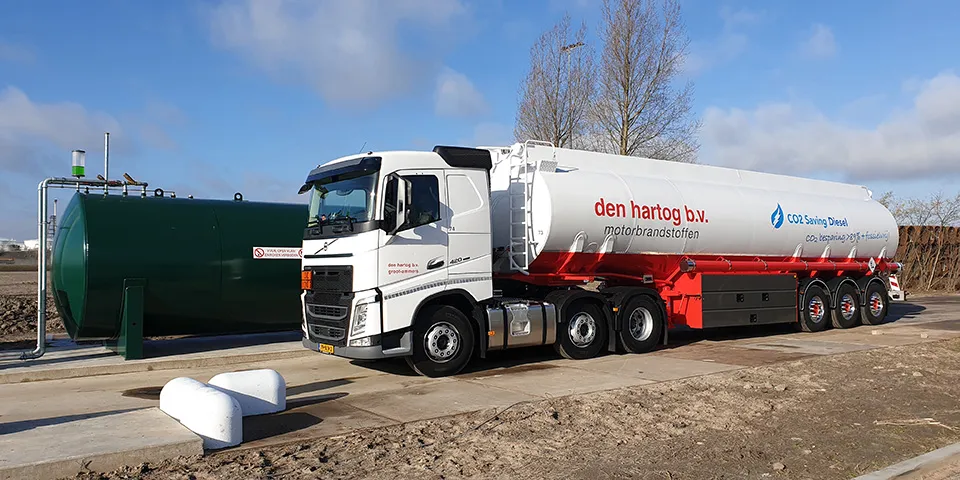
One of the companies working hard on this is Den Hartog BV. The company supplies top-quality products, including Mobil lubricants. It also supplies fuels. Den Hartog holds large stocks of fuel at its own depot on the Lek in Groot-Ammers, with a capacity of no less than 23 million litres. With transport and drivers also managed in-house, Den Hartog can guarantee a rapid response and therefore swift delivery of fuels and lubricants. Den Hartog is a member of the Platform Duurzame Biobrandstoffen, which aims to put the Netherlands at the forefront of decarbonising fuels across various transport sectors.

The Den Hartog fuel depot can store 23 million litres. Of this, 4 million litres are CO2 Saving Diesel.
Minimising environmental impact
“We are a major fuel supplier with substantial stocks, guaranteeing supply and quality control. Quality is a top priority for us. The government is pushing hard to reduce CO2 emissions. Our CO2 Saving Diesel is our response to this.” Niek Roessink, business development manager at Den Hartog, explains: “Conventional biodiesel has limitations in terms of the proportion that can be blended in. It can also be of lower quality than diesel. It has a reputation for clogging fuel filters and damaging fuel systems. Biomass to Liquid (BTL) biofuel does not have this drawback.”
More than 89% CO2 reduction with CO2 Saving Diesel
CO2 Saving Diesel contains very little sulphur and few aromatic compounds. This substantially reduces particulate matter and soot emissions, by up to 46%, and cuts sulphur emissions to practically zero. Nitrogen emissions are reduced by 14%. The pure grade cuts CO2 emissions by more than 89%. The way this fuel is produced gives it a higher quality than “old-fashioned diesel”. This pure grade fully meets the EN15940 standard.

In the groundworks, roadbuilding and water engineering sector, contractors use CO2 Saving Diesel to win contracts.
Added value for many businesses through 74% MKI saving
The major advantage of CO2 Saving Diesel is that it blends perfectly with conventional diesel. Den Hartog therefore offers a range of blends. The higher the proportion added, the greater the CO2 savings. Den Hartog’s products can be used without modification in current-generation diesel engines. “It pays for itself because it enables customers to generate more business,” Niek explains. “Companies working in infrastructure are increasingly coming up against MKI values in tendering processes. That is why we commissioned a Life Cycle Analysis of our CO2 Saving Diesel, which also established its MKI value. Compared with the MKI value of conventional fossil diesel, savings of more than 70% are possible. The LCA is being made available to the National Environmental Database (NMD). This data enables our customers to draw up environmental declarations for their own products or services.”
Question about this story? Ask your question
Keep following this
Get an email when a new story is published. No account needed.
- ThemeLower emissions and more reuse
- SubjectBouwMat







