









A torrent of new machines
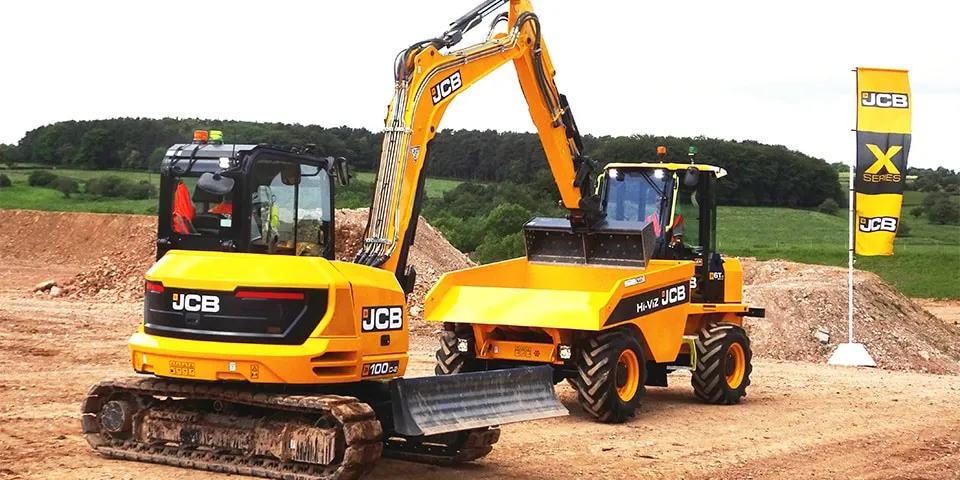
Brexit or not, the world keeps turning for JCB. The British construction equipment manufacturer continues to innovate and share the results with that same world. In early June, trade press from across Europe got a close look at a large number of new machines and digital tools.
Starting with the biggest news: the Hydraload 555-210R is not only JCB’s first rotating telehandler, it is also set to be a gamechanger on sites where a lot of work involves prefabricated elements or, for example, the installation of sewer pipes. With a lifting height of 20.5 metres and a maximum lifting capacity of 5.5 tonnes, it can replace mobile and even fixed cranes, while also handling a wide range of other materials-handling tasks. It can of course also be used for ‘normal’ telehandler work with a platform. Its outrigger system is highly flexible: it can be used in wide or narrow configurations and features automatic levelling, making set-up very quick.
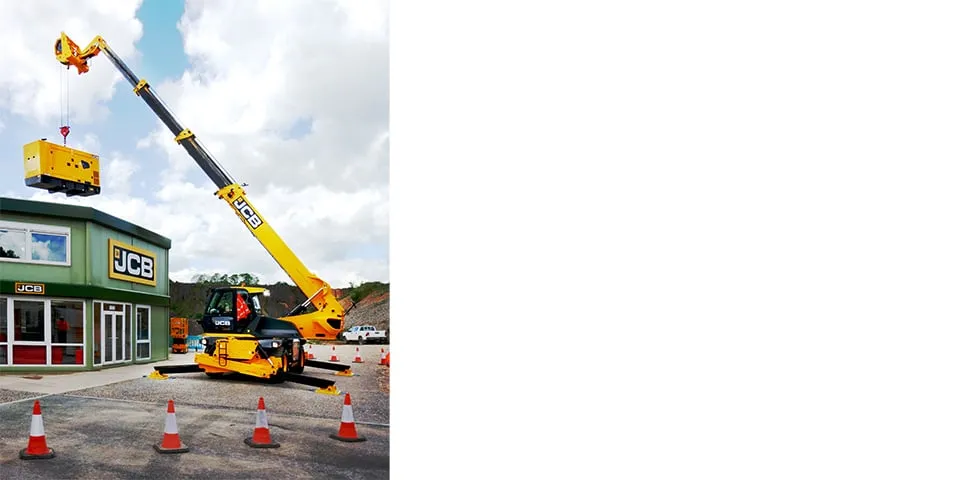
The Hydraload 555-201R is due to go on sale in Europe later this year. It is set to be a gamechanger on sites where a lot of work involves prefabricated elements.
A 2-metre jib is available for lifting work, while attachments are recognised automatically and the correct load chart selected. The Hydraload 555-201R is due to go on sale in Europe later this year, adding the largest and most advanced model yet to the existing Loadall telehandler range.
More electric machines
The prototype of the fully electric 1.9-tonne 19C-IE mini excavator is now ready for production and will be available from the autumn. It is five times quieter than the diesel version and is designed for use outdoors, in cities for example, or inside buildings and tunnels for excavation or demolition work. Another electric addition is the new Teletruk 30-19E. This compact telehandler is also fully electric and is intended in part to replace or complement a forklift truck, while offering several distinct advantages. Its telescopic mast, for example, allows it to place pallets further away and higher up: it can handle up to 1,900 kg at a distance of 2 metres, and has a minimum turning radius. The absence of a lift column greatly improves forward visibility, while its lower profile means it can now drive straight into containers. Its handling also outperforms that of a forklift truck. It operates quietly, both for those nearby and in the new Command Plus cab.
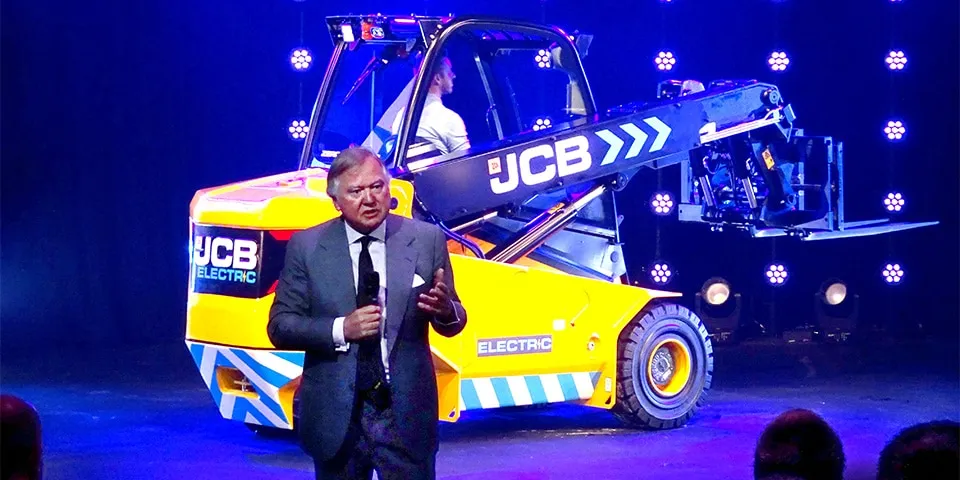
Lord Bamford explains to the European trade press why the fully electric Teletruk 30-19E is such a major step forward.
Smaller updates
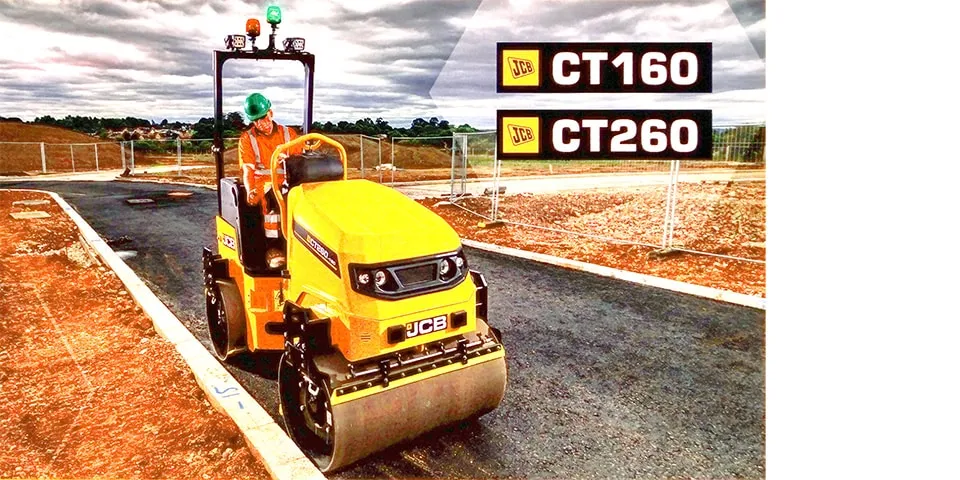
There is plenty of smaller news worth mentioning, including the two compact CT160 and CT260 vibratory rollers. There is a choice of two drum widths, visibility of the drums has been improved and the rollers are easy to operate. The dumper range has gained a second 6-tonne model, the 6T-1HiViz. Its safety features match the high standards of last year’s 7-tonne HiViz, and visibility has been improved further without adding sensors or cameras. A lower centre of gravity has increased stability. It can also be fitted with JCB’s SiteSafe cab.
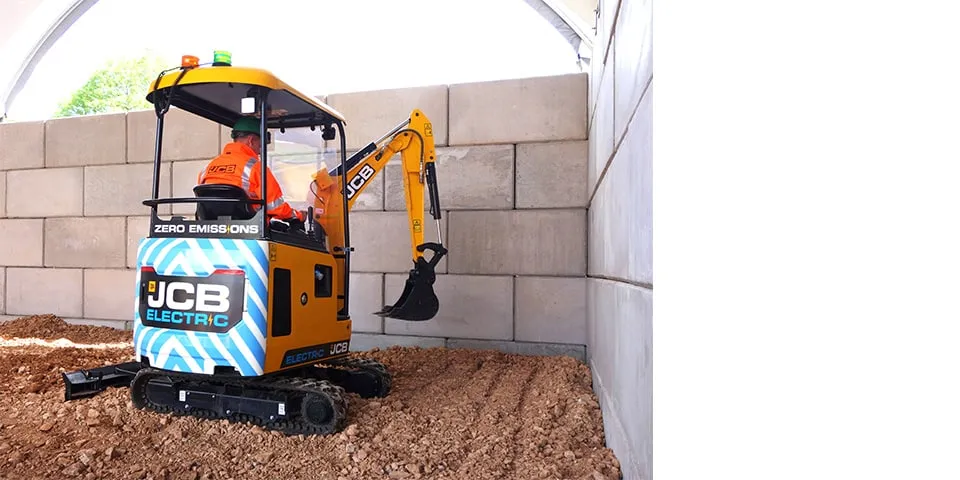
The electric 19C-IE mini excavator, shown as a prototype last year, will actually be available to buy later this year.
Cleaner diesel engines
JCB maintains that diesel engines will be in use for a long time to come, but they must of course be very clean. The company is working hard towards that goal. Its own DieselMax engine range is fully ready for Stage V and is already fitted to the necessary machines. JCB calls it ‘almost zero emission’, a bold claim that reflects its statement: “We want to be part of the solution, not the problem.” JCB has now produced a quarter of a million diesel engines, so the stakes are high. It was also announced that JCB will henceforth use Cummins diesel engines in its heavier machines.
The assembled trade press were given a tour of JCB’s impressive Uptime Center at its headquarters in Uttoxeter (UK).
Digital tools
Uptime is the buzzword of 2019. At JCB, it is increasingly the starting point for customer relations. JCB machines are reliable by design, and that reliability needs to be proven in practice. This can be achieved through extensive monitoring of machine data. JCB has Uptime Centers at five locations around the world, soon to be six, where customers are helped to keep their machines working 24/7. JCB’s LifeLink system has been supplemented with an ‘Operator app’ (the iOS version is already available, with Android to follow later this year) and a fleet management system.
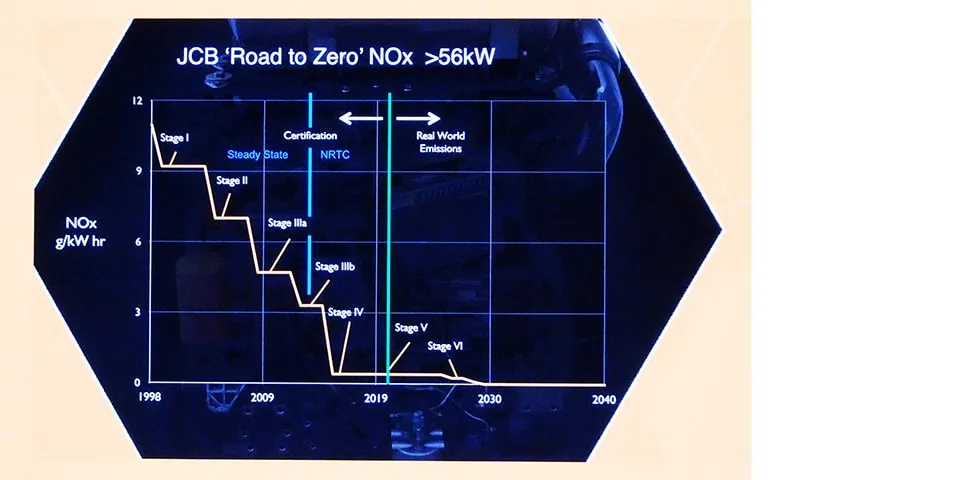
JCB calls the Stage V version of its own DieselMax engine ‘almost zero emission’ and this graph shows how close we have come to that point.
Question about this story? Ask your question
Keep following this
Get an email when a new story is published. No account needed.
- ThemeConstruction equipment and transport in motion
- SubjectBouwMat







