









A sustainable route to road safety
We are seeing increasing use of glass road studs as road surface reflectors. Glass road studs are certainly not new, but interest in them has never waned. With sustainability and light pollution now receiving ever more attention, they could be an ideal solution.
Van Wylick Wegdekreflectoren BV has been the specialist in glass road studs since 1993. First installed in a concrete paving slab as ‘De Steen Van Wylick’, the glass road stud already helped make roads safer. Now, 26 years later, the company has grown into an experienced family business. “The product is still highly relevant,” says Lisette van Wylick, daughter of founder Chris van Wylick and a member of the team. As an active member of the ‘Horizontale Markeringen’ Standards Committee, Lisette attends European meetings as the Dutch representative. “This is how we contribute to developing a standard that includes a proper assessment of glass road studs.”
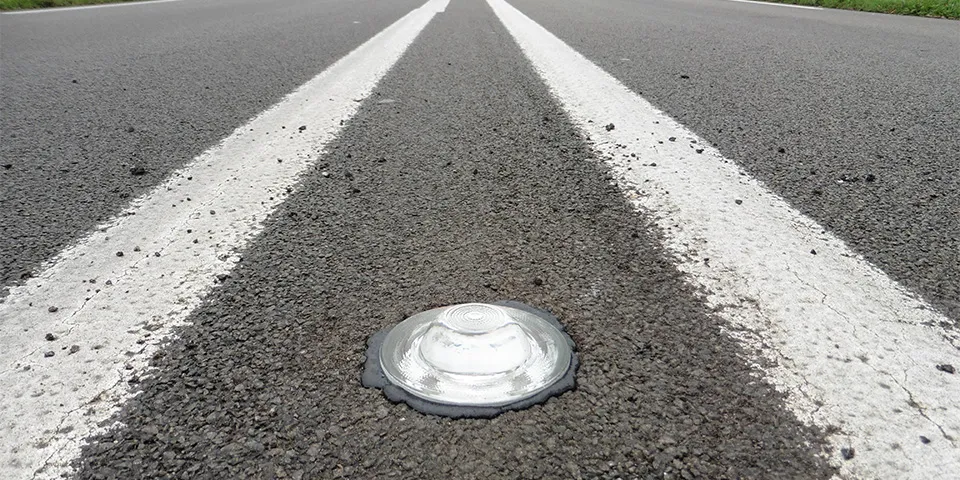
The strongest glass road stud, with a compressive strength of no less than 80 tonnes.
Making roads more sustainable
Van Wylick has noticed growing attention in the current debate to how municipalities and provincial authorities can become more sustainable. How can you save on energy costs and reduce CO2 emissions while complying with the Nature Conservation Act and maintaining road safety? Van Wylick has an answer: “Depending on the circumstances, it may be possible to dim or even switch off street lighting by installing our LUX glass road studs. This also addresses the Nature Conservation Act’s aims on light pollution: reflectors when they are needed, then darkness again, as it should be.”
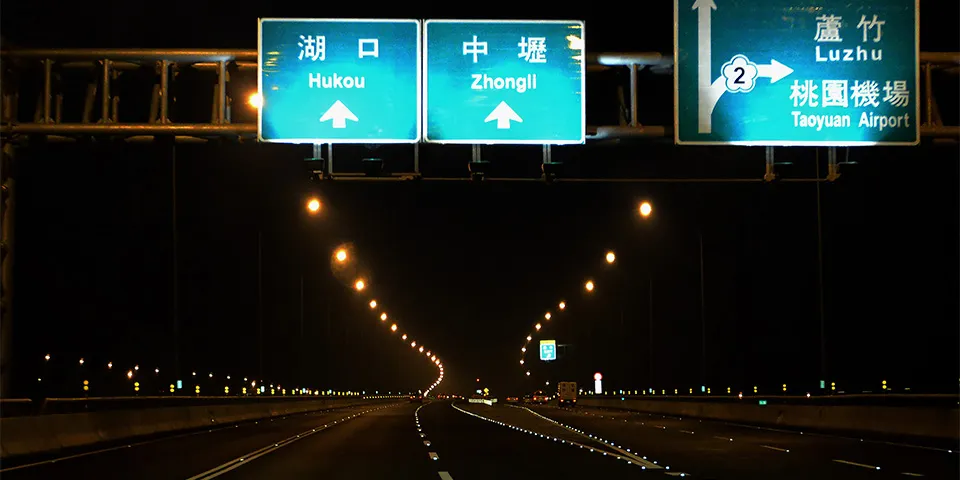
Glass road studs have been used abroad for some time, including on motorways such as this one.
Safety first
“Glass road studs are clearly visible in the dark, as well as in the rain and in bright sunlight. They are already widely used on motorways in several countries. In the Netherlands, the provinces of Flevoland and Overijssel are the main users, applying glass road studs as standard. Other provinces use them only at specific locations, such as roundabouts. It would be a positive development if the ongoing research by the knowledge platform showed that our glass road studs really do play a significant role in the safety and lighting of public roads,” says Van Wylick. “If guidelines are introduced, other provinces will undoubtedly follow.”
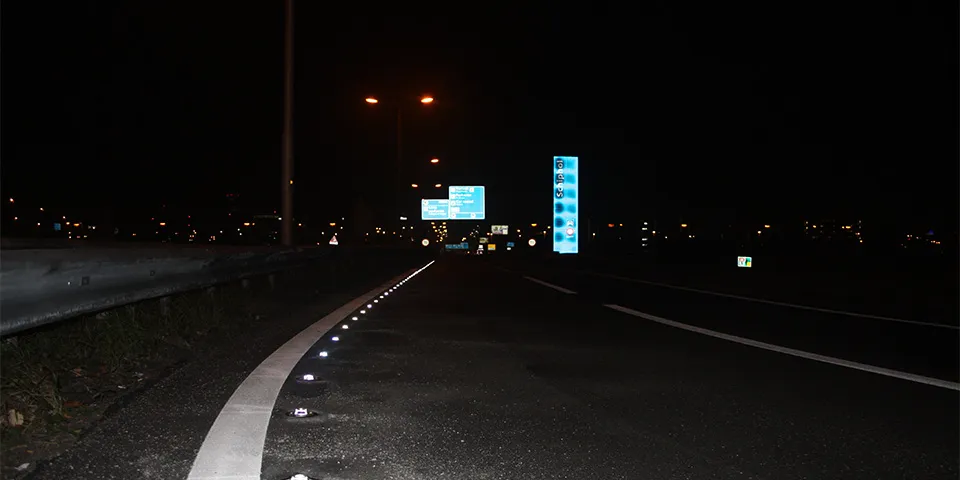
Schiphol exit, LUX glass road studs installed to maximise road safety on sharp bends.
LUX glass road studs, the perfect solution for separating carriageways and traffic directions
“Glass road studs reflect through 360 degrees and are clearly visible in the dark, as well as in the rain and in bright sunlight.” Van Wylick continues: “They require no maintenance because the solid glass does not attract dirt and is kept clean by rain. Rain often leaves a film of water on the road surface, but this does not affect our glass road studs, which remain clearly visible.” The LUX glass road studs have an exceptionally high impact strength, at no less than 80 tonnes, so they can be driven over at all times. They can also withstand snowploughs, provided the blades have rubber edges. “Tests have shown that under normal use they outlast the asphalt, do not come loose and, crucially for road safety, retain their reflectivity.”
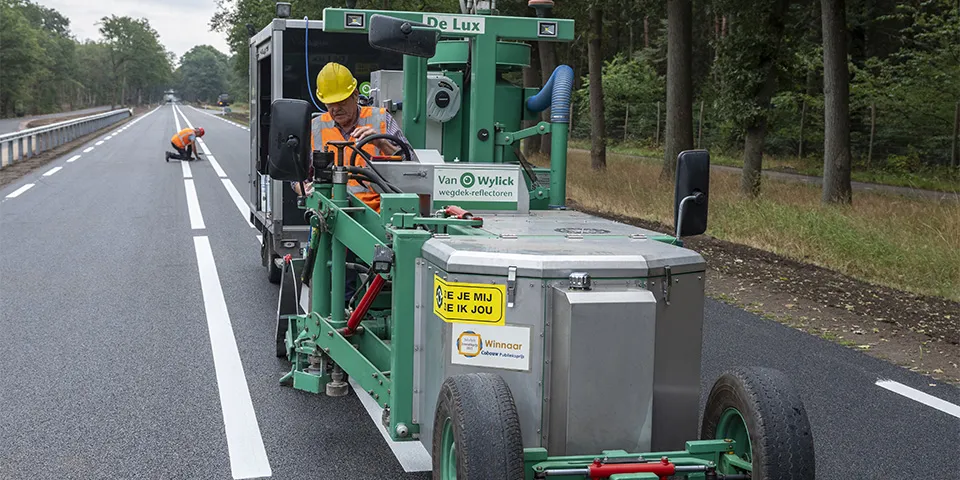
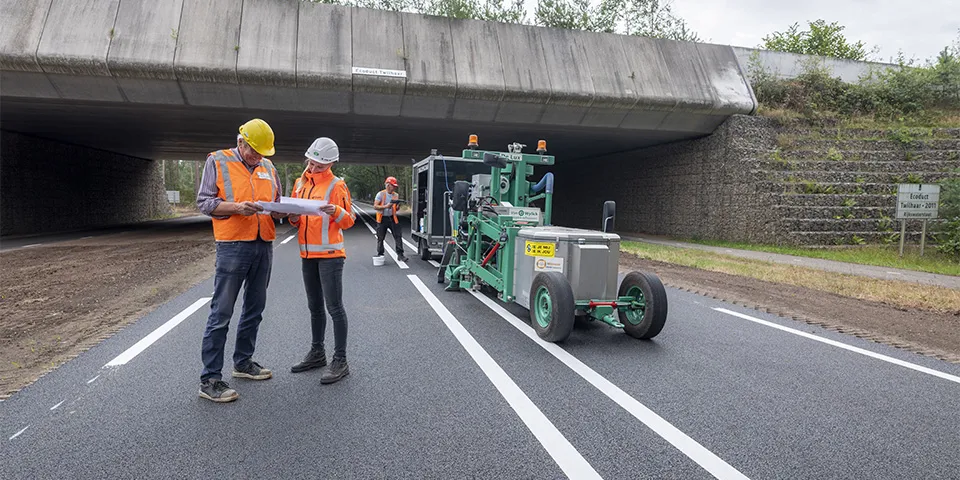
A purpose-built Van Wylick machine enables high output and precise installation of LUX glass road studs. Here it is being used on Rijksweg N35.
Fast, professional installation with a purpose-built machine
Van Wylick uses a specially developed machine to install glass road studs quickly, professionally and accurately in asphalt and concrete elements (see cover photo).
Een zakelijke vraag aan Van Wylick wegdekreflectoren BV? Get in touch
Companies in this story
Keep following this
Get an email when a new story is published. No account needed.
- ThemeExtending the life of roads and civil engineering structures
- SubjectBouwMat
- CompanyVan Wylick wegdekreflectoren BV







