









A new method for assessing non-water-retaining objects on primary flood defences
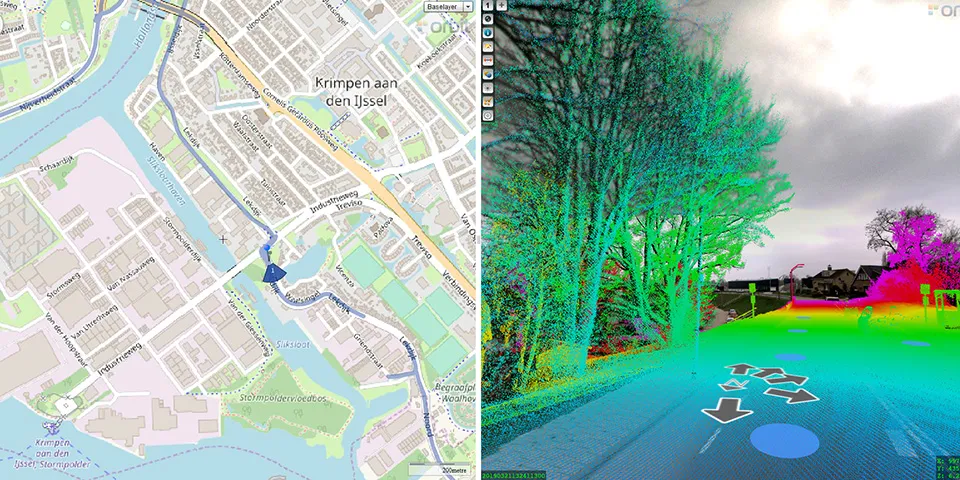
In the Netherlands, primary flood defences must undergo safety assessments every few years. Since 2017, a new assessment system has been in place: the Statutory Assessment Instrument (WBI) 2017. The assessment also covers non-water-retaining objects (NWOs) located on a flood defence, such as trees, buildings, cables and pipelines. These objects can affect the safety of the flood defence. For example, if a tree falls and leaves a scour hole, this can cause instability and damage to the protective covering.
However, the assessment tools for NWOs have not yet been fully developed, and are not suitable for dealing with large numbers of objects. So how do you assess thousands of objects? Is there a smart way to approach the task and make it manageable?
6,000 trees and 3,000 buildings
Hoogheemraadschap Schieland en de Krimpenerwaard (HHSK) has around 6,000 trees and 3,000 buildings on its 70 kilometres of primary flood defences. That is far more than at most other water boards, owing to the densely built-up urban area in the region. All these objects must be assessed against the new statutory safety standards by 2023. HHSK held a market consultation to find out how companies in the sector viewed the problem. Following the consultation, HHSK defined the requirements for the assignment and put it out to tender. Iv-Infra and Tauw won the contract and are currently developing a method for assessing large numbers of objects efficiently.
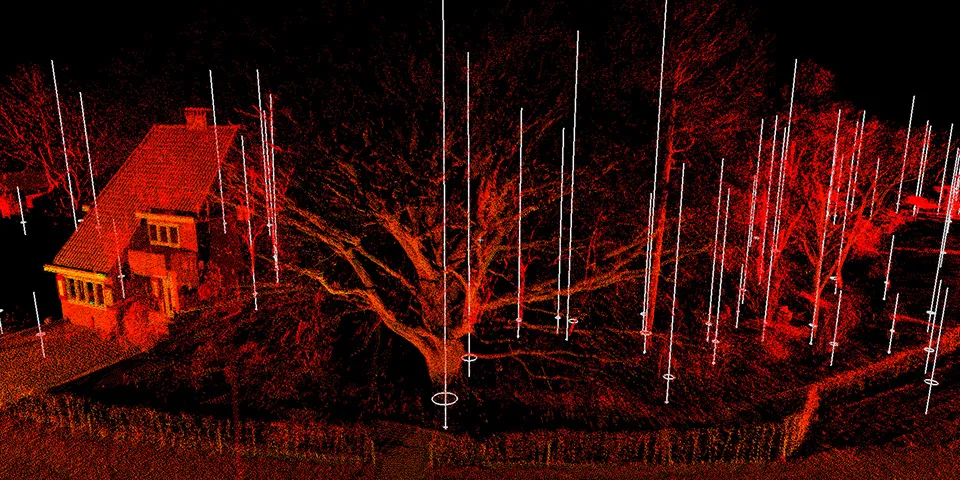
Trees are identified as such.
A reliable and efficient method
Given the large numbers involved, it is important that objects can be assessed efficiently and that the method is traceable and reproducible, so it can also be used in future assessment rounds. The reliability of the new method is another key consideration, since safety is at stake. But how can reliability be demonstrated? Iv-Infra and Tauw’s method is based on three pillars: securing information, applying knowledge and expertise, and automation.
Securing information
The water board’s existing data is verified and validated, and supplemented where necessary. The digital register contains details of the objects, but these are subject to change. Trees grow or are felled, and houses are demolished or newly built. To update the register, Iv-Infra’s unique mobile scanning vehicle was used to map the non-water-retaining objects accurately. Exactly where is the tree, how tall is it, and what is its trunk diameter? These details can be measured easily with the scanning vehicle. With this additional information, objects can be approved quickly, for example when it can be shown that their dimensions are so small that any potential failure would have no impact on flood safety. This makes the assessment of all non-water-retaining objects more effective and efficient.
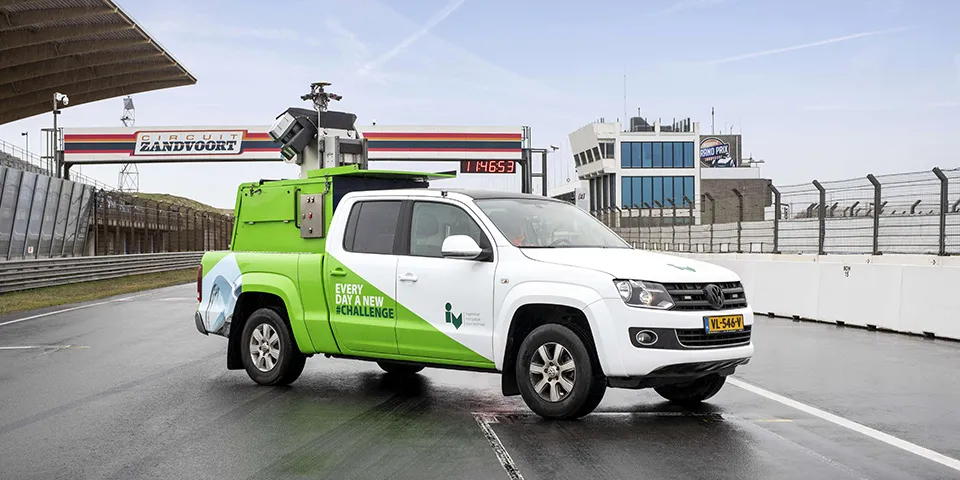
The specialised scanning vehicle.
Applying knowledge and expertise
Iv-Infra and Tauw have extensive experience assessing primary and regional flood defences, and are currently working on several projects involving non-water-retaining objects. The specialist knowledge gained through this work is now being brought together and applied in the development of this new method. Rather than adhering rigidly to rules and guidelines, the teams also apply practical judgement. For example, would a falling tree really increase the risk of piping if it is behind a toe ditch that is deeper than the potential scour hole?
Automation
The assessment process is automated as far as possible to make it as efficient as possible. The large volumes of GIS data collected from the existing database and the scanning vehicle are supplemented with up-to-date elevation data captured by helicopter. Specially developed GIS scripts then determine the relevant parameters for each object, and use these to carry out the simple assessment automatically. Automating the process reduces the risk of errors and cuts down on labour-intensive tasks.
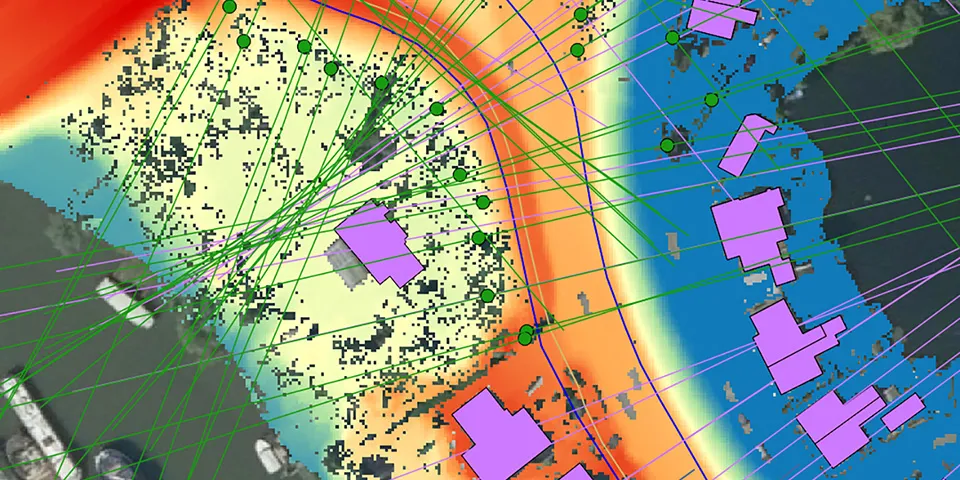
GIS data visualisation.
Assessment in two stages
Non-water-retaining objects are assessed in two stages. The first is a simple assessment, which is almost entirely automated (around 90%). The remaining 10%, involving drawing contour lines, checking data, validation and field spot checks, is carried out by advisers from Tauw and Iv-Infra. To avoid a labour-intensive process, the aim is to approve as many objects as possible through the simple assessment. However, additional calculations will inevitably be needed for some objects. These are covered by a detailed assessment, in which objects are grouped into clusters and the governing object in each cluster is assessed using additional calculations. The assessments are followed by a decision: is the NWO safe or not? HHSK then takes any necessary measures based on this safety assessment.
Towards an individual assessment of every non-water-retaining object
Developing this new method has involved analysing all the available data in depth, collecting additional information and devising innovative solutions. The process is still under development, but progress towards the final method is good. The reliability and traceability of the data, and the reproducibility of the method, are paramount. This will ensure that the data can also be used in future assessments or reinforcement projects. Although bespoke work will still be required, developing this method marks an important step towards an accurate safety assessment of every non-water-retaining object, whereas previously only a generic assessment was possible.
Question about this story? Ask your question
Keep following this
Get an email when a new story is published. No account needed.
- ThemeFlood protection and climate-resilient water management
- SubjectBouwMat







