









Plastic fire main for the Nieuwe Sluis in Terneuzen
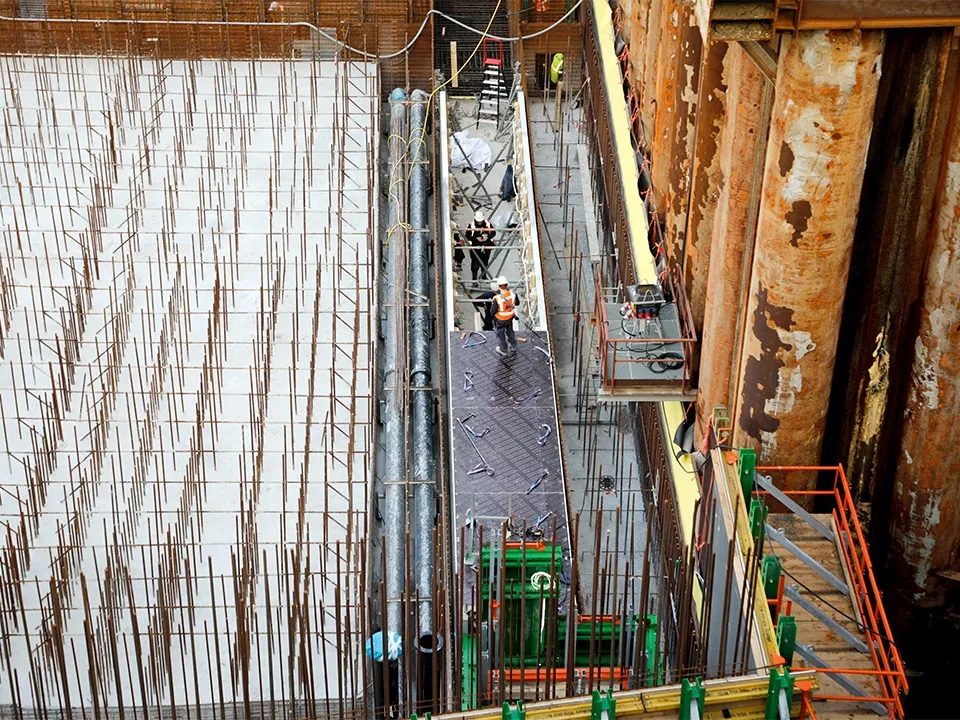
You would rather not imagine a fire breaking out at the Nieuwe Sluis in Terneuzen. If it does happen, however, the fire mains installed as part of the project will be available. The supplier of the HDPE fire mains is plastics engineering company RKT from Tholen. We speak to Pascal de Viet and Fabian van Oosterbosch of RKT.
Ready for use at all times
At the time of the interview, the crossing pipe at the outer head had just disappeared from view. Van Oosterbosch: “This pipe runs through the concrete from wall to wall. Work is now under way to raise the structure. Each time the opportunity arises, we are called in to extend the pipes at four points. So we work to the project schedule. We test the pipes after each raise by pressurising them and keeping them under pressure while the concrete is poured. Once a pipe has been declared 100% leak-tight, we release it.”
Pipes embedded in the concrete are installed in duplicate, leaving a spare pipe for future use. De Viet: “This means a backup pipe is always available in an emergency, or can be brought into service if more capacity is needed.” RKT normally looks at whether some of the pipework can be prefabricated in its workshop. This project is an exception. Most of the pipework is prefabricated on site, so that only the joint welds need to be made at the bottom of the lock,” explains van Oosterbosch.
Additional pipes added
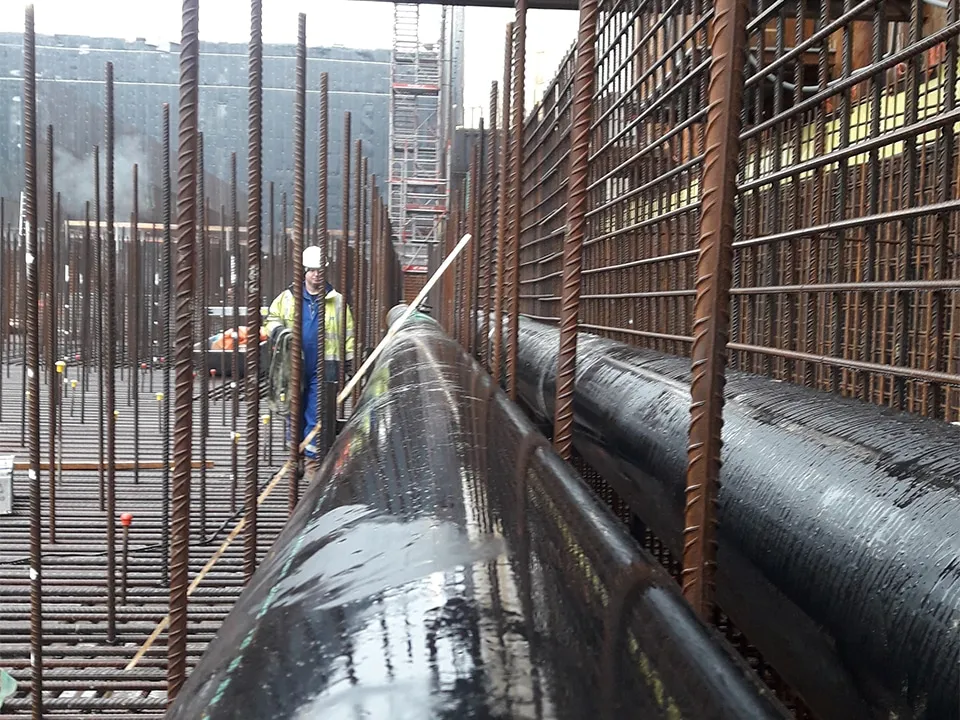
At the outer head, the Ø355 pipes are already in the ground and work is progressing at pace to raise the structure. “Our scope has since been expanded to include more pipes, and we have also been asked to install the measuring tubes in PE. These are located in the walls and are used to measure the water level. They will be installed later,” says De Viet. “The installation method is the same as for the fire mains, but the testing procedure is less stringent and uses lower pressure.”
RKT Tholen is a full-service supplier that likes to help develop solutions. It supplies and installs the materials and carries out the welding itself. “That involves quite a range of disciplines. We have our own quality officer who takes care of all the paperwork for projects like this,” says De Viet. “Our work on the fire main consists of three phases. The first was the outer head, in the concrete floor. The second phase, at the inner head, is the same as phase 1. The third phase involves laying the ring main around the lock at ground level, as well as supplying and installing various hydrants.”
Question about this story? Ask your question
Keep following this
Get an email when a new story is published. No account needed.
- SubjectUnderground infrastructure







