









Pipe jacking in the Peel!
The Burning Man is well known to many as the festival held in the desert near Las Vegas. But in Uden, TBM is the name of a company that operates biomass plants to produce sustainable heat.
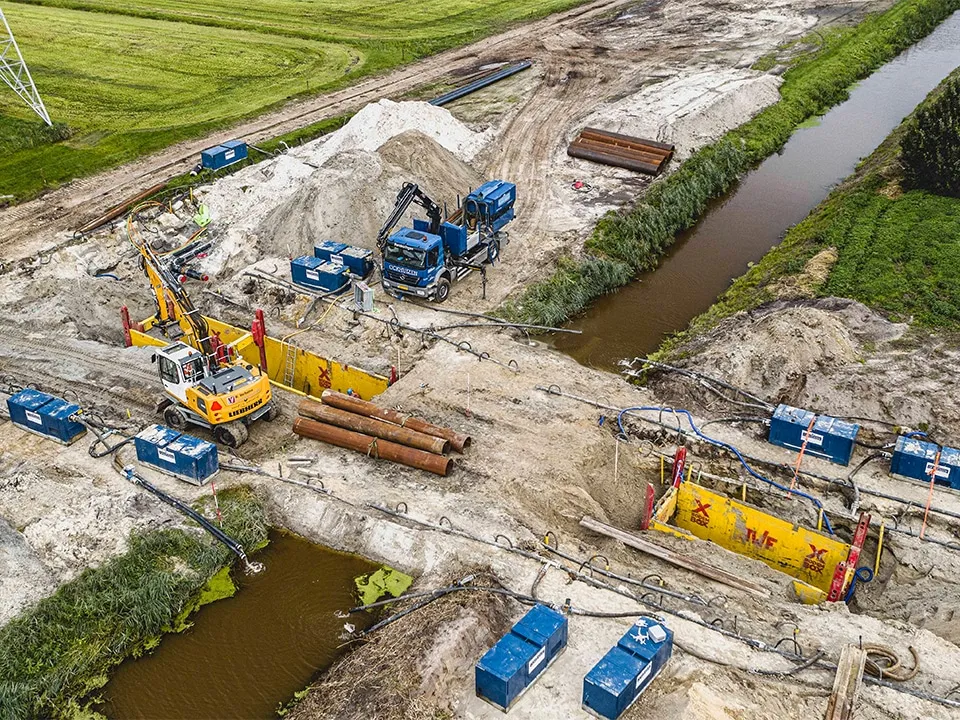
Glasshouse horticulture is a sector with high heat requirements, making growers dependent on gas. This is also the case on Waardjesweg in Asten-Heusden, where a group of vegetable growers runs several glasshouses. TBM has provided a sustainable alternative with a biomass boiler. Such a boiler requires heat pipelines, so Hurkmans was brought in.
We speak to Luke van de Ven, a fourth-generation member of Hurkmans Groep and an infrastructure man through and through. Luke tells us that Hurkmans is laying a heat pipeline between the various glasshouses. Hurkmans was asked to deliver the entire project, including traffic management, wellpoint dewatering and pipe-jacking operations. The Hurkmans Groep handles all of this in-house.
Pipe jacking
At several points, the pipelines cross the stream ‘de Aa’. Various options were considered, including directional drilling, auger boring and open-cut excavation combined with a temporary pumping system. After weighing up the options, Hurkmans called on its sister company Ockhuizen to assess whether pipe jacking combined with dewatering would be feasible. Pipe jacking is one of Ockhuizen’s specialisms. The company is best known in the industry for its wellpoint dewatering work. Luke would like to change that perception, as Ockhuizen now has two fully equipped pipe-jacking teams. Its expertise in ground drilling and wellpoint dewatering means it can offer a complete package.
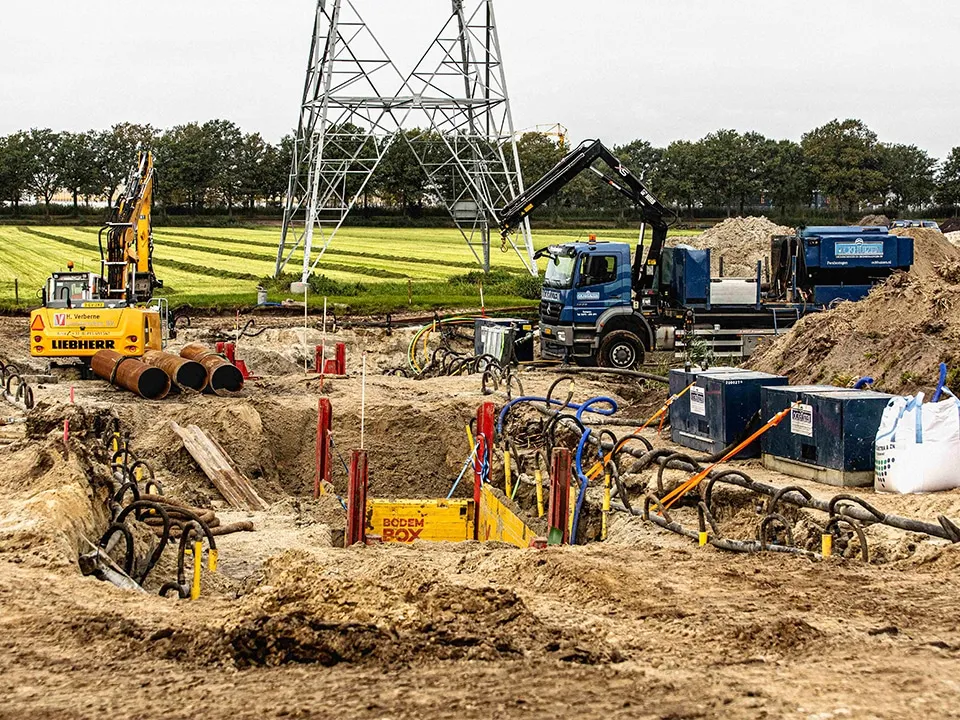
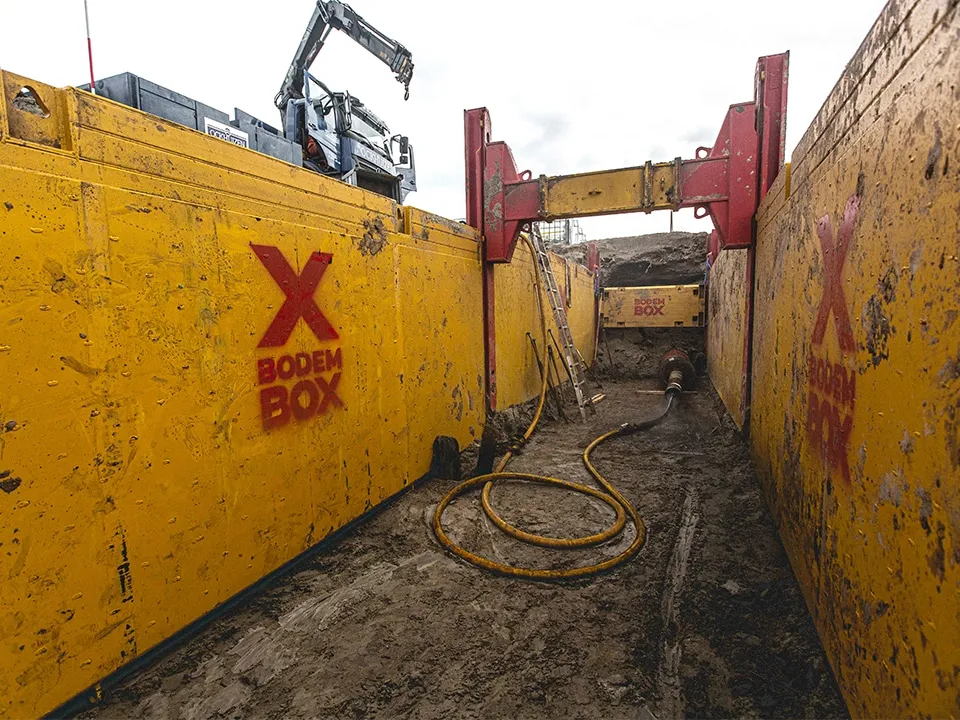
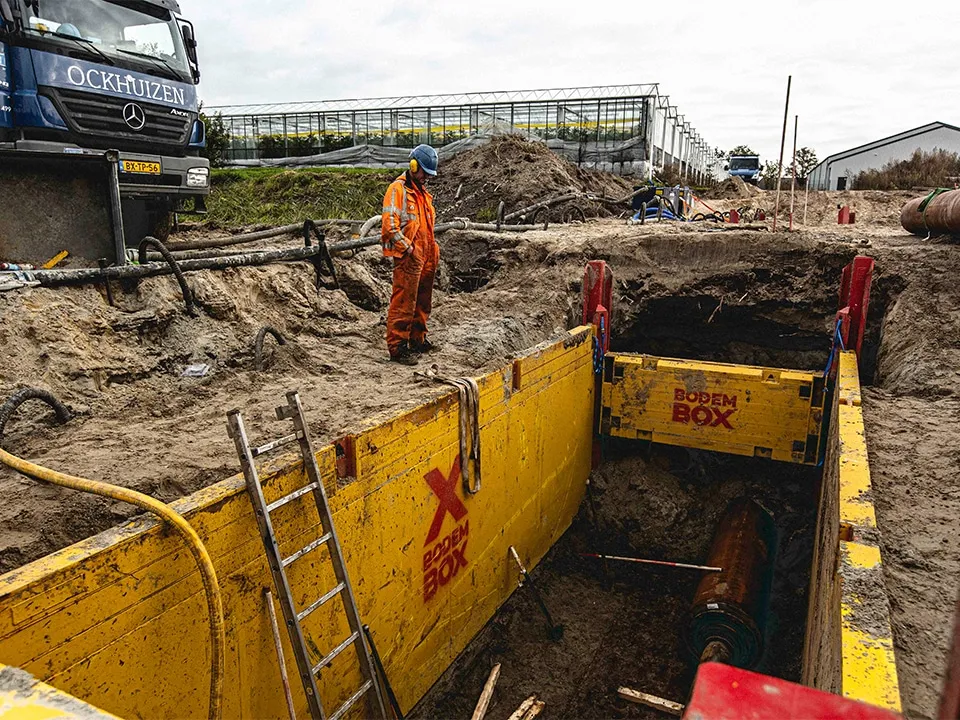
In Asten-Heusden, it was more efficient to carry out the crossings using 2 pipe-jacking operations with a diameter of 610 mm over 20 metres and 2 with a diameter of 610 mm over 30 m. The pipe jacking was not straightforward, but was ultimately completed successfully, thanks in part to the use of a BodemBoX system. The project site has soft ground with low bearing capacity, making it unsuitable for working with battered excavation sides. In addition, jacking causes vibration, making open-cut excavation with soft sides less than ideal from a safety perspective. The team therefore opted for a safe excavation within a BodemBoX system. Using a single-guided roller-slide BoX system, Hurkmans was able to create a jacking pit and a reception pit on each side of the Aa for the pipe-jacking operations.
Raising awareness of pipe jacking
For Ockhuizen, this is a routine job, as the company is part of the select group that carries out pipe-jacking operations for Synfra. Stichting Synfra is a partnership between Enexis, Brabant Water and WML Limburgs drinkwater. As a subcontractor to the chain partners, Ockhuizen carries out a large number of pipe-jacking operations. Luke nevertheless feels that the market is still not sufficiently aware that Ockhuizen offers pipe-jacking services, so he is working hard to raise the company’s profile.
When we ask Luke about Ockhuizen’s future, he replies without hesitation: “digitalisation”. Ockhuizen is developing an app that will give customers full insight into the operation of their dewatering system. The company already uses pressure transducers in monitoring wells to record groundwater levels continuously and display them digitally in an app. When the maximum groundwater drawdown is reached, the dewatering system can be controlled remotely, keeping the amount of groundwater abstracted to a minimum. In the near future, a similar app will also be made available to customers, and the entire process will be further digitised. Luke sees his own future out in the field, working on site: that is where his passion lies.
Question about this story? Ask your question
Keep following this
Get an email when a new story is published. No account needed.
- SubjectUnderground infrastructure







