









How It’s Made: Ground anchors with double corrosion protection
Text Roel van Gils Image DYWIDAG
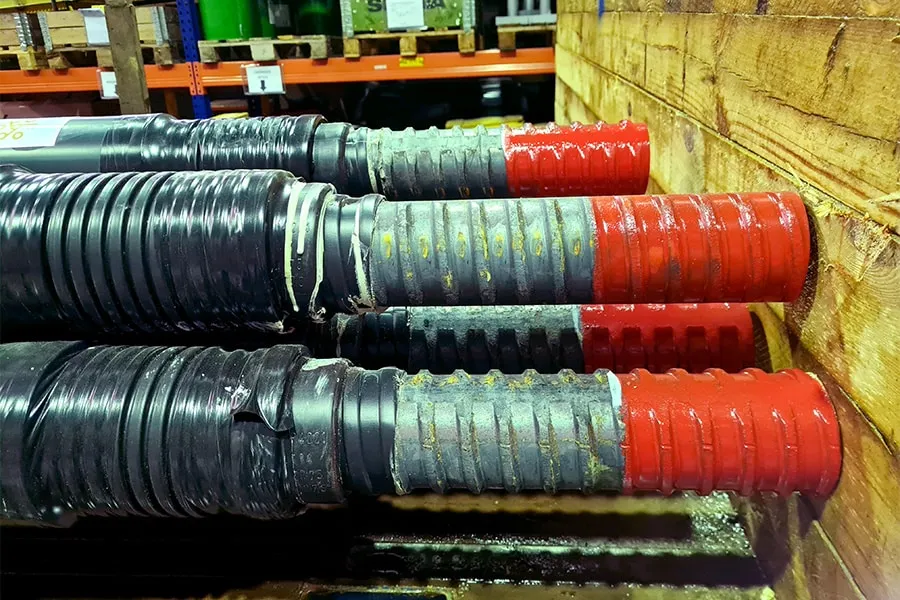
In practice, often the only part of a ground anchor you can still see is the anchor head on the sheet pile wall. But there is a whole process behind it. For our ‘How It’s Made’ series, this time we visit DYWIDAG’s production site in Zaltbommel, where we witness the manufacture of extremely large ground anchors with double corrosion protection.
Ground anchors are often enormous and heavy. “A typical anchor consists of bars 13 to 14 metres long, with diameters of 50 to 63 millimetres,” says Robert Jansen of DYWIDAG. “Depending on the project, they are coupled to achieve greater lengths.” For a special project just across the border, DYWIDAG is departing from standard sizes and producing anchors with a diameter of 75 millimetres and a total length of no less than 36 metres. And as if that were not special enough, the bars are encased in double corrosion protection.
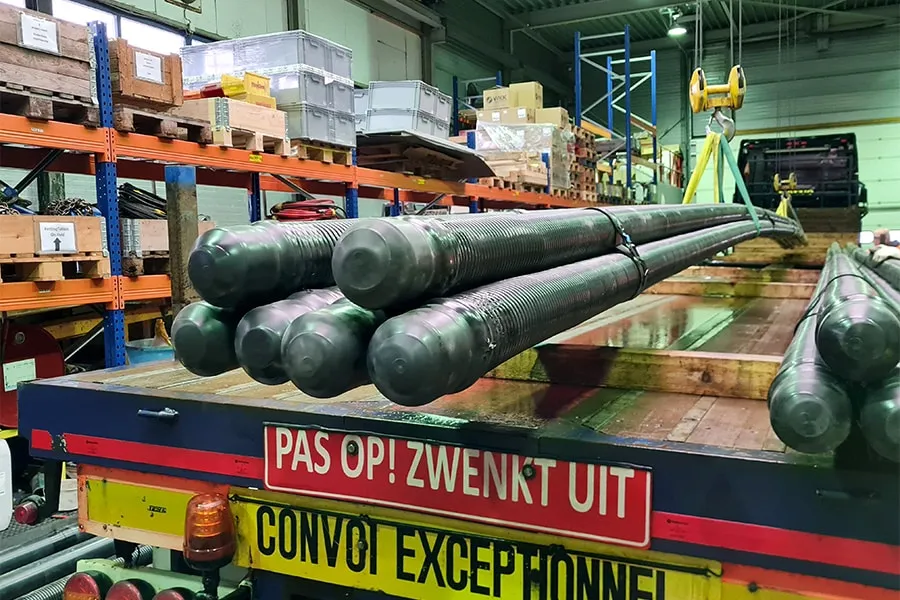
PE pipe
Only a handful of companies can produce so-called DCP anchors with double corrosion protection. DYWIDAG is even the only company to manufacture them in the Netherlands. Robert gives us a behind-the-scenes look at the production site in Zaltbommel. “The DCP anchors we are currently producing consist of two coupled bars, each 18 metres long and 75 millimetres in diameter. The combined bar is then inserted into a ribbed PE pipe. The void is filled with a special injection grout. Finally, a smooth PE pipe is slid over the ribbed pipe. Together, these provide double corrosion protection.”
Craftsmanship
Inserting a coupled bar into a PE pipe is no easy task, let alone having to repeat the process and then inject the grout as well, says Robert. “It takes considerable craftsmanship. And we have mastered the technique better than anyone, as you can see.” DYWIDAG is producing a total of 125 coupled DCP anchors for this project. “It’s a major job, but we are equipped for it. That said, with these sizes we are pushing the limits of our production capacity.” The first DCP anchors in the series have already been delivered to a satisfied customer.
DCP anchors are often used to anchor sheet pile structures or concrete floors. “Think of it as a tension anchor installed to hold a structure in place,” Robert explains. “On site, the anchor is drilled in and then almost entirely disappears from view. Only the tip, the anchor head, remains visible.” Now we know what lies behind it and how the anchor is made and protected against corrosion.
Question about this story? Ask your question
Keep following this
Get an email when a new story is published. No account needed.
- ThemeMaterials and techniques for infrastructure
- SubjectUnderground infrastructure







