









‘We are integrating the energy transition into our business operations’
Text Roel van GilsImage Verboon Maasland
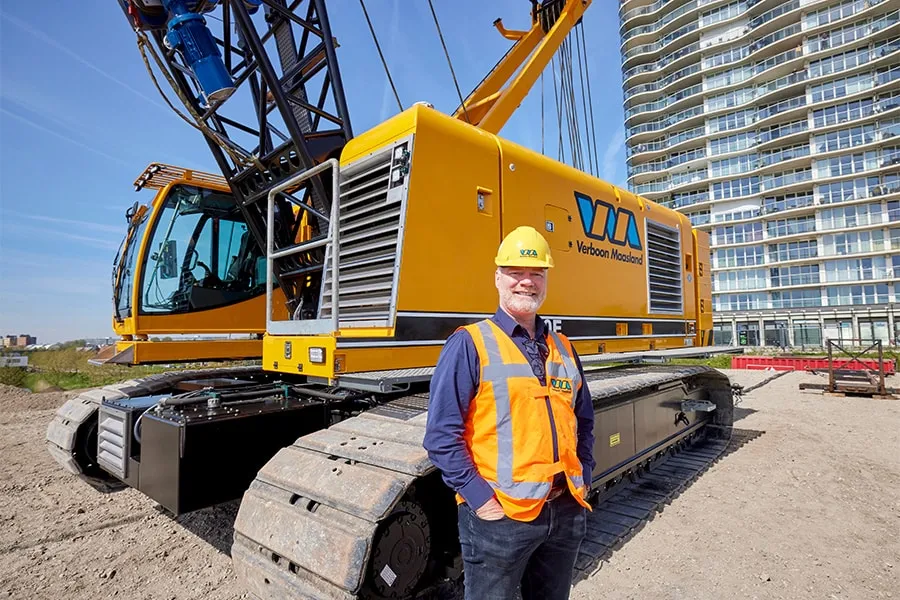
Verboon Maasland is taking a company-wide approach to making its operations as sustainable as possible. “In the current era of CO2 and nitrogen emissions reduction, we are able to carry out many of our specialist activities completely emission-free,” says managing director Ruud van Wijk. “We are taking responsibility and integrating the energy transition into our business operations. Now it is up to our clients.”
Delivering sustainable infrastructure and water engineering projects is now part of Verboon Maasland’s DNA. “We are making great strides in sustainability, and we have not only come up with ideas, but also developed a clear policy,” says Ruud. “The world around us is changing faster than we think. Whenever we replace a piece of equipment, we switch to a sustainable alternative. This is a deliberate part of our policy. For now, that means electric, but in future it could just as well be hydrogen or another energy source.”
Adjusting budgets
Quite a number of projects are currently on hold temporarily because of nitrogen emissions restrictions. “With emission-free equipment, it may be possible to start work on such projects before too long. But we cannot do this alone as a contracting industry. We really need the government to provide room to manoeuvre and subsidy schemes, so that contractors investing in emission-free equipment are not doing so for nothing,” says Ruud. “Budgets need to be brought up to date. Projects are still too often put out to tender with budgets dating from 2017-2020. These do not take into account the fact that contractors now have different financial operating costs because they are investing in electric equipment. The old prices are no longer appropriate. Budgets need to be adjusted accordingly. And, if a client genuinely wants a project to be delivered sustainably, they will also have to pay for it and allow for the price level associated with emission-free construction. An electric crane or lorry can cost one and a half to two times as much to buy.”
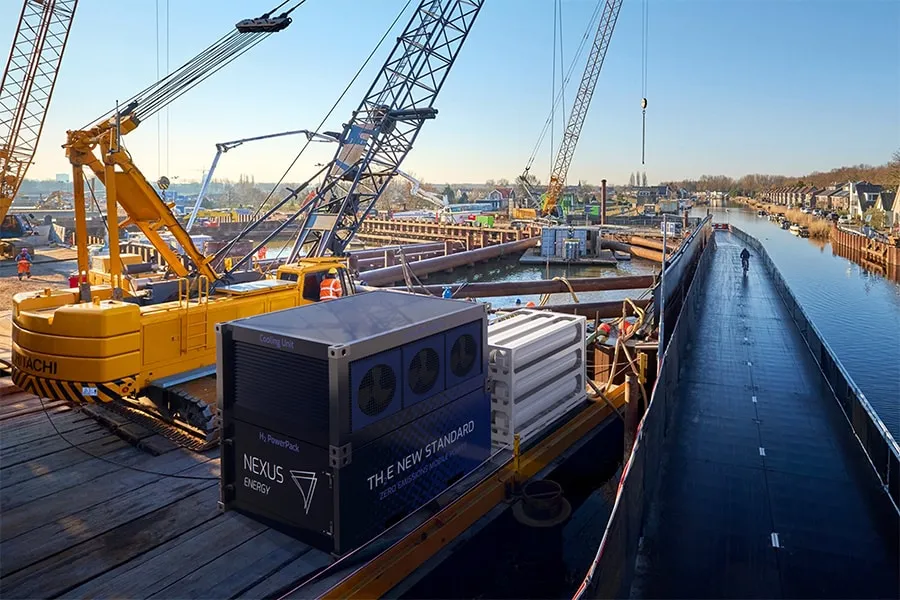
Ruud is only too happy to give us a look around the plant fleet. We see, among other things, an electric cutter suction dredger, a 100-tonne electric cable excavator, two electric 8×4 lorries, a 23-tonne electric excavator, an electric push boat, electric cars, vibrating plates and more. “We already have a sizeable fleet that can operate emission-free. And this summer we added a hydrogen fuel cell, which can supply enough power for our electric cutter suction dredger or our 100-tonne electric cable excavator. So we can work completely emission-free even at sites without a shore power supply. We have integrated the energy transition into our business operations. Now it is up to the government to integrate it into project delivery objectives,” Ruud says firmly.
Question about this story? Ask your question
Keep following this
Get an email when a new story is published. No account needed.
- ThemeLower emissions and more reuse
- SubjectYearbook







