









Stainless steel tie cables are a vital link in jointless transitions
Text Roel van GilsImage Carl Stahl Benelux
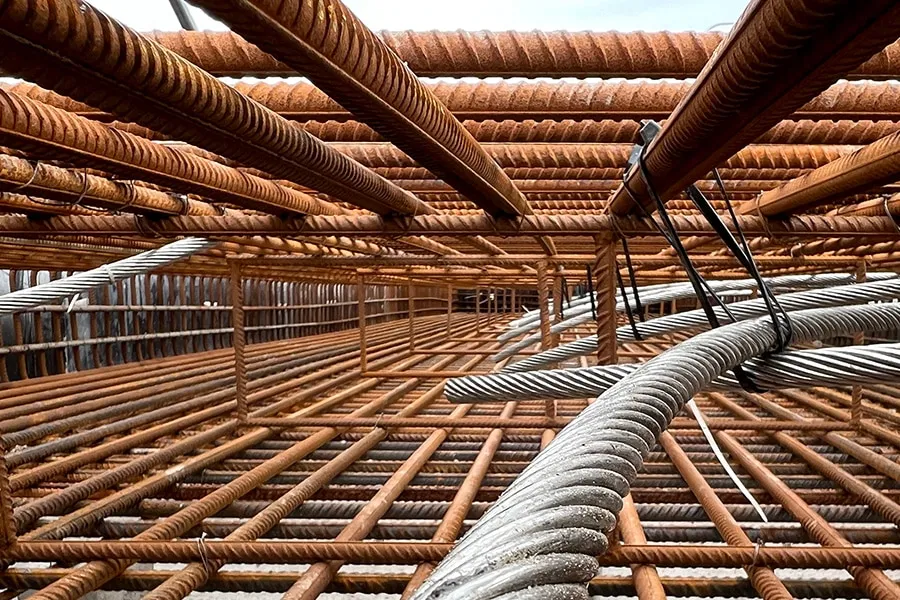
Jointless transitions, in which the abutment is structurally connected to the deck, are increasingly being used on structures on provincial roads and motorways. Stainless steel tie cables are a vital link in these transitions. Carl Stahl supplies these robust cables as a ready-to-install product for road contractors, fully compliant with the technical specifications set by Rijkswaterstaat.
Cracks can form where the transition slabs or floors of a structure meet the abutment. Traditionally, joints have been used here, but increasingly the transitions are jointless, with the various sections joined to form an integral structure. Stainless steel tie cables connect the transition slabs, which lie in front of and behind a structure (a concrete construction), to the rest of the concrete structure. The continuous structure is then better able to withstand temperature fluctuations, vibration and deformation. This in turn means a longer service life, less maintenance, less noise nuisance and greater aesthetic appeal.
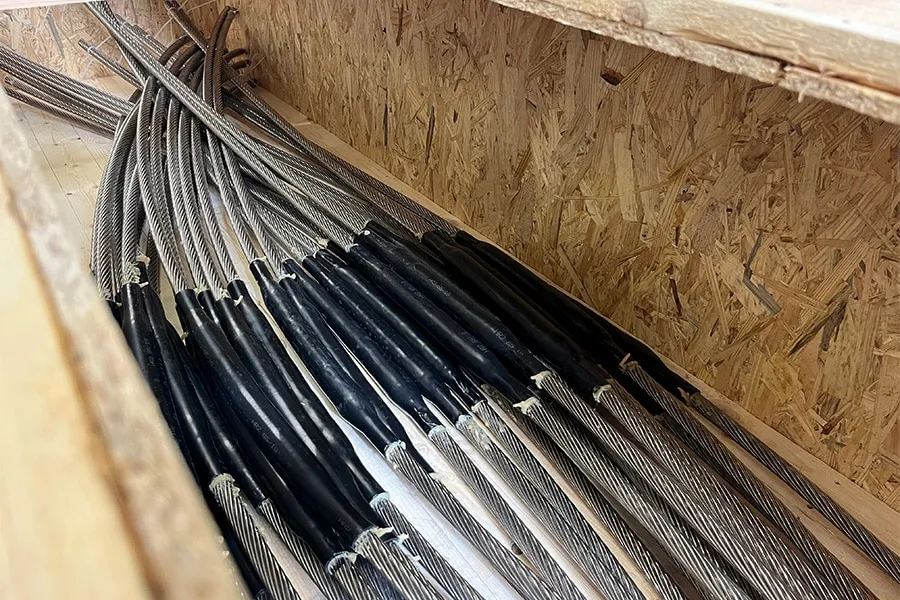
Made-to-measure stainless steel tie cables
A jointless transition leaves minimal space between the abutment and the deck. The expansion joint between the deck and the abutment prevents the concrete from cracking, while the stainless steel tie cables prevent the deck and abutment from shifting or settling, keeping everything in place. Specifically for jointless transitions, Carl Stahl manufactures these stainless steel tie cables to order in lengths of 3.50 metres. In accordance with Rijkswaterstaat specifications, the cable has a diameter of 22 mm and consists of 1×19 wires twisted together. This creates a notably rigid construction that does not bend easily. A 600 mm length of Densoband is then applied at the centre of the cable, inside a protective plastic heat-shrink sleeve, to absorb stresses caused by rotation of the deck. These preparations result in a complete, ready-to-install product for road contractors.
A value-added wholesaler
Carl Stahl is a leading specialist wholesaler operating in the Netherlands and abroad, with its head office in Germany. The company has been in business since 1880 and has built up extensive knowledge and expertise worldwide in working with stainless steel cables. For the Dutch market, these are supplied to road contractors as fully custom-made products. In addition to stainless steel tie cables, Carl Stahl supplies the infrastructure sector with stainless steel grab lines along quay walls, with or without a plastic coating, cables to prevent resonance in bridges, and stainless steel cable nets for fencing and/or fall protection around infrastructure and car parks. Carl Stahl is also happy to work with you on bespoke applications and ideas.
Question about this story? Ask your question
Keep following this
Get an email when a new story is published. No account needed.
- SubjectYearbook







