Sustainable collaboration: recycling asphalt in situ
Text Roel van Gils Image Rijkswaterstaat
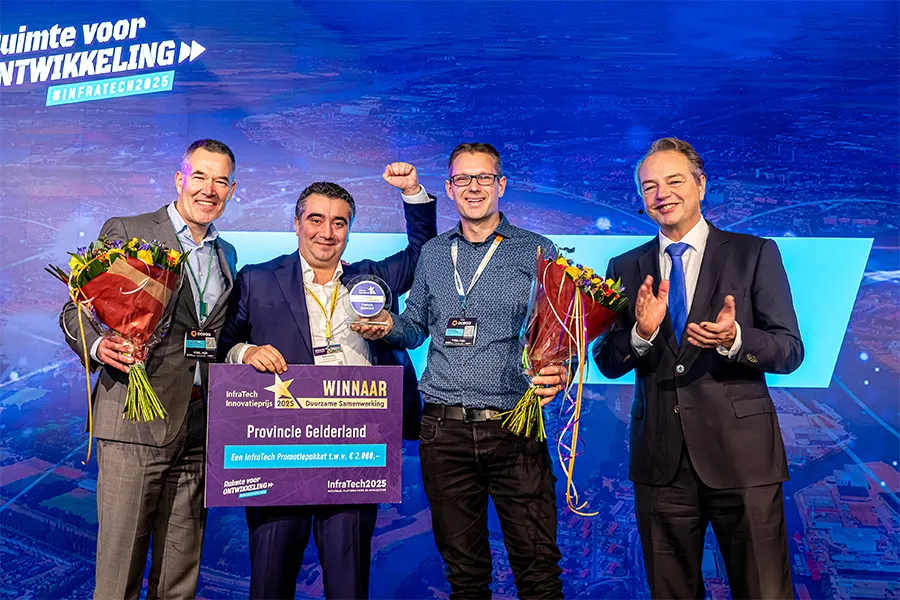
InfraTech Innovation Award 2025, sustainable collaboration category
And the award in the sustainable collaboration category of the InfraTech Innovation Award 2025 goes to: the Asphalt Recycling Train (ART). The ART is a series of machines that work in sequence, heating, loosening, mixing and relaying the asphalt. The ART makes road surface maintenance much more sustainable. The old asphalt is processed on site by the ART into new asphalt, contributing to an almost fully circular approach to road surface maintenance, with 100% reuse of materials. The ART also reduces emissions by an estimated 65%, because considerably fewer construction materials need to be quarried or transported.
According to Robbert Naus, product development manager at Dura Vermeer, the principle of a train that eats up old asphalt and spits it back out on the road as new asphalt is at least forty years old. “It is widely used around the world, particularly on routes with no asphalt plant nearby. Even in the Netherlands, we had an ART at the start of this century, but because sustainability and circularity were not taken into account in tenders, the machine was sold at the time. With demand for more sustainable solutions growing, we brought the concept back off the shelf in 2018. And successfully. A year later, we won Rijkswaterstaat’s competition for market-ready innovations in sustainable asphalt with the ART, and things started moving again.”
Sustainable collaboration
Rijkswaterstaat was not the only organisation interested in the ART. The province of Gelderland was also inspired by Dura Vermeer’s presentation about the ART at Asfaltdag 2023. “The current ecosystem we are caught up in is focused on costs, price and straightforward performance, whereas a sustainable paving sector should be driven more by value,” says Fredy Sierra Fernandez, strategic adviser on sustainable road pavements at Rijkswaterstaat. “In the current system, there is no incentive to reuse asphalt on site. That is why we felt the government should take this on, or at least play a part in it. There is also scope to invest in innovations that make asphalt use more sustainable. An investor was found who brought the ART to the Netherlands and gives contractors the opportunity to work with the machine. Dura Vermeer has the expertise to operate the ART. We funded a validation programme to learn how to use it, and the province of Gelderland made trial sections available. We came together quite naturally and agreed to roll out the concept further together.”
Sustainability strategy
The province of Gelderland has been working for many years to make construction materials more sustainable, reuse construction materials and reduce CO2 emissions. “Our sustainability strategy for circular infrastructure focuses on two approaches: stimulating the market and scaling up,” says Reinier Trommel, sustainability coordinator at Provincie Gelderland. “Stimulating the market means investing in technologies that are not yet market-ready but have considerable potential. At the same time, we want to apply proven technologies more widely. Both steps are needed to make progress on sustainability, because existing technologies alone will not be enough. The ART sits precisely between the two, and came our way at just the right time. The concept has not yet been fully validated, but it is not a new technology, so rapid scaling up is possible.”
Trial sections
Over the coming period, work will focus on validating the ART, which requires trial sections. “In the Netherlands, the ART is particularly suitable for use on motorways and provincial roads. That means three types of surface course,” says Robbert. “At least five trial sections must be laid for each of these surface courses to validate the process. The first pilot was carried out in March 2024 to test the machine. The ART was then used in Gelderland to replace part of the asphalt on the N315 provincial road. The next step is to monitor how the surface course performs and, of course, to lay many more trial sections.” There is already progress on that front: according to Fredy, Rijkswaterstaat alone has designated eight trial sections. “Several municipalities and provinces have also expressed interest,” he says. “The more sections we can lay and monitor, the more we learn. We are doing this for the whole sector, all the results will be made public, and any contractor can use the ART.” A truly sustainable collaboration.
Question about this story? Ask your question
Companies in this story
Keep following this
Get an email when a new story is published. No account needed.
- ThemeExtending the life of roads and civil engineering structures
- SubjectInfraTech
- CompanyInfraTech