Effective use of software for circular material use
Text Lisa Zeijpveld Images Esri
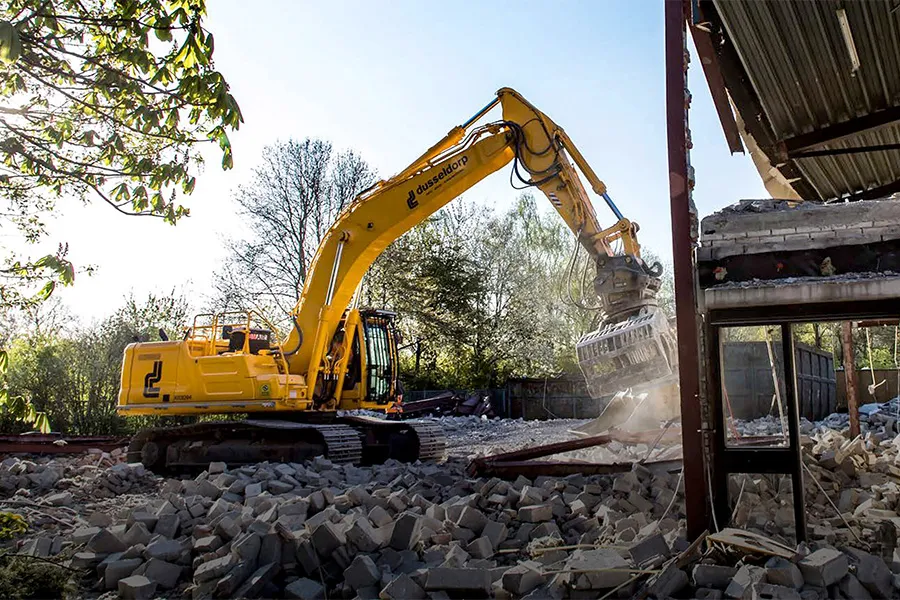
The demolition division of Dusseldorp ISM (Infra, Sloop en Milieu) in Lichtenvoorde focuses entirely on the circular dismantling of buildings and structures. Materials released in the process are carefully salvaged rather than demolished in the traditional way. The company uses various tools in ArcGIS Online for the different stages of this circular material use process.
Dusseldorp ISM works in Construction Information Management. The company explores how digital information, in the broadest sense, can be used as intelligently as possible. Maurits Koenders, BIM Specialist at Dusseldorp, explains how the company does this. “ArcGIS Online makes it possible to overlay a large volume of survey data. The software also makes it easy to share all that information with the client and other stakeholders.” Dusseldorp’s focus on reusing materials is partly driven by the growing scarcity of raw materials. Fossil fuels are also running out, while production processes are generating increasing amounts of waste. It is therefore no coincidence that Dusseldorp wants to move from a throwaway economy to a circular economy. The company is taking the lead in this transition.
Demolition using the 10R model
For circular demolition, Dusseldorp uses the 10R model, also known as the R-ladder. “This helps determine the maximum reuse potential of a particular material or raw material,” Maurits explains. “The first two rungs of the ladder are to rethink and refuse demolition. The most sustainable option is still simply to keep using a building. The final rung is incineration with energy recovery. All the steps in between are possible routes to reuse.”
If a decision is made to demolish a structure, the materials that will be released need to be identified. The on-site survey often has to be carried out in a limited amount of time. It is conducted using a mobile device, making it possible to record the presence of specific materials as you walk through a building. During the survey, each material is photographed and provided with a description, its location in the building and other details, such as quantity and composition.
Surveying with ArcGIS Survey123
Dusseldorp carries out the survey using ArcGIS Survey123, after which the data is sent to its own data enrichment dashboard. Maurits: “That is also where the optimal R-value is determined straight away. The enrichment dashboard also lets us make certain materials available immediately for external marketing through Insert, a marketplace for construction materials recovered after demolition. This is done when a material is unsuitable for reuse in the project itself. Others may be able to use it, helping us prevent waste.”
The data enrichment dashboard was built with ArcGIS Experience Builder. This makes it easy to link projects to a map showing their locations and display various project attributes separately, along with photos of materials taken during the survey. In the app, users can select a material and enrich its data. The aim is to determine the optimal R-value. We also want to populate the material attributes as fully as possible, to make marketing as straightforward as possible and, for example, show the CO2 reduction achieved through reuse.
Maurits: “A good example is when a survey reveals that a structure is contaminated with asbestos or chromium-VI. We can then assess whether it is possible to clean the material while maintaining its quality. If cleaning gives it an R-8 rating, we can see what happens if we carry out a second, more intensive cleaning. If that results in an R-3 rating, the material can be reused straight away. This makes it easy to establish which variables have a positive effect on the R-value of each material.”
More possibilities in the future
In the future, Dusseldorp hopes to make greater use of interactive 3D models and 360-degree cameras, and to integrate the files they generate. The 3D models are generated from a scan of the building using a LiDAR scanner or 360-degree camera. “Developments in integrating 3D web scenes into Experience Builder are promising,” says Maurits. “Linking one to our dashboard could, for example, allow building measurements to be verified afterwards. It would also make it possible to take clients on a virtual tour of the building. In addition, we want to expand the data enrichment dashboard so that we can provide data for the materials passport in accordance with Madaster’s requirements. For us, technology is the key to achieving CO2-neutral operations, demolition and transport.”
Savings
The process helps accelerate the transition from a linear throwaway economy to a circular economy by providing shareable insights into material flows released during demolition. This promotes reuse and marketing, both within and outside the company. It also enables Dusseldorp to determine the optimal reuse strategy (R-value), extending the lifespan of materials and making more efficient use of them. In addition, the process streamlines internal business operations by automating administrative tasks, resulting in a more efficient workflow and higher-quality output. Reducing human intervention minimises errors and improves the reliability and consistency of results.
A business enquiry for Esri Nederland? Get in touch
Companies in this story

Keep following this
Get an email when a new story is published. No account needed.
- ThemeLower emissions and more reuse
- SubjectDigitalisation & software
- CompanyEsri Nederland