Amsterdam tunnels to be connected to new traffic control centre
Text Roel van Gils Image Gemeente Amsterdam
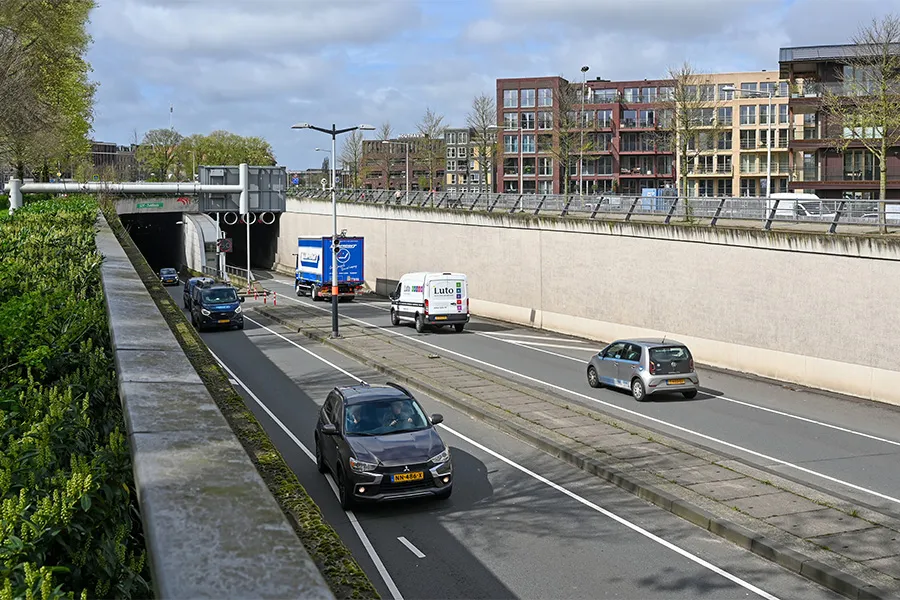
Work is under way in Amsterdam on a new traffic control centre. The existing centre, which dates from 1968, no longer meets requirements, and its current building cannot accommodate future developments. To continue operating and monitoring Amsterdam’s urban tunnels from the new centre, data must be exchanged via a standardised interface. On behalf of the municipality of Amsterdam, INNOCY is working on two of the existing tunnels so that they too can communicate with the new centre.
The existing traffic control centre, above the IJ-tunnel on Dijksgracht, has grown organically since the IJ-tunnel opened in 1968, explains Daan Seesing, project manager at the municipality of Amsterdam. “The five municipal tunnels are now operated from the centre, and traffic flow across Amsterdam’s road network is monitored 24/7. However, the centre has outgrown its premises considerably, hindering future developments. That is why a new traffic control centre is being built, but the challenge goes far beyond simply putting up a new building. The underlying technology is primarily ICT and involves a complex interplay between systems and users. The project has therefore been divided into three sub-projects.”

Blueprint
The construction of the new centre is one sub-project. “That is now well under way and is expected to be completed by mid-2025,” says Daan. “The second sub-project is developing the functional systems. This includes all the technology that turns the building into a traffic control centre, such as ICT, hardware and software. The system design for the renovated Piet Heintunnel provides the blueprint. The third sub-project involves connecting the Michiel de Ruijtertunnel and the Spaarndammertunnel via the new standardised interface, so that they too can communicate with the new centre in the same way and be operated and monitored flawlessly from there. One contractor has been appointed to build the centre. As a municipality, we are implementing the functional systems together with alliance partners, while INNOCY is providing project management for the third sub-project.”
Extensive network
For the work required on the tunnels, we decided to involve market parties in the design process at an early stage, which also makes the project more complex, says Ramon van Gils, project manager at INNOCY. “For both tunnels, we chose to develop the design in-house up to and including the Preliminary Design stage. We also brought in construction expertise as early as possible, for example by involving the maintenance contractor in the design process. For the Spaarndammertunnel, we opted to develop the design as part of a construction team.” Daan adds: “The documentation for both tunnels did not always give a 100% accurate picture of the current situation. Involving market expertise at an early stage also reduces the project’s risk profile. This is also one of INNOCY’s strengths: the company has sound expertise, many years of experience and an excellent network, and can also call on experts from ICT Group if needed. That is highly valuable on a project this complex.”
Bringing risks forward
The work on the Michiel de Ruijtertunnel mainly involves changes to the network. The work on the Spaarndammertunnel is more extensive. The entire audio and video chain is being replaced, the network is being renewed and the control system is being modified. “We are changing everything except the components inside the tunnel tubes,” says Ramon. “Implementing new software in an existing tunnel while causing as little disruption as possible to traffic and the city presents considerable challenges. We are therefore building the new systems completely in parallel, testing them at the test centre, then moving into the tunnel to switch over at night and test again. Only after that do we make the full switch. So we bring as many risks forward as possible and, to ensure everything works correctly, consider the entire chain from component to operator console.”
The renovation of the Piet Heintunnel has optimised the system chains for communication with the new traffic control centre. The same will soon apply to the upgraded Michiel de Ruijtertunnel and Spaarndammertunnel. The upgrades required for the other two tunnels are so extensive that they will have to wait for a major renovation or maintenance programme before they can be connected to the new traffic control centre via the standardised interface.
Question about this story? Ask your question
Keep following this
Get an email when a new story is published. No account needed.
- ThemeUnderground construction
- SubjectDigitalisation & software