









World’s largest charging hub for heavy equipment
Text Roel van GilsImage WattHub
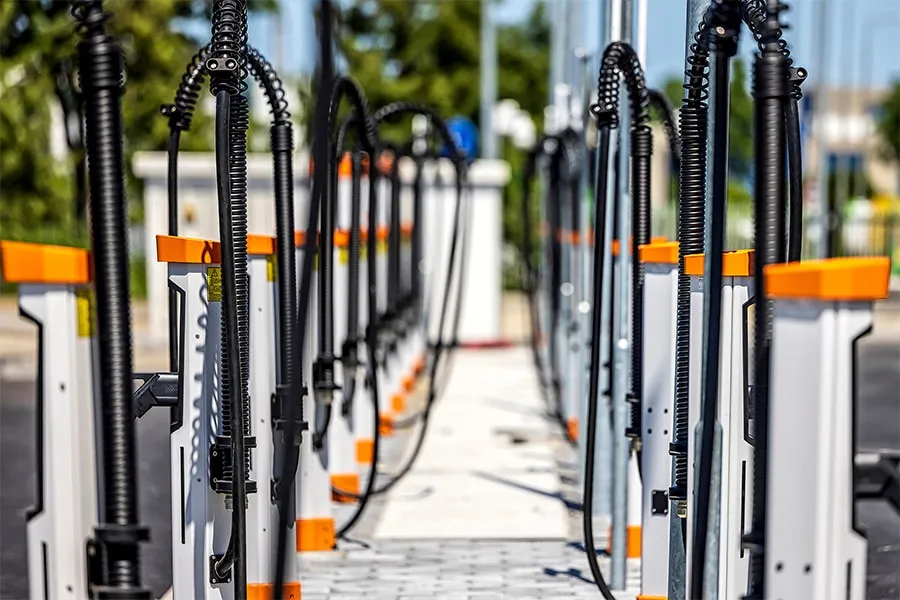
Renewably generated, smart charging
On 28 September, no less than King Willem-Alexander opened the world’s largest rapid-charging hub for heavy construction equipment and electric lorries. WattHub is a development by the Mekante Diek construction consortium in partnership with Betuwewind, initially created to support the zero-emission requirements of the Tiel-Waardenburg Dyke Reinforcement project. Its unique set-up also makes the rapid-charging hub accessible to others and, thanks to its dynamic pricing, highly attractive.
WattHub grew out of an ambitious client, Waterschap Rivierenland, explains Gerben van den Berg, director of WattHub. “They put the contract for the dyke reinforcement between Tiel and Waardenburg out to tender with the ambition of carrying it out almost emissions-neutrally. Several contractors submitted bids, but Mekante Diek, comprising Ploegam, Dura Vermeer and Van Oord, had the winning concept. The question soon arose: how would we charge all that equipment? There was not enough power available. At one point, the consortium entered into discussions with Betuwewind and simply asked whether its three local wind turbines in Geldermalsen might be able to help supply electricity. And that is what happened.”
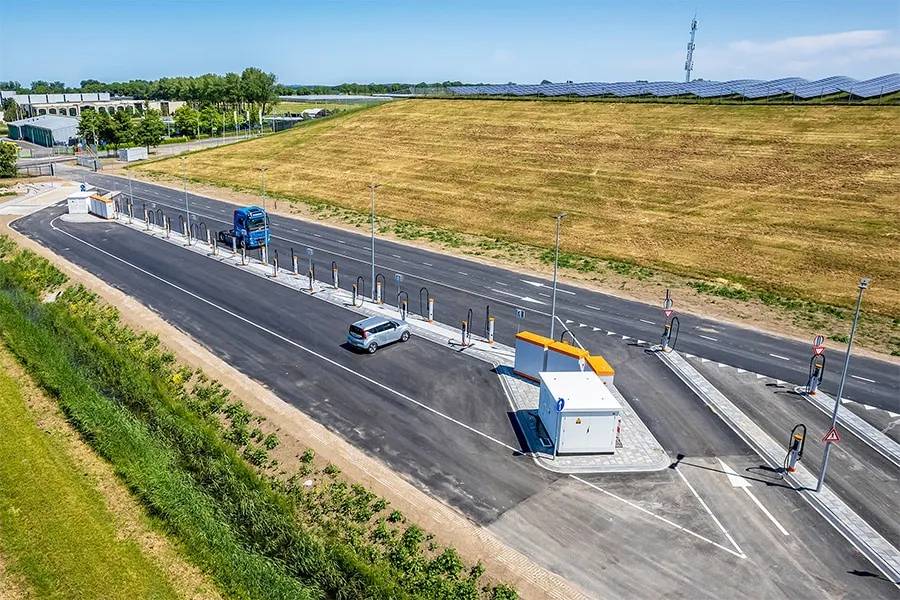
42 smart charging points
WattHub was initially set up as a company to meet the needs of the dyke reinforcement project, but the ambition to run it commercially soon followed, says Gerben. “Since June this year, Mekante Diek’s electric equipment has been charged at the hub every day, and since August it has also been open to third parties. Over the four years, the construction consortium will need around 7% of the available capacity supplied by the three wind turbines (10 MW). So there is plenty of capacity for others.” The first parties have already made enquiries, according to Gerben. “The hub has 42 smart charging points, including 36 DC chargers with a charging capacity of up to 400 kW and 6 AC charging points for battery containers or older electric equipment, for example.”
Solar farm
WattHub currently gets its electricity from the wind turbines. “So when there is no wind, there is no electricity,” Gerben acknowledges. “On average, there are between seventeen and forty windless days a year in our country. That is when things get a little more challenging. We are therefore preparing to connect the neighbouring solar farm, which has a capacity of 9.5 MW, and we also have a grid connection from Liander as a back-up. In summer, we can draw three MW from the grid 24/7, and in winter only between 23:00 and 6:00. We can always take the power supplied by Betuwewind, so it does not feed into the grid and cause grid congestion.”
Dynamic pricing
Because WattHub relies largely on natural sources, it charges dynamic rates. Gerben explains: “Our motto is ‘renewably generated, smart charging’. We are the only charging hub in the Netherlands with flexible pricing, and we try to charge equipment when costs are as low as possible. We pass those costs on directly. Customers also pay a fee to use the hub. We therefore make as much use as possible of a booking system to guarantee a space and charging capacity.” Third parties without a WattHub charge card are still allowed to use the hub, but smart charging is unavailable and a fixed rate applies.
WattHub aims to establish several rapid-charging hubs across the country. “There is strong demand in the market. A new holding structure is being set up, which will put WattHub on its ‘own feet’ and enable it to invest in new locations. This is always done in partnership with local parties, preferably a local wind co-operative. Wind is a more constant source and is also available at night.”
Question about this story? Ask your question
Companies in this story

Keep following this
Get an email when a new story is published. No account needed.
- ThemeFlood protection and climate-resilient water management
- SubjectNews
- CompanyVan Oord







