









Working together for a thriving water construction sector
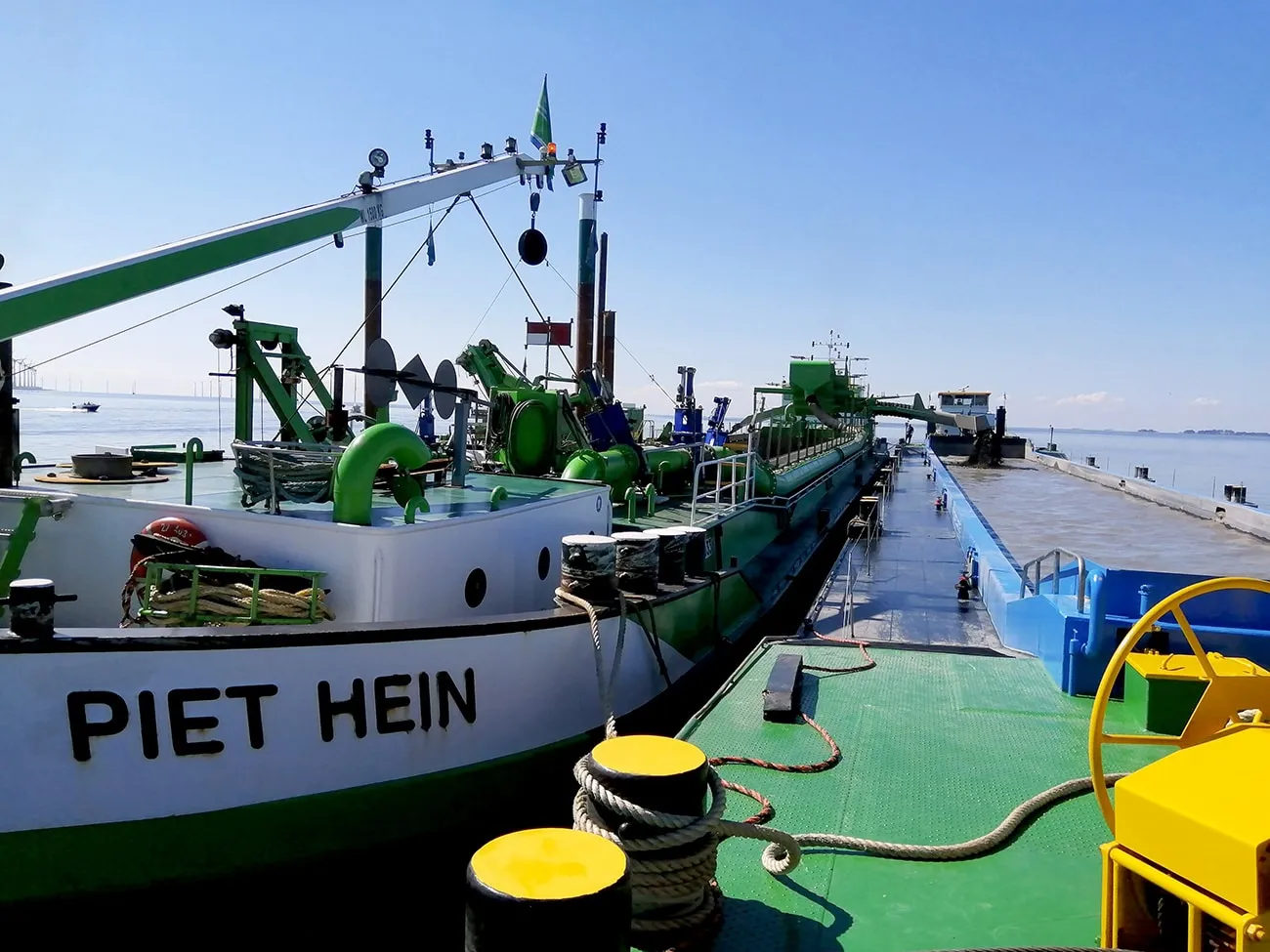
Sustainability, innovation and circularity are key themes in water construction. As a result of what it sees as excessive regulation, the sector is now in a worse position on circularity than it was five years ago. At the same time, we are expected to make far-reaching investments in reducing emissions and greening the water construction fleet. That is the view of Yves Marsé, adviser to the Vereniging van Waterbouwers. He is calling for stronger government leadership, with sustainability and circularity addressed as an integrated whole.
The Vereniging van Waterbouwers is the employers’ and business organisation for contractors and service providers in water construction. “We represent the interests of our 91 members and work together continuously to maintain a thriving water construction sector, in both freshwater and saltwater,” says Marsé. “We focus exclusively on companies active in the Netherlands. Our members range from large dredging companies to small businesses that, for example, dredge ditches, and everything in between.”
A long-term vision
As part of the Clean and Emission-Free Construction programme, the Vereniging van Waterbouwers has worked with Rijkswaterstaat, various water authorities and Havenbedrijf Rotterdam, among others, to develop a transition pathway for water construction. “The government’s current sustainability policy is rather disjointed,” says Marsé. “We need clarity and, above all, a consistent long-term vision to achieve the targets of a 55% reduction in CO2 emissions and a 60% reduction in nitrogen emissions by 2030. As a sector, we are keen to align with these targets, provided a number of preconditions are met. We have therefore done a great deal of groundwork together and developed a transition pathway, which has now been submitted to the cabinet. We hope it will be approved in the autumn, providing the market with an investment outlook so it can continue to become more sustainable. At present, there is a great deal of uncertainty, making it difficult to justify investments.”
A phased approach to the ambition level
The transition pathway has been drawn up in accordance with the Clean and Emission-Free Construction (SEB) framework and consists of two parts. “The first sets out measures to meet the minimum requirements, while the second sets a higher level of ambition, the upper limit,” says Marsé. “Both parts are divided into four periods of a few years each, to achieve the reduction targets and ambitions for 2030 step by step. For each period, the minimum requirements for engines and energy carriers are specified. For 2028, CCR2 has been set as the minimum requirement. Importantly, this applies to the weighted average of all engines on board. For the second part of the transition pathway, the availability of funding is a serious bottleneck. It remains to be seen how far the cabinet is willing to go to make these ambitions a reality. We commissioned TNO to study options for making the freshwater fleet more sustainable. Zero-emission equipment cannot be used everywhere, and where it can, it requires an investment 5 to 10 times higher, amounting to around 300 to 400 million in additional costs by 2030. The question we all need to ask, and which is now before the cabinet, is: are we prepared to pay that?”
According to circular principles, soil or dredged material generated by a project should preferably be reused locally, says Marsé. “That is what happened until a few years ago. Unfortunately, regulation is creating more and more obstacles, with PFAS the most pressing example. On the one hand, industry is allowed to release kilograms of pollutants into our environment through the air and water. Naturally, these are found during dredging. That would not in itself be a problem, were it not for the fact that the limits set for us are in tenths of a microgram. That is a billion times smaller (!) and completely out of proportion. The rules are also far stricter than those for other substances. As a result, contractors have to transport soil and dredged material over increasingly long distances to one of the three disposal sites in the Netherlands, even though the material is often reusable. This is anything but circular and runs counter to the government’s policy of encouraging reuse. As well as being bad for the climate because of the additional transport emissions, it also costs a great deal more, money that would be far better spent on making the sector more sustainable.”
As a trade association, we would like to see circularity and sustainability addressed as an integrated whole, so that decisions can be made on a consistent basis, Marsé concludes. “The current policy of imposing ever stricter standards at the end of the process is not sustainable in the long term. It needs to be considered in proportion. This is a difficult political debate, and we will continue to raise it in The Hague to help create a more realistic picture. Five years ago, we were more circular than we are now. Unfortunately, this is not widely recognised, but it is a consequence of current policy.”
Question about this story? Ask your question
Keep following this
Get an email when a new story is published. No account needed.
- ThemeLower emissions and more reuse
- SubjectNews







