









Wheel washing system tackles emissions problems
Text and images FRUTIGER
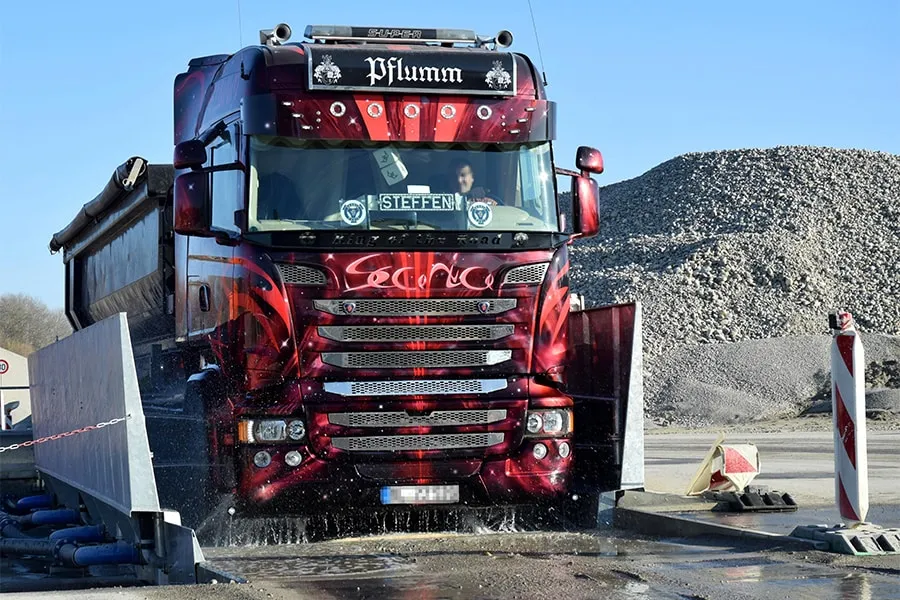
Dirty roads, dust and sticky dirt on vehicles are everyday problems at many landfill sites, bulk material loading areas, container parks and construction sites … As the global market leader, FRUTIGER has been offering a wide range of modern, practical solutions for more than 30 years.
A wheel washing system tackles the problem of
dirty roads
In 1995, FRUTIGER developed the world’s first drive-through system. With a drive-through system, lorries no longer have to stop for their tyres to be cleaned. As the vehicle passes the light barrier at the entrance, the washing system starts automatically. As it drives through, the numerous nozzles clean the tyres and chassis with powerful jets of water. The wash water automatically flows back into the system, where it is treated for the next wash. An integrated scraper system or a sludge removal system removes the sprayed-off sludge, which can then be disposed of with ease.
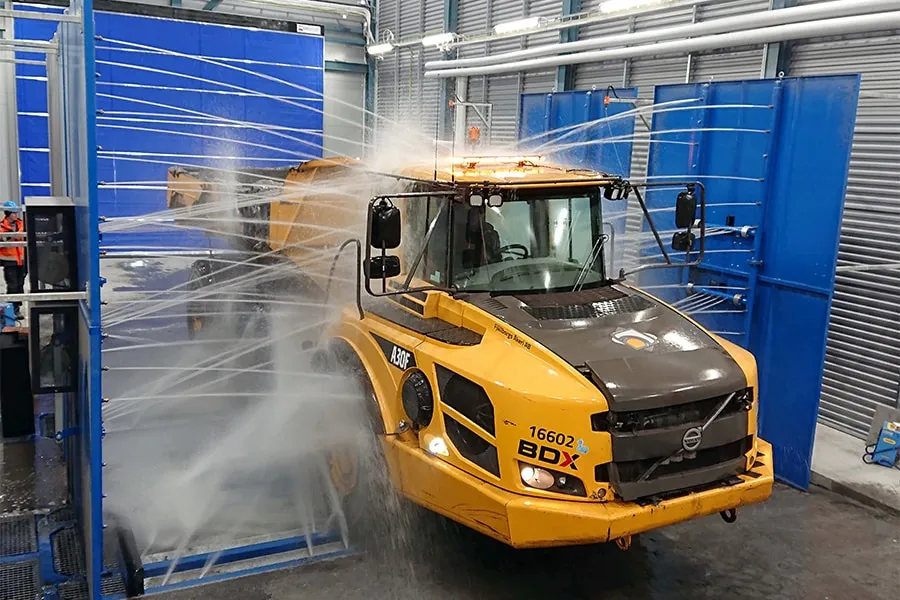
Demucking systems clean dirty construction vehicles
Unlike a wheel washing system, a demucking system is not intended to keep public roads clean, but to remove heavy dirt and debris from the chassis, underside and wheels or tracks of construction vehicles. A demucking system can clean tracked vehicles up to the size of a Caterpillar D11, as well as dump trucks and wheel loaders. A complete wash of the front, sides and chassis takes only a few minutes with a demucking system. This means you can put the vehicles straight back to work. You also save resources, reduce the impact on the environment and contribute to the wellbeing of everyone on site.
Dust suppression systems effectively capture dust particles
FRUTIGER’s dust suppression systems work by binding dust to tiny water droplets. High-quality medium- and high-pressure pumps, operating at pressures between 20 and 100 bar, spray a mist containing a large number of very fine water droplets through special nozzles. These almost microscopic droplets are more effective because, as well as being more numerous and more uniform in size, they remain airborne for longer due to their lower velocity in flight and descent. This means they exert a weaker attractive force around them, so they bind with dust particles more often and bring them down to the ground. Thanks to this proven technology, the water used effectively suppresses dust.
Question about this story? Ask your question
Keep following this
Get an email when a new story is published. No account needed.
- ThemeLower emissions and more reuse
- SubjectNews







