









‘The asphalt industry needs the government to drive change’
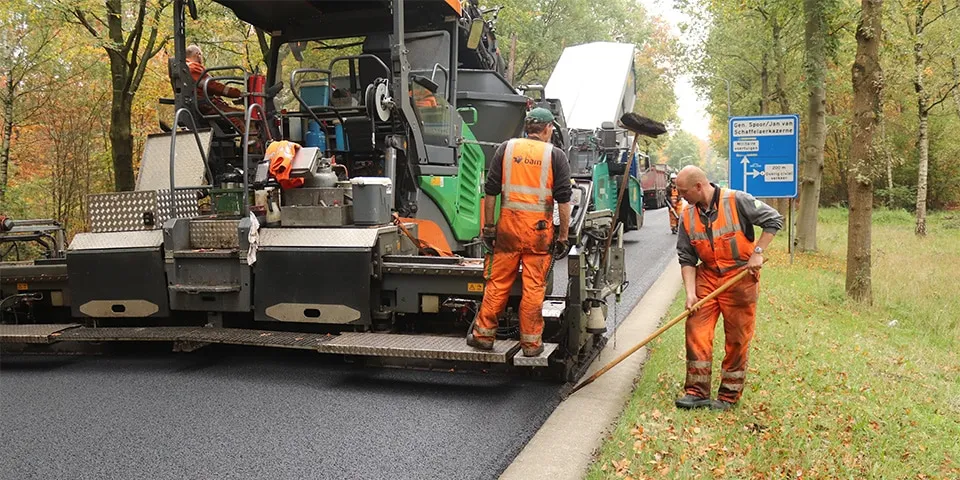
When it comes to cutting CO2 emissions, BAM Infra Asfalt is a leader in its sector. The company has several projects underway and is helping to meet the climate targets set by the Dutch government. One example is the BEAMER project, for which BAM received a grant from the Netherlands Enterprise Agency (RVO.nl). ‘Producing sustainable asphalt is the future. That is why we are fully committed to developing it.’
GRANTS FOR CO2 REDUCTION
By 2050, the Netherlands must emit 95 per cent less CO2 than in 1990. By 2030, emissions must already have fallen by 49 per cent. These targets are set out in the climate objectives. Based on these goals, the government imposes requirements on industrial companies. It supports them in meeting those requirements through expertise, networks and grants.
New grants
Through the Netherlands Enterprise Agency (RVO.nl), the government offers a range of new grants. The Demonstration of Energy and Climate Innovation (DEI+): Circular Economy grant and the Accelerated Climate Investment in Industry (VeKI) grant are unique, one-off schemes. These grants help accelerate progress towards the 2030 CO2 reduction targets. In 2020, a completely new type of scheme will also be launched to support innovative, integrated solutions for industry: the Mission-driven Research, Development and Innovation (MOOI) scheme.
Interested?
RVO.nl can help. Use its grant and finance guide to find out straight away which CO2 reduction grants your organisation may be eligible for. You can also find out how to benefit from RVO.nl’s expertise and network.
Turning old asphalt into new asphalt at a production temperature far below the norm. That is the aim of the BAM Energy-efficient Asphalt and Mastic Recycling (BEAMER) project. ‘And it fits well with our sustainability vision,’ says Ernst Demmink, technical innovation manager at BAM Infra, the infrastructure arm of Koninklijke BAM Groep. ‘The BEAMER project will help us cut our CO2 emissions substantially.’
Driving change
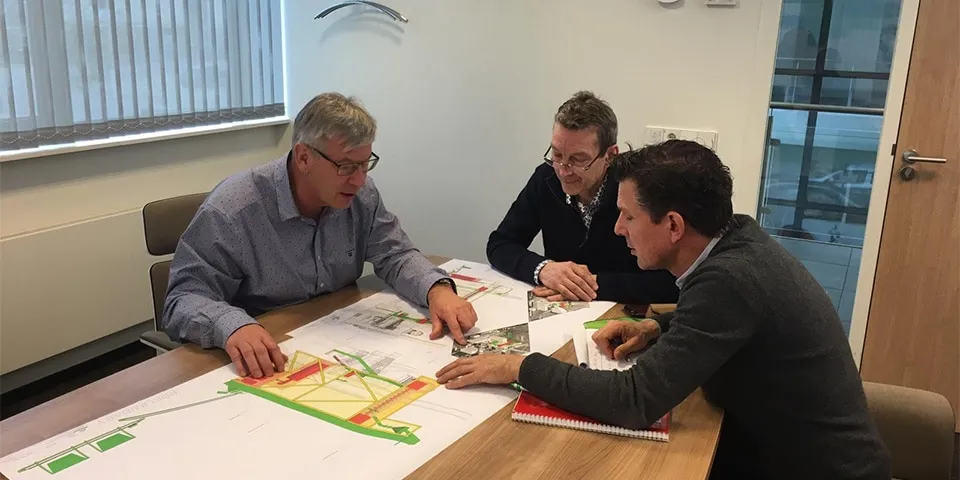
‘At BAM Infra, we provide innovative and sustainable solutions for road construction,’ says Demmink. ‘Asphalt production accounts for only a small part of BAM Groep, the largest construction company in the Netherlands. Even so, we are responsible for around 15 per cent of the total CO2 emissions of BAM as a whole. That is less surprising than it might sound: the asphalt industry is highly energy-intensive and emits a lot of CO2. But however understandable that may be, it is something we want to change.’
BAM Infra has undertaken several innovative projects to address this. One example is the Low Energy Asphalt Concrete (LEAB) project, in which asphalt is produced at 100°C rather than 170°C. There is also the Low Emission Asphalt Pavement (LE2AP) project, which uses mainly recovered materials to make asphalt, with less energy and fewer emissions. The BEAMER project, for which BAM Infra received the Demonstration of Energy and Climate Innovation (DEI+) grant, builds on the success of these projects. Its focus is on recycling, energy saving and CO2 reduction.
Lower energy consumption
In the BEAMER project, BAM Infra produces low-temperature asphalt made largely from reused materials. This new production process will cut the company’s energy consumption and CO2 emissions by 35 to 50 per cent. Demmink: ‘Asphalt is made from aggregate, sand and a special binder. We heat the materials, which takes a lot of energy. While “normal” asphalt is produced at 170°C, in the BEAMER project we do it around 70° lower, at 100°C. This “low-temperature asphalt” therefore uses much less energy and produces less CO2. We also make the new asphalt from 95 per cent old asphalt. That is a substantial proportion: in conventional asphalt, the proportion of old asphalt reused is 38 per cent.’
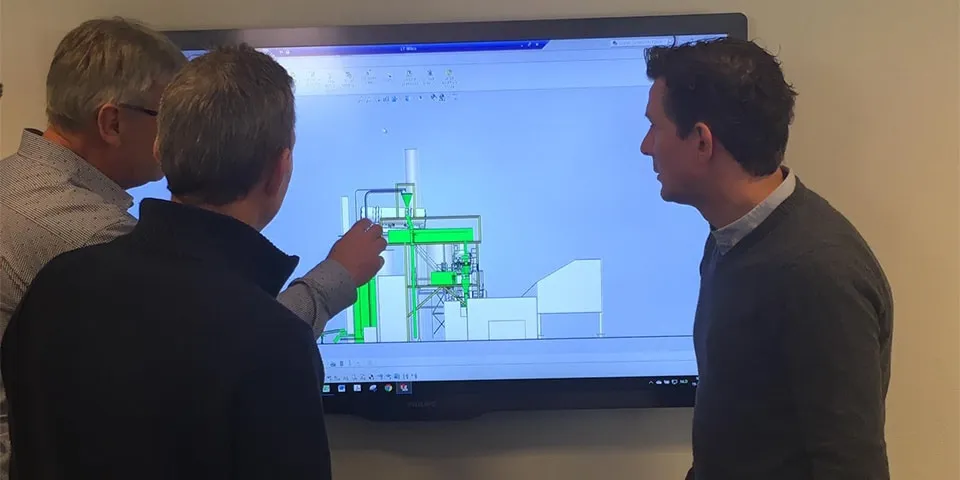
The significant potential reduction in CO2 emissions offered by this new approach is why BAM Infra is keen to get the BEAMER project under way. ‘We will start building a BEAMER prototype plant in 2021. This will be followed by a two-year testing period. The asphalt will then need to remain in place for a few years before we can assess its actual performance. If successful, we will scale up the project and implement the system on large-scale asphalt projects!’
Essential development
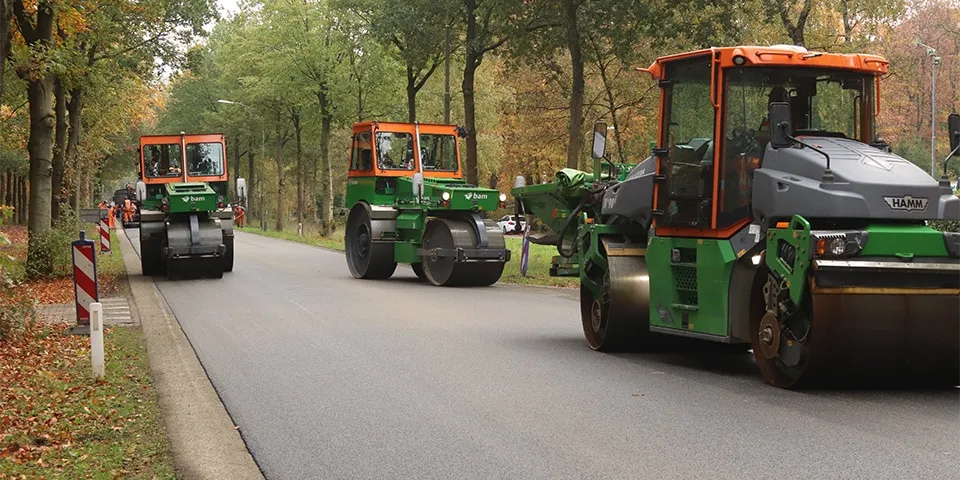
BAM Infra typically consumes around 13 million cubic metres of gas a year. The BEAMER project will bring that to an end. Demmink: ‘We need to move away from gas. That is why our new machines will be powered by hydrogen. Green electricity was not an option: the energy grid cannot handle it at this scale. And other forms of energy do not contribute to CO2 reduction.’ In the BEAMER project, BAM Infra is taking the first step towards heating with hydrogen. ‘This is the future. We simply have to develop it.’
Demmink recognises that rethinking processes in his sector is not easy: ‘The government has tasked us with becoming more circular. But particularly when old asphalt is heated, gases are released. We cannot simply let them escape. In the BEAMER project, we are introducing an afterburner with additional emissions-reduction technology. That is another substantial investment. The project is currently estimated to cost around 3.5 million euros. Fortunately, we are receiving more than 700,000 euros in DEI+ funding from RVO.nl. We are also looking into whether other grants may be available. The AC-adviseurs consultancy is helping us with this; they have expertise in this area that we do not have.’
A conservative industry
Annual asphalt production in the Netherlands is around 8.5 million tonnes. BAM Infra produces about 1.5 million tonnes of that. ‘At 16 kg of CO2 emissions per tonne of asphalt, there is a lot of scope to reduce carbon dioxide emissions, but we are the only asphalt producer genuinely working on CO2 reduction,’ says Demmink. ‘The asphalt industry is highly conservative. BAM, for example, has been able to produce high-quality low-temperature asphalt for ten years. Yet less than one per cent of new asphalt in the Netherlands is produced this way. That figure needs to be much higher. The asphalt industry can make a huge contribution to meeting its clients’ climate targets. And with this asphalt, that is relatively easy. It does not cost more and is at least as good in quality, so why shouldn’t we all do it? That way, we as an industry can meet the climate targets much sooner.’
Deadline approaching
BAM Infra believes the government should put more pressure on the industry. Demmink: ‘A lot is already happening. There are, for example, increasingly more government grants for innovations like ours. RVO.nl also has many people with business experience and in-depth knowledge; they are keen to help develop new and more sustainable approaches to meeting the climate targets.’ As a technical innovation manager, Demmink sees that the climate targets apply across projects, while government procurement policies often do not. ‘Scaling up innovations requires more than grants alone. For example, there is still a bottleneck in procurement policy, where innovative techniques like ours do not face enough competition to be included in the tender.’ Demmink also believes those tenders still focus too heavily on price. ‘They do not, for example, take into account the significant CO2 savings we can achieve with our circular BEAMER project.’
‘The transition we are going through as a country affects us all,’ says Demmink. With only ten years to go until 2030, he can see the deadline drawing closer. ‘The time for talking is over,’ he says. ‘RVO.nl and its grants are already helping us a great deal. Now it is time to take real action.’
Question about this story? Ask your question
Keep following this
Get an email when a new story is published. No account needed.
- ThemeExtending the life of roads and civil engineering structures
- SubjectNews







