









Testing of RijnlandRoute tunnel systems already under way
The complexity of tunnel technical installations (TTI) can cause major delays and additional costs on tunnel projects. At the RijnlandRoute, a number of deliberate choices have been made to prevent this. For example, integrated testing of the TTI is taking place before tunnel boring has even begun. A first in the Netherlands.
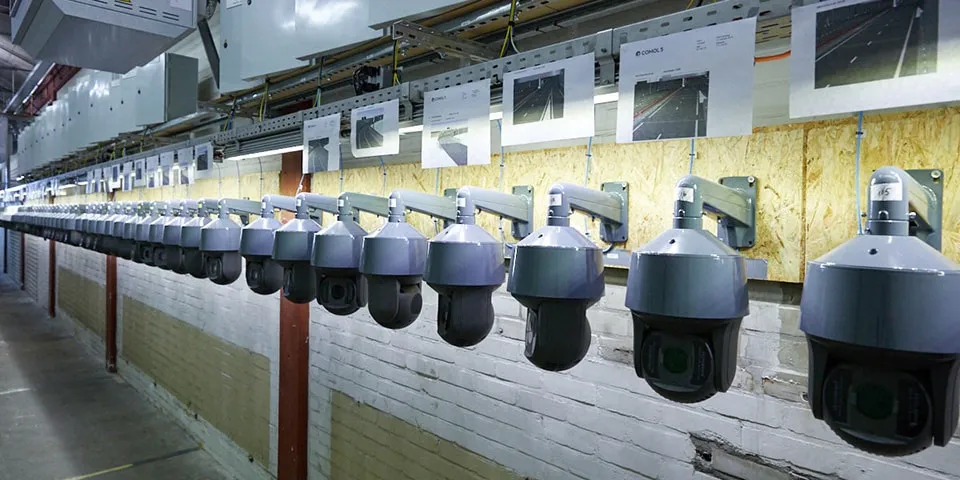
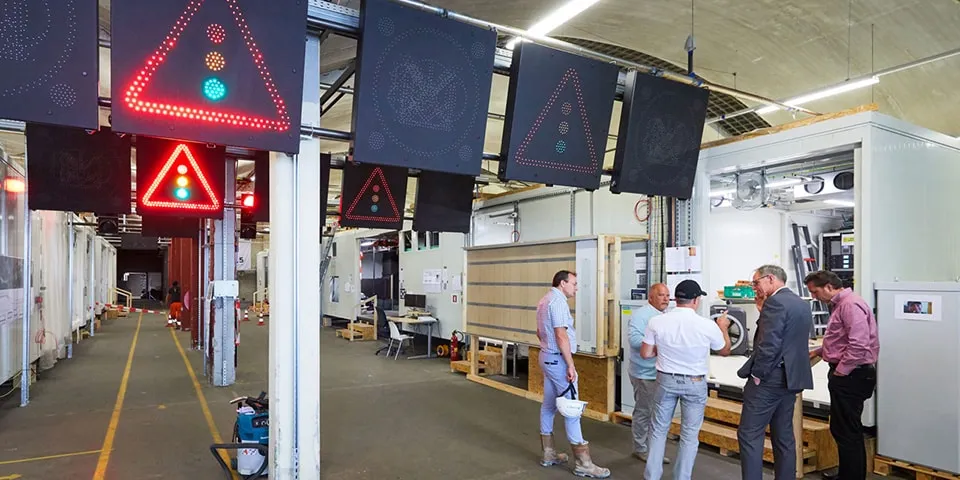
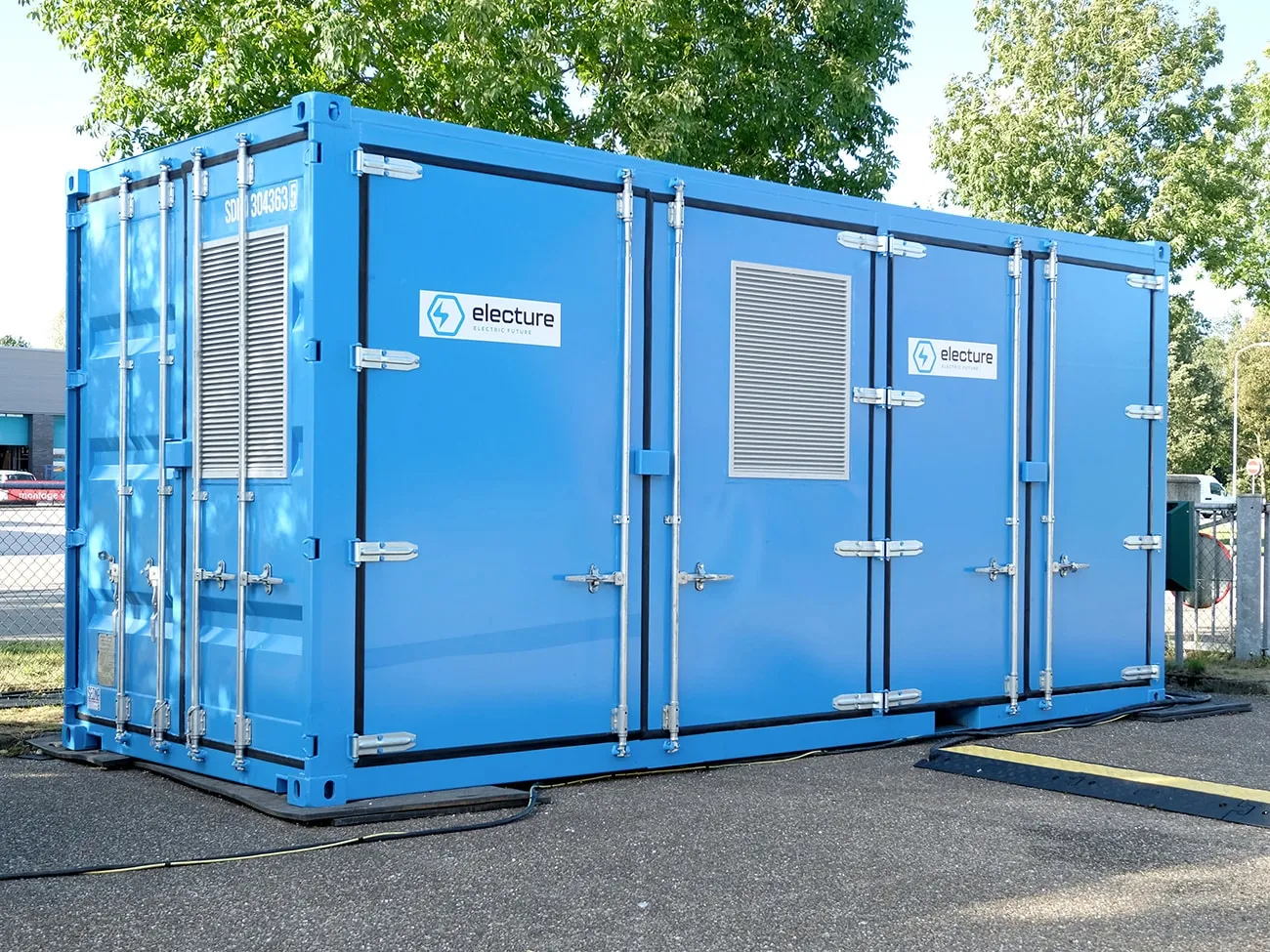
Driving into the industrial estate in Eindhoven, it is hard to imagine that highly innovative work is taking place here. The factory buildings, dating from the 1950s, evoke images of industrial heritage and craftsmen in blue overalls. Nothing could be further from the truth. In the halls rented by COMOL5, the construction consortium building the RijnlandRoute, 130 cameras have been mounted on the walls to monitor traffic in the tunnel and sunken road section in a few years’ time. The ceilings are fitted with, among other things, variable message signs, sections of tunnel lighting and loudspeakers. The hall also contains barriers, visibility meters and more than twenty brand-new, mobile modules, container-like structures filled with control cabinets, computers, transformers and a few workstations. This is where COMOL5 is testing whether the TTI and its control systems work properly, years before the RijnlandRoute opens to traffic.
Recreated
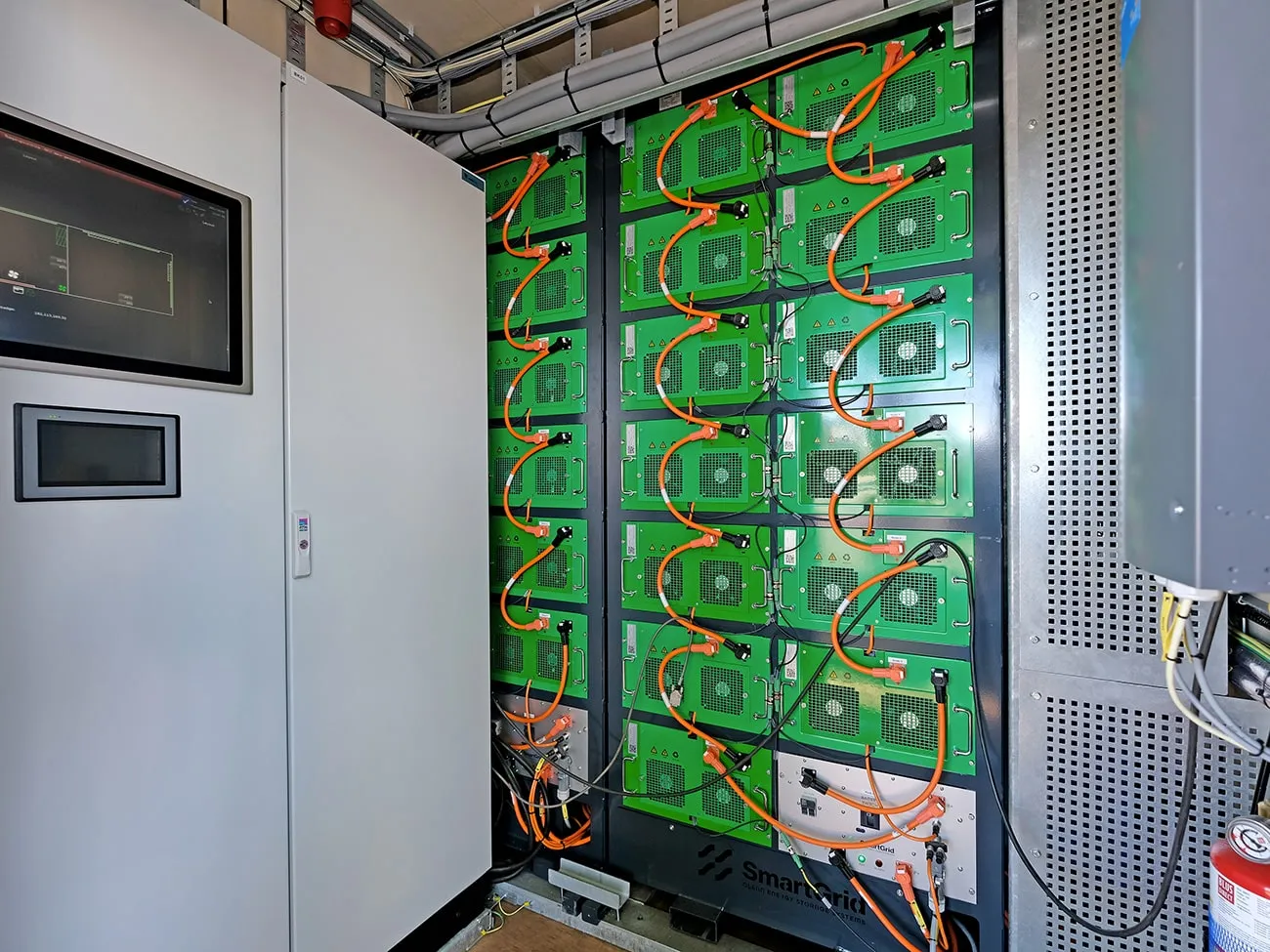
“We have almost everything here that will be needed to control the tunnel and the adjoining sunken road section of the RijnlandRoute, all installed and connected,” says Croonwolter&Dros project manager Hans Nuhn. “We have installed in the modules all the equipment that will eventually go into the RijnlandRoute’s two service buildings. Since we need to be able to control the TTI from both buildings, much of this equipment is duplicated. The modules for the East service building are at the front of the hall, with those for the West service building at the back. We have connected all the systems needed for tunnel safety and traffic management to the modules. For the audio and video systems, where the risk of defects at handover is relatively high, we have installed every unit. For systems with a lower risk profile, we have installed only some of them. For example, we have recreated one of the escape passages that will eventually run between the two tunnel tubes, complete with all the installations, signage and escape doors.”
“By building most of the TTI here at this test facility, we can thoroughly test how everything works together at an early stage and iron out any teething problems. We have also established a fibre-optic connection between the test facility and Rijkswaterstaat’s Zuidwest Nederland traffic control centre in Rhoon, from which the RijnlandRoute will be operated once it opens. This means we can already check that the connection to the centre is working properly.” Such an early connection, three years before the tunnel opens, has never been seen before on a tunnel project.
Additional requirements
Early integrated testing of the TTI was a key requirement for the province of South Holland, says Piet Jansen, TTI discipline lead for the RijnlandRoute at the province: “About ten years ago, I was involved in the Spoorzone Delft project at ProRail as TTI contract manager and construction manager. By then, various projects had shown that tunnel openings were significantly delayed by TTI problems. We wanted to prevent that, so we developed this testing strategy at the time. For Spoorzone Delft, for example, we added what is known as an integrated factory acceptance test (IFAT) to the standard tests. An IFAT tests the integrated operation of the TTI, including controls and procedures, in a test environment. Since this early testing proved very successful, we included an additional requirement in the RijnlandRoute tender documents: the contractor must demonstrate that all systems work in a test environment at least two years before the tunnel opens.”
The province is also pleased with the early connection to the traffic control centre in Rhoon. Jansen explains: “Projects often see contractors design a tunnel for local control first, adapting it for central control only at a later stage. In practice, this usually means that all kinds of elements have to be redesigned, at considerable cost. We therefore stipulated that the RijnlandRoute tunnel must be ready from the outset for central control from Rijkswaterstaat’s Zuidwest Nederland traffic control centre in Rhoon.”
According to Jansen, the reason local control is often chosen first is risk aversion: “If a project team opts for central control straight away, it has to start working with Rijkswaterstaat Centrale Informatievoorziening (CIV) at an early stage. That makes the client jointly responsible for meeting the handover deadline, which can sometimes put a project team off. However, I am convinced that it is perfectly possible to design for central control from the outset and save a significant amount of public money in the process.”
‘Integrated desk’
The tender documents also specify that the tunnel will be operated from an integrated desk, a workstation in the traffic control centre from which several tunnels can be monitored and operated simultaneously. Jansen says: “Given that tunnels need to be monitored 24/7, it is obviously much more efficient to connect several tunnels to one workstation.”
Bert ‘t Hart, transition manager at the Zuidwest Nederland traffic control centre in Rhoon, wholeheartedly agrees: “If a workstation can operate only one tunnel, as is the case with so-called dedicated desks, you need a lot more staff. After all, these workstations also have to be staffed 24/7. In addition, staff working at a dedicated desk cannot take on other control tasks, because those functions are not available at that workstation. And dedicated desks also take up a lot of space in the traffic control centre, space we simply do not have. We will soon have to give up our meeting room because we need to create standalone workstations for two new tunnels.”
‘t Hart is pleased that COMOL5 is already testing the TTI in Eindhoven and has connected it to the traffic control centre: “Since 2 July, we have been showing the images from Eindhoven at a workstation in our training room. It is a good way to introduce our staff to the RijnlandRoute ahead of its arrival. It is still too early for our training, exercising and familiarisation programme, but I like the fact that our staff can already ‘play’ with the controls for this new tunnel from time to time and get used to them. The tests and connection to the traffic control centre also mean that we are already in dialogue with COMOL5. The contractor has said that it will address any shortcomings in the graphical user interface (GUI) that we identify during testing well before the tunnel opens, in line with the national standard for traffic control centres. That is very reassuring, because once the tunnel opens, we need to be able to operate it properly.”
Benefits
Like Jansen and ‘t Hart, Nuhn is convinced that early testing of the TTI in a test hall has many advantages: “First and foremost, you have plenty of time to resolve any problems. If the TTI is installed only after the civil engineering work is complete and testing starts afterwards, the risk of time pressure is enormous, especially if not everything works as it should. In a hall, it is also much easier to install everything, without having to contend with other construction activities, site waste or moisture. It is also very convenient to have everything close together. Take the cameras, for example. Here, we have mounted them on both walls of the hall, all next to one another. So when we needed to check that the date and time were set correctly on each camera, we were able to do it very quickly. Carrying out checks like this only once everything is in its original position would take much longer. The distance between the first and last camera would then be more than three kilometres, and we would also need a mobile elevating work platform to reach them.”
Nuhn adds: “Another advantage comes from the modular design we have chosen. Since most of the equipment is installed in the modules, and the cables, for example, enter each module through the same point, we have significantly fewer interfaces with other disciplines. This reduces the risk of errors. Early procurement and testing also make logistics planning easier, and the handover documentation is ready before the tunnel is commissioned.”
Unique codes
Nuhn continues: “The plan is to carry out all the tests here over the coming year. We will focus mainly on how the TTI works, but we will also check, for example, whether the control cabinets can be fitted into the recesses in the service duct beneath the tunnel road surface. To check this, we have built a section of the duct here. Once testing is complete and we are sure that everything works properly, we will unscrew all the components. Each component has its own unique code, and we will store them carefully so they can be transported to the tunnel. We will move the modules, contents unchanged, to the service buildings, where a crane will place them in their final positions.”
In the test hall, COMOL5 has installed each component in the position it will occupy in the tunnel and sunken road section, based on its 3D BIM model. Nuhn says: “Once the civil engineering work on the tunnel and sunken road section is complete, we will move everything there and install all the components. We will use the unique codes to put everything in the right place. If something does not work during testing in the tunnel, we will then know to look for a problem in the cabling or a fault in the specific component. We will not make any further changes to the modules once everything is working properly. That will make troubleshooting much easier later on.”
“Another advantage is that we will need to carry out considerably fewer tests in the tunnel, because we have already proved here in Eindhoven that the TTI works. We will then be able to focus mainly on the physical tests required, such as checking the overpressure and ventilation capacity. This approach minimises the risk of the tunnel opening late because of TTI problems.”
A business enquiry for Croonwolter&dros? Get in touch
Companies in this story

Keep following this
Get an email when a new story is published. No account needed.
- ThemeUnderground construction
- SubjectNews
- CompanyCroonwolter&dros







