









Striking a balance between minimal disruption, maximum safety and optimal planning
Text Suzanne van GaaleImage Marcel Steinbach
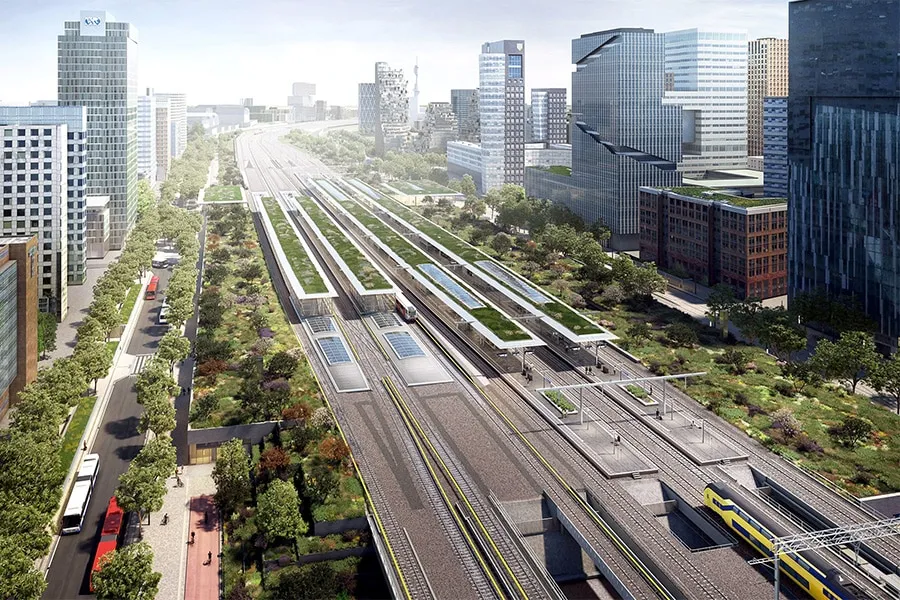
Zuidasdok: an infrastructure project with a major impact
Anyone who regularly travels by car or train through Amsterdam’s Zuidas knows that major works are under way here. And they will continue for years to come, until at least 2036. The large-scale Zuidasdok project is one of the biggest infrastructure projects in the Netherlands for good reason. It is also complex, given the busy urban environment, limited working space and the fact that everyday life for residents and workers goes on as normal. Jelger Vos, Zuidasdok project manager, and Erik van Weesep, project director at Bouwcombinatie Nieuw-Zuid, explain how they repeatedly have to strike a balance between minimal disruption, maximum safety and optimal planning.
To better understand the complexity of Zuidasdok, here is a brief explanation of what it is, why it is being built and who is involved. Zuidasdok is one of the biggest infrastructure projects in the Netherlands. The programme will improve connections to Amsterdam and the northern part of the Randstad, by both road and public transport. Zuidasdok comprises three major projects: modernising Amsterdam Zuid station, widening and partly putting the A10 Zuid motorway underground, and redesigning the De Nieuwe Meer and Amstel interchanges. The reasons will be clear to many: the region is growing thanks to good transport links. There is Amsterdam Zuid station, several metro stations, the A10 Zuid motorway and Schiphol Airport nearby. Thousands more homes and many offices will be added here in the coming years. This will place considerable demands on the infrastructure. Zuidasdok was developed to safeguard accessibility and liveability for decades to come. Rijkswaterstaat, ProRail and the municipality of Amsterdam are working together on Zuidasdok. Work on the station is being carried out by Bouwcombinatie Nieuw-Zuid, comprising Boskalis, Mobilis and Van Gelder.
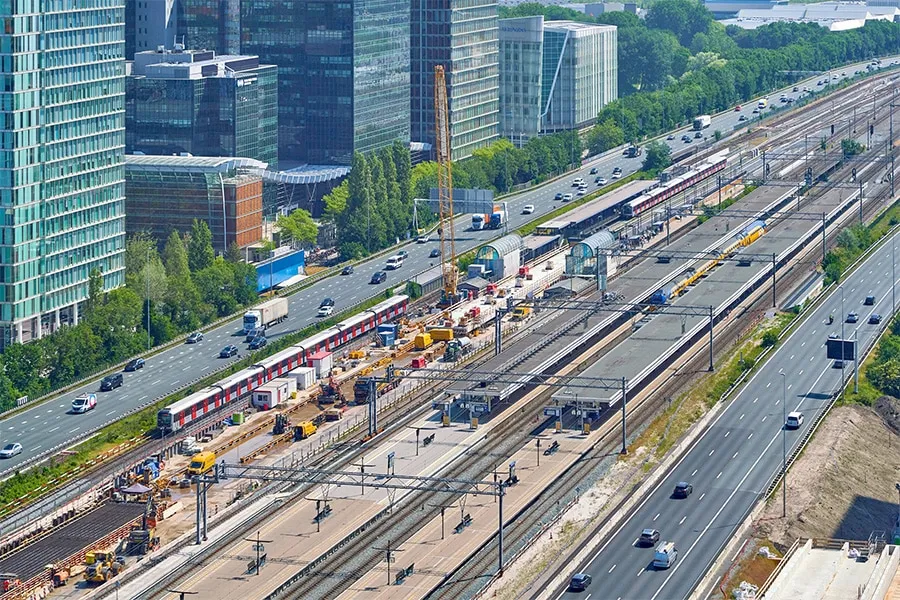
Modernising Amsterdam Zuid station
Major works are currently under way to modernise Amsterdam Zuid station, the fastest-growing station in the Netherlands. To give an idea of the scale, Amsterdam Zuid station was built in the 1990s as a temporary station, serving 9,000 passengers a day at the time. It is expected to grow into the Netherlands’ third-busiest station, with 200,000 passengers a day by 2035. The station is being expanded to accommodate current and growing passenger numbers. Easier said than done, as the station is squeezed between the carriageways of the A10 Zuid. The existing station entrance, the Minervapassage, is being widened and raised, and a second entrance, the Brittenpassage, is being added. The new station area will also include shops and a range of facilities. Burying the motorway will create space in future to extend the platforms, allowing international train services to depart from the station too. One common type of work is installing sheet piles. In August and September alone, more than 200 steel sheet piles were installed at the station. Erik: “From Bouwcombinatie Nieuw-Zuid’s perspective, this is certainly a technical puzzle.
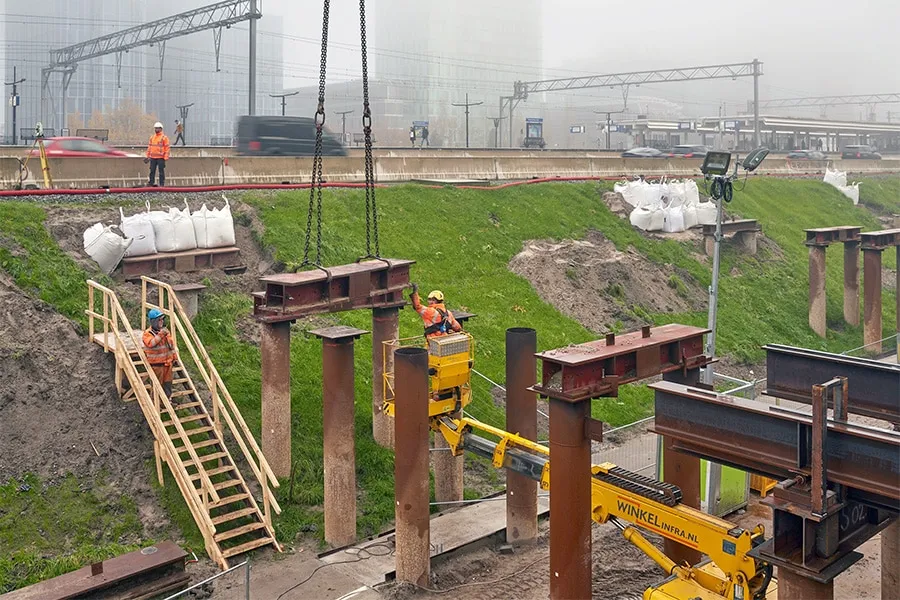
Beneath the railway tracks, we have installed a combination of steel sheets and tubular piles, along which we will excavate the new passage. The working space is only 3 metres high. It is quite a challenge to work with 6-metre sheets and 23-metre-long pipes. We also have to take possible noise nuisance into account. To minimise it as much as possible, we use two methods to install sheet piles at Zuidas: pressing or vibrating them into place.”
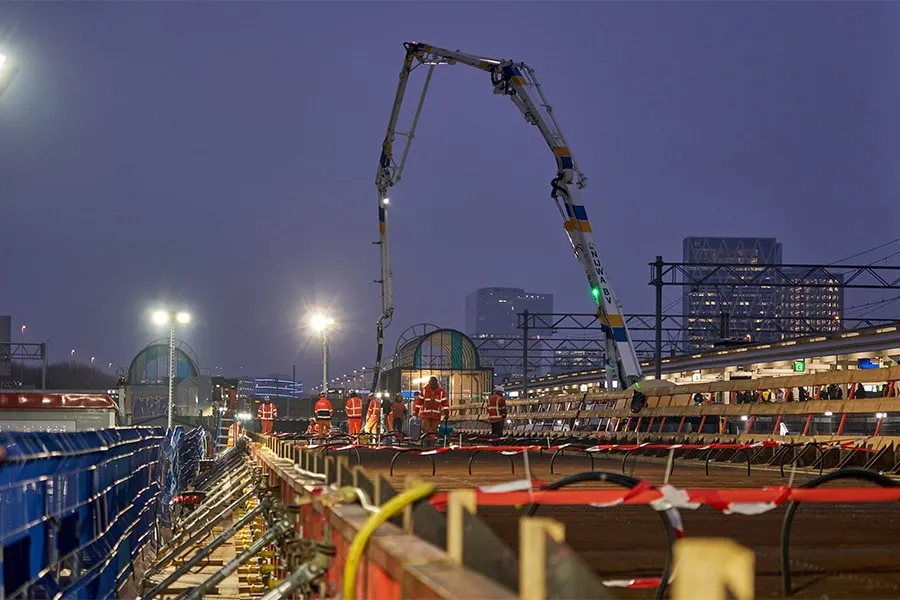
Phasing is essential
Carrying out the work in the middle of a busy urban area is another major challenge. Jelger: “Think of it simply as rebuilding a house from scratch while demolishing the old one, all while still living in it. If that is a challenge on a small scale, imagine it on the scale of Zuidas.” According to Jelger, this makes it one huge, complex puzzle. “The key is to make it manageable. Previously, Zuidasdok was one project with one contractor, but there were too many cross-connections and dependencies. So we divided the whole project into separate projects and phases. The advantage is that it makes the work more robust and predictable. Everyone can do their job while getting in each other’s way as little as possible. We have also divided the work over time. That does not make it cheaper or faster, but it does make it more achievable. By the time we start building, we have a well-thought-out plan. The construction itself is already complex enough in this environment.” Jelger gives the tunnel on the south side of the station as an example of the phasing. “Initially, we planned to build it at the same time as the Brittenpassage. After all, the faster you build, the lower the cost. Until we realised that this would no longer be manageable, with all the associated risks. At the same time, we remain ambitious enough to deliver the whole project within the planned timeframe. For Zuidasdok, as the client, the challenge is to strike a balance between working as independently as possible and combining different projects wherever we can.”
Safety is a priority
Alongside balancing the work, safety is another key issue. This means the safety of passengers, road users, people working in Zuidas and passers-by, as well as the safety of the structures, so that they will last for more than a hundred years. Erik: “We are working right next to public spaces and between two motorways. You cannot simply close something off or shut it down. We want to minimise disruption to traffic and to the people who live and work here. That means much of the work takes place at night, at weekends and during holidays. Before any work can start, detailed construction plans are drawn up, addressing safety in the surrounding area, accessibility and liveability. During the work, strict checks are carried out to ensure everyone follows the safety rules.”
A unique partnership
Zuidasdok is a unique partnership. On 26 August 2021, Bouwcombinatie Nieuw-Zuid signed the first phase of the contract, namely the construction of the second station passage, the Brittenpassage. Construction of the next phase of the station modernisation will start in 2026. The official go-ahead is important, as it means design and preparation can begin now. This phase of the station modernisation will also have a major impact on rail, metro and road traffic, and requires timely coordination with all the transport operators and infrastructure managers involved. Jelger: “At ProRail, we have gained a great deal of experience in managing passenger flows during station renovations. Think of the renovations at Utrecht Centraal, Arnhem and Rotterdam.” In its collaboration with Zuidasdok, the construction consortium focuses primarily on the technical challenges. Who has which expertise, and how can we make the best use of it in our work? “For each section, we work together to establish the right conditions. We look at how the work will be built, and what risks and costs are involved.”
First milestone
Asked what they are both proud of, each man has his own priority. Erik: “I am proud of the collaboration between all the parties, and especially of the team doing the work on site. The journey has become more important than the destination, as we keep managing to fit another piece of the jigsaw into place.” Jelger is particularly proud that the project is on schedule. “We are halfway through in terms of time, and we are still on schedule. Of course, we regularly have to make adjustments, but the plan is still holding. We manage that because we do it together. It is easy to blame someone else, but we make a plan together and adjust it together whenever necessary. If we keep going like this, we will get there. I am looking forward to the opening of the Brittenpassage. For me, that is the first milestone. At the moment, people are mainly experiencing the disruption, without seeing any tangible results: temporary platforms, diversions, construction fencing and occasional closures. But once the Brittenpassage is ready, there will be something impressive to show, and people will see the first results of years of hard work.”
Have a business enquiry for Mobilis? Get in touch
Who worked on Zuidasdok
- construction consortiumVan GelderIn this story
- clientZuidasdokIn this story
- demolition workStruijk Sloop- en GrondwerkenMentioned in ‘Circular demolition is a journey we embark on together’
- contractorBouwcombinatie Nieuw-ZuidMentioned in ‘Circular demolition is a journey we embark on together’

Keep following this
Get an email when a new story is published. No account needed.
- ProjectZuidasdok
- SubjectNews
- CompanyBoskalis Nederland
- CompanyMobilis
- CompanyVan Gelder
- CompanyZuidasdok







