









Keeping our feet on the ground while understanding what happens below it
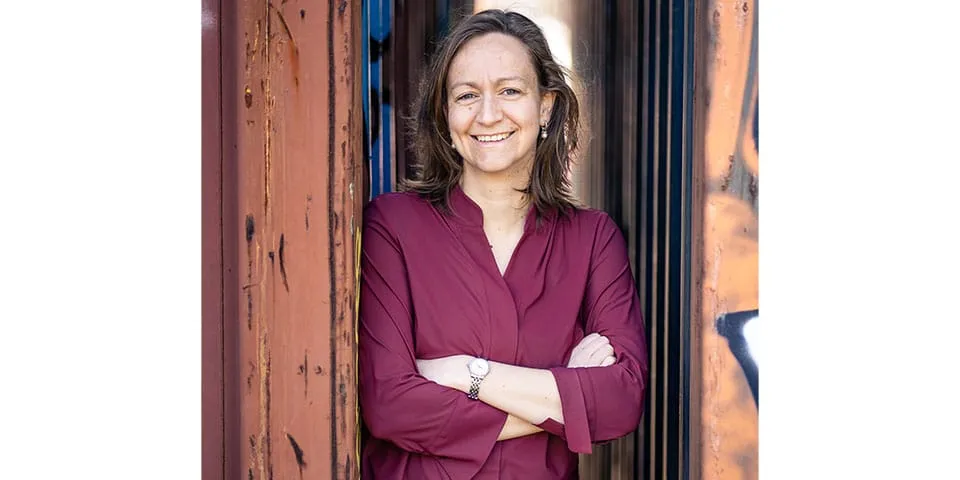
We are often inclined to ignore what we cannot see directly. That applies to everything hidden from view underground, too. But there are specialists who can see what is invisible to the naked eye. These geotechnical engineers provide advice and carry out calculations on everything relating to soil strength and stiffness.
Royal HaskoningDHV in Nijmegen has a team of ‘ground engineers’ comprising no fewer than 16 people. Their team leader is Monique Sanders, MSc, Associate Director Advisory Group Infrastructure. She has a strong vision of how best to work together to bring out the best in people.
From excavation support to flood defences
“We provide advice and carry out calculations to determine the strength and stiffness of the soil. Our team designs excavation support systems, foundations, sheet pile walls and flood defences, to name a few examples. So we focus purely on calculating soil strength, not on what is built in or on it,” Monique begins. “For example, we calculate foundations for airport runways, bridge abutments and quay structures. Our clients include contractors, construction projects, Rijkswaterstaat, water authorities, provinces and local authorities. Overall, we work for both the public and private sectors, in the Netherlands and abroad. We spend a lot of time overseas, directly supporting projects and discussing designs.”
A passion for excavations, tunnels and quay structures came naturally
“When I started my Civil Engineering degree in Delft, I had no idea I would ever end up in this field,” Monique continues. “During my studies, I developed a passion for water engineering and water management. That is why I chose a Master’s in Structural Hydraulic Engineering. I loved deep excavations, tunnels and quay structures. It was a great combination of the maritime side and the practical side, geotechnical engineering.”
Monique worked on Adam Bezuijen’s PhD research at Deltares, supervised by Adam and Bert Everts. “We investigated grouting as a mitigation measure for foundations during construction of the Noord/Zuidlijn. It was a wonderful project, especially because I was given so much freedom. That prompted me to apply for a job as a geotechnical engineer. I wanted to work in a group in the maritime sector. That brought me to Royal HaskoningDHV in 2007.”
The only woman in a male-dominated world
When she started work in 2007, Monique had not realised during her studies that she would be the only woman in a male-dominated world. She says: “The first year was quite a challenge for me. Fortunately, I received a lot of support from my manager and was given plenty of scope to shape my role. I looked at what I would like to see done differently and drew up a detailed plan setting out what I wanted to learn and how I wanted to develop.”
Things have changed considerably since 2007: “We have many more women working here now than we did then, and our people are more diverse. I have also worked hard to bring about that change. People approach work differently nowadays. I quickly built up a network within the company and became friends with some colleagues. Work should above all be enjoyable. I have always enjoyed, and still enjoy, our international projects.”
Staying involved in the technical work
In 2016, Monique’s manager decided to take a different direction, and the position she holds today became available. “I thought carefully about it beforehand, because suddenly there was an opportunity to have a real, substantial role in shaping change. The biggest change I wanted to make was to be there for people: to always have an open door for colleagues and be as accessible as possible,” Monique explains. “But I remain actively involved in the technical work; that hasn’t changed. I do give careful thought to how teams are put together. I don’t form teams based only on skills; I also consider the personalities of the team members. They need to work well together to get the best out of both the people and the work. Call it coincidence or not, but the first three people I interviewed in this new role were women. That was very welcome, given our aim of promoting greater diversity!”
A safe and supportive working environment
Monique notes that more women are applying for advertised vacancies. “It may help that they are applying to a woman. That makes them feel safe. I also see a change in the men’s attitudes: they are more open in their interactions nowadays and value social conversations more, even in the site cabin! Do men behave differently when there is a woman present? Definitely.”
Creating a safe and supportive working environment is one of Monique’s priorities. She wants people to be themselves and gives them the space to do so. “That helps you work more closely together and deliver better teamwork. You get further together. We are all human, and each of us has problems from time to time. Then we help each other through them. Reaching that level means you have achieved a lot.”
(With thanks to Nina van Arum for nominating this Top Woman. Nina is co-owner of Provades and founder of the Topvrouwen Bouw & Infra networking organisation, a growing network that now has more than 750 active female members.)
Question about this story? Ask your question
Keep following this
Get an email when a new story is published. No account needed.
- ThemeUnderground construction
- SubjectNews







