









Government climate challenge and opportunities for infrastructure
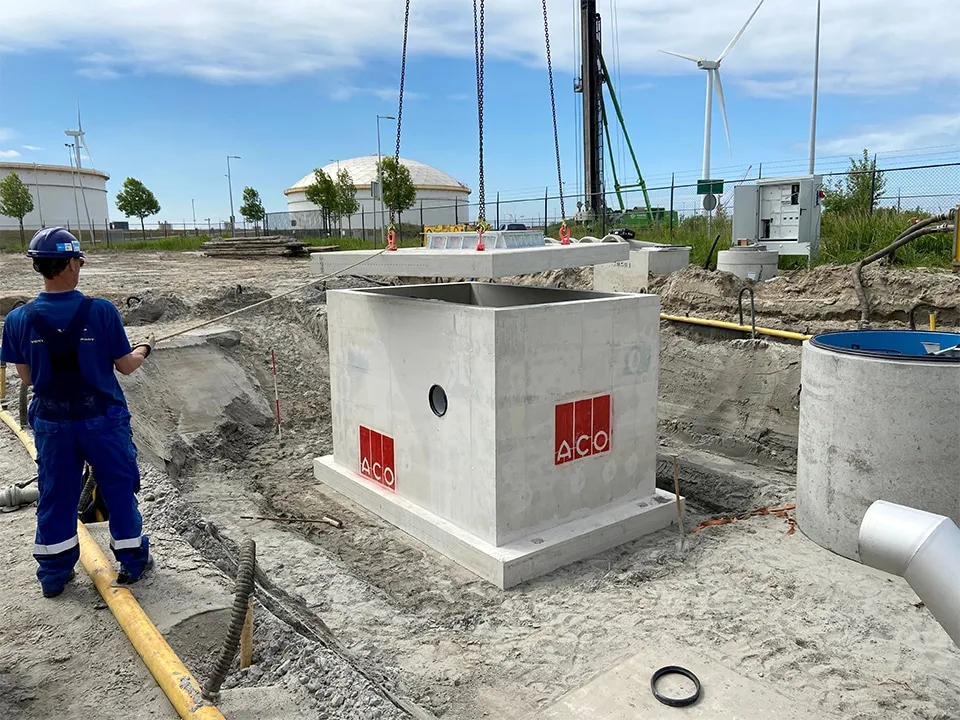
The government faces a climate challenge. Improving the quality of surface water runoff is therefore important to reduce the burden on the sewer system and prevent flooding.
There is still much to be gained, particularly on business parks. How can we help the government prevent the discharge of polluted water, reduce the burden on the sewer system and prevent flooding?
Improving the quality of surface water runoff from business parks
Climate change is bringing increasingly extreme weather. Heavy rainfall and dry periods are becoming more frequent. Heavy rainfall causes flooding, while at other times water shortages lead to drought. Flooding causes considerable disruption and damage for residents and businesses. The government therefore faces a climate challenge.
In the past, rainwater often flowed directly into the sewer. In the context of climate adaptation, collect, clean, hold and release have become important elements in the drainage chain. Today, we want to prevent flooding and reduce the burden on the sewer system. This requires better-quality surface water runoff. On business parks in particular, runoff often contains pollutants originating, for example, from stored materials or caused by wear to car tyres and brake linings.
Disconnecting rainwater from the sewer is a highly efficient way to prevent the sewer system from being overloaded by excessive rainfall and to make better use of the water. This approach is being adopted in more and more places, sometimes as a requirement. Large public areas and industrial sites are particularly suitable for disconnection. There is a risk that runoff from these sites will be contaminated with oil or fine sediment. An oil and petrol separator (OBA) with a very high capacity is therefore desirable. This entails a substantial investment, but other solutions are available.
A smart OBA with a buffer cuts costs and supports the climate challenge
Instead of installing an OBA with a very high capacity, you can choose to bypass excess wastewater. In that case, only the “first flush” will be treated, rather than the entire flow resulting from the rainfall event. If you want to ensure that all runoff is treated without bypassing, there is another option. Excess water can be stored temporarily and passed through the OBA later. This is just as effective, considerably more efficient and therefore cheaper. But you need to know how to do it. That is why the sales engineers at ACO can engineer a smart, bespoke solution. A good example is the bespoke solution developed for PARO Amsterdam, a specialist in processing construction and commercial waste.
PARO’s site has a large catchment area. When the site was expanded, careful consideration was given to a new treatment system that complies with current laws and regulations. After all, the discharge of polluted rainwater must be prevented. PARO set the requirements, and ACO engineered a much more cost-effective solution. Because PARO accepted that rainwater would remain on the site temporarily, the water could be collected and stored without the need for additional, costly underground storage.
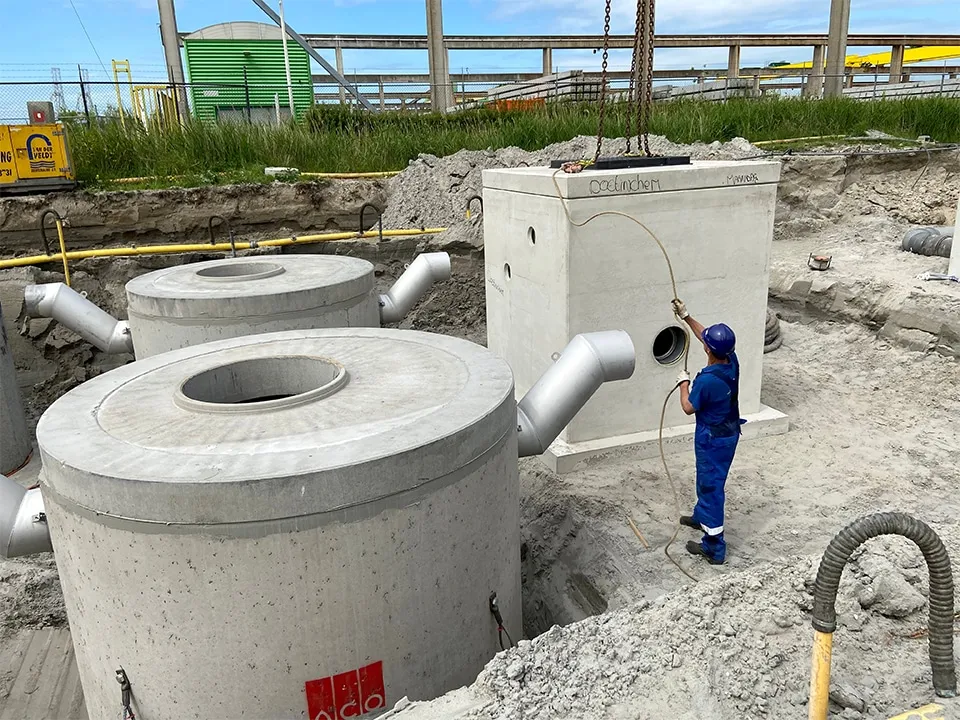
Where an OBA with a capacity of NG 900 might otherwise have been installed, the chosen solution is now two oil and petrol separators connected in parallel, each with a capacity of NG 160. A distribution chamber equipped with two flow regulators prevents the OBA from being overloaded during heavy rainfall. Using the storage capacity of the site’s drainage system, together with a pump chamber that pumps excess water to a temporary buffer, prevents flooding.
After a rainfall event, an automatically controlled valve releases the entire contents of the buffer through the OBA for treatment, after which the water can be discharged into the Noordzeekanaal. During dry periods, water from the buffer is also used to keep stored products wet. A fine example of rainwater reuse and climate-adaptive design for a business park.
When designing climate-adaptive business parks, it is essential to consider every drop of water. ACO would like to hear about your climate adaptation challenges in the infrastructure sector.
Question about this story? Ask your question
Keep following this
Get an email when a new story is published. No account needed.
- ThemeFlood protection and climate-resilient water management
- SubjectNews







