









Fugro investigates piping beneath dikes on tidal sand
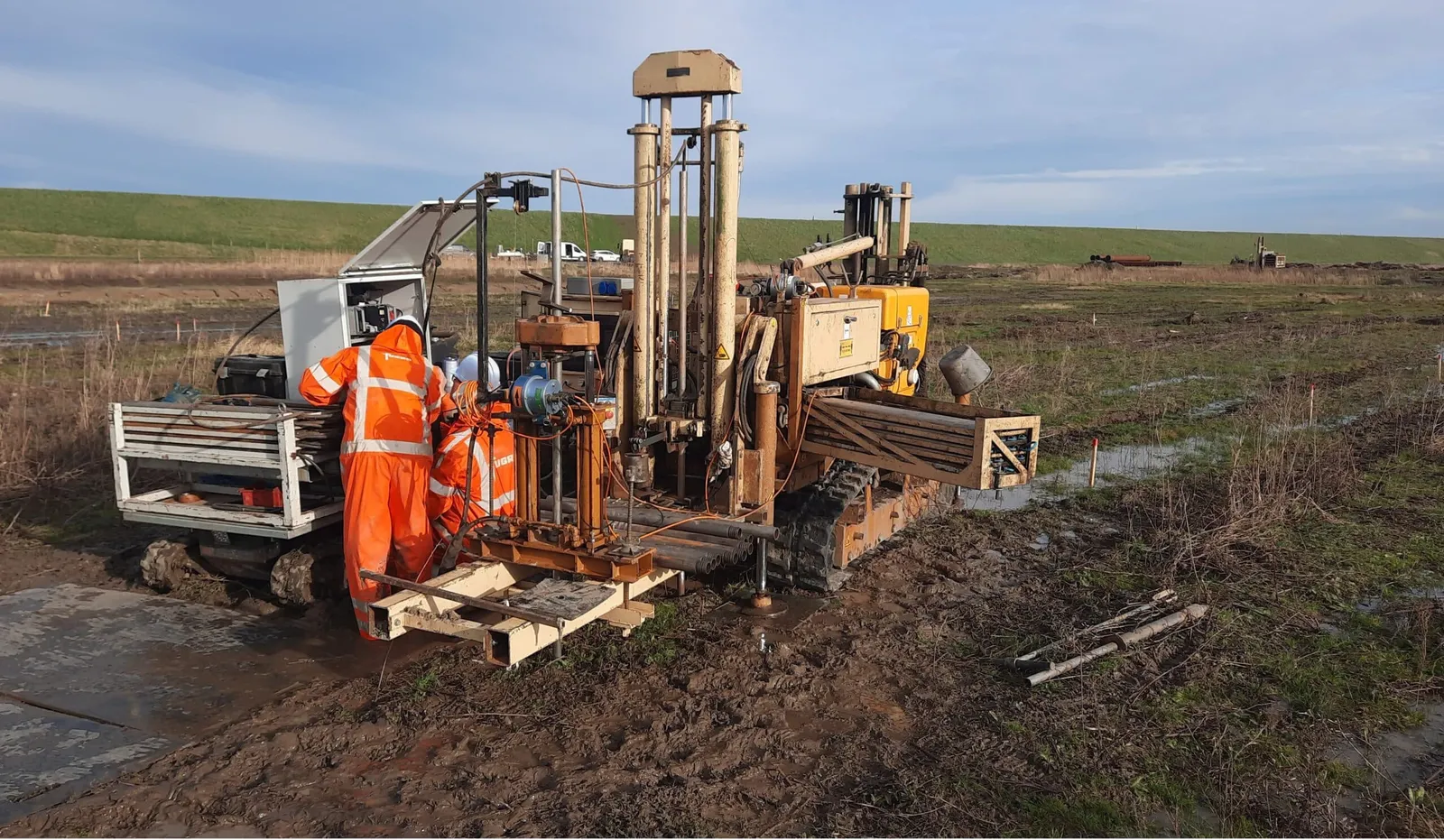
One of the failure mechanisms assessed in Dutch flood defences is piping: the formation of channels in the sandy subsoil beneath a dike, through which water seeps.
Small amounts of seepage are not a problem. But a larger flow of water carrying sand can seriously weaken a dike. In the latest assessment round, many dikes failed to meet requirements under the current calculation rules, partly because of the risk of piping. Detailed practical knowledge of this failure mechanism is still lacking, making further research necessary.
Dikes on tidal sand may be stronger than expected
In 2020, Fugro, Deltares and Wetterskip Fryslân carried out a field trial on the Frisian coast of the Wadden Sea. The results indicated that sand deposited by the sea appears to be much less susceptible to piping than sand deposited by rivers. The current calculation rule used to assess and design dikes is based on river sand. If tidal sand proves to be stronger, fewer dikes will need reinforcement, or reinforcement can be carried out at lower cost, with less impact on the surrounding area and the environment.
Commissioned by waterschap Hollandse Delta, Fugro and Deltares have now started a large-scale field trial in the Hedwigepolder in Zeeuws-Vlaanderen, building on the results of the trial in Friesland. The Hedwige project aims to determine the actual resistance of tidal sand to piping. This knowledge will then be translated into practical guidance for the assessment and reinforcement of flood defences. The Hedwigepolder piping trial is part of the international Living Lab Hedwige-Prosperpolder project. The project initiator, Departement Mobiliteit en Openbare Werken/Waterbouwkundig Laboratorium, is working with STOWA to facilitate dike-strength trials and emergency exercises.
Funding from the Flood Protection Programme
As the Hedwigepolder is being returned to nature, it provides an opportunity to carry out an extensive field trial. The Flood Protection Programme (HWBP) has made more than 5 million euros available to waterschap Hollandse Delta for this purpose through its Knowledge and Innovation Agenda. Initial preparations began in mid-2020. Based on the soil profile and subsoil properties, Fugro and Deltares have now selected a test site with a suitable, naturally deposited layer of tidal sand. The trial will be carried out in 2021, with results expected in 2022.
Innovative research method
Fugro is carrying out the geotechnical and hydrological investigations that will inform the trial design, in close collaboration with the project partners. An important factor is the permeability of the tidal sand. This is measured using the innovative AMPT® probing technique, developed by Fugro.
Gert-Ruben van Goor, project manager at Fugro: ‘AMPT stands for anisotropic mini pumping test, an efficient addition to Hydraulic Profiling Tool (HPT) soundings. One advantage of this method is that it provides a much more detailed picture of the subsoil structure. Permeability can be measured more accurately both horizontally and vertically than with other, large-scale techniques. This makes it possible to map not only the different soil layers, but also variations in permeability within individual layers. We use this to build a highly accurate digital 3D model of the subsoil. Deltares uses our measurements to create a 3D groundwater flow model, providing an accurate picture of water flows through the sand layer. This, in turn, improves the results of the piping risk analysis, which Fugro and Deltares will use as the basis for their recommendations following the trial.’
Savings of 100 million euros
A typical dike reinforcement costs around 6 million euros per kilometre. If this trial makes it possible to determine the risk of piping more accurately, fewer kilometres of dike may need to be reinforced, or dikes may not need to be built as wide as previously thought.
Marco Boer, project manager at waterschap Hollandse Delta: ‘The Hedwigepolder offers us a unique opportunity to carry out this innovative field trial in close collaboration with many partners. At waterschap Hollandse Delta, we are keen to support and facilitate innovative projects. We hope and expect that dikes with tidal sand in the subsoil will need reinforcement less often. This could save an estimated 100 million euros across the Netherlands and limit the impact on the environment and surrounding areas.’
Significant environmental benefits
A further benefit is the potential to significantly reduce the environmental burden, as dike reinforcement will require less space and fewer materials. This means, among other things, fewer transport movements and less noise and vibration at dike reinforcement sites. It will also significantly reduce CO2 emissions from lorries and earthmoving machinery. In short, the impact on the immediate surroundings and the environment will be reduced.
A business enquiry for Fugro? Get in touch
Companies in this story
Keep following this
Get an email when a new story is published. No account needed.
- ThemeFlood protection and climate-resilient water management
- SubjectNews
- CompanyFugro







