









Delivering infrastructure and water engineering projects sustainably
Text Roel van GilsImage Verboon Maasland en Vincent Basler Fotografie
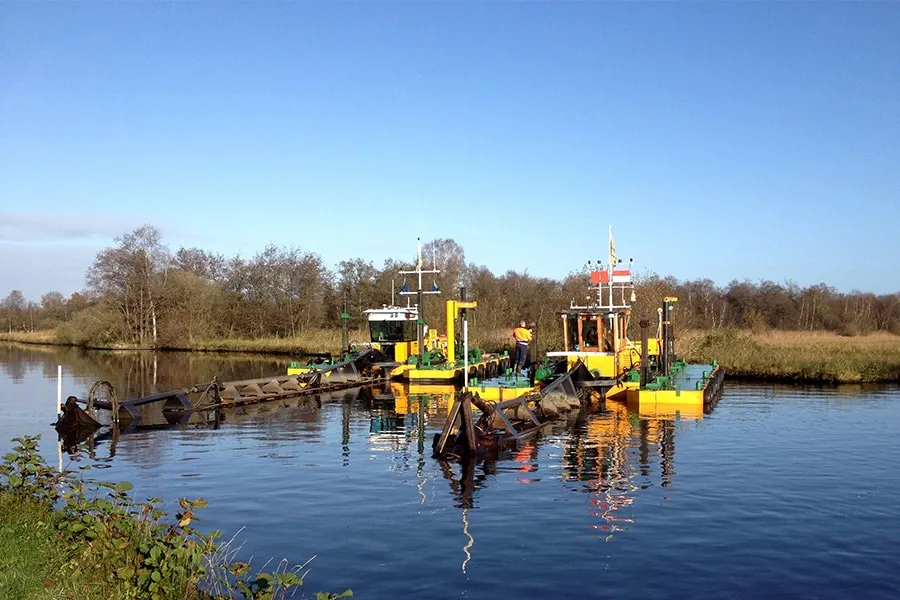
Since 2020, Verboon Maasland has had a clear focus on delivering its projects sustainably at the interface between land and water. The first electric cutter suction dredger entered service in 2021, an electric 100-tonne cable-operated crane has recently been commissioned, and this summer the company will have access to a fuel cell, ready for a pilot project following a collaboration with Nexus Energies. “In today’s climate of CO2 and nitrogen reduction, we are able to carry out many of our specialist operations entirely emission-free,” says Ruud van Wijk, director of Verboon Maasland. “We are taking responsibility and investing in the energy transition. Now it is up to clients to do their part.”
There is often no shortage of initial interest in delivering projects emission-free, but when it comes down to it, many clients eventually pull out, Van Wijk has learnt from experience. “The market is still in a transition phase. On the one hand, this phase is characterised by targets set by the government to move towards low-emission and emission-free project delivery. On the other, budgets are often proving inadequate. Electric equipment is simply more expensive, and in many cases in water engineering and infrastructure, additional facilities are also needed, such as a suitable construction site or shore power connection. It is then tempting to fall back on what is familiar: traditional diesel fuel and HVO100. That is typical of the transition phase we are all going through, and which will last for years to come,” Van Wijk expects.
Subsidies for emission-free operations
According to Van Wijk, projects currently being put out to market by government bodies are still budgeted on the basis of the era before demand for emission-free operations and more ambitious climate targets. “The budgets do not yet take emission-free operations into account, so they are inadequate. That may seem worrying, but fortunately there are initiatives (in other words, subsidies) that clients can apply for. Rijkswaterstaat, for example, has a dedicated fund to encourage the use of emission-free equipment. Water boards can also access additional funding, on top of the project budget, to promote emission-free operations. We therefore encourage clients to champion sustainable delivery, to seek this additional funding from the national government, and above all not to remain stuck in the old way of doing things.”
Electric cable-operated crane
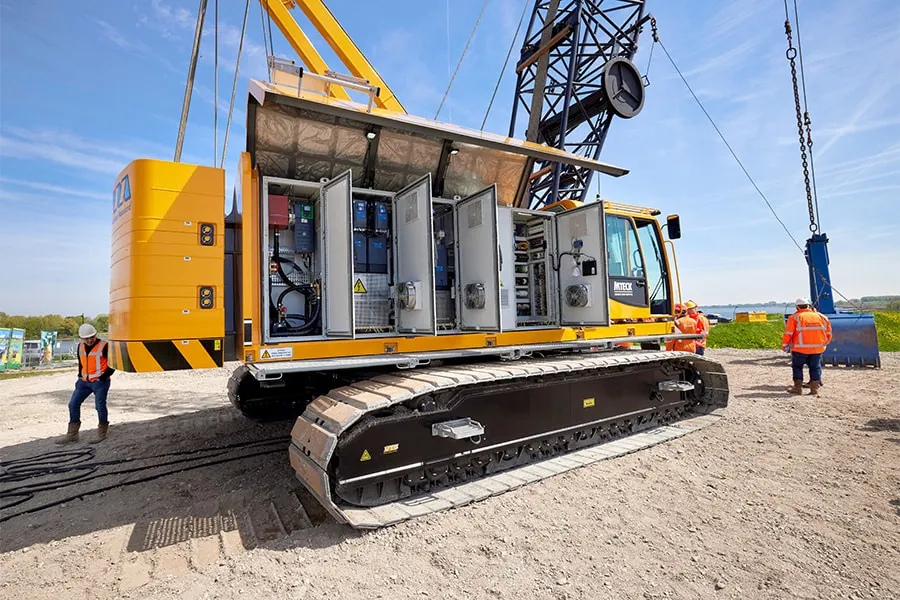
With its electric cutter suction dredger, Verboon Maasland was among the early adopters. The company is now taking sustainable steps in another of its specialist areas: excavating water-filled construction pits. “We are well known across the country for this work and have been active on almost all of the major infrastructure projects in the Netherlands, including the Rijnlandroute, A13-A16 Rotterdam (De Groene Boog) and the A24 Blankenburgverbinding,” says Van Wijk. “In 2021, we decided to invest in a new 100-tonne cable-operated crane to expand and modernise our fleet. It is capable of operating entirely emission-free. The machine was custom-built by MTeck of Stellendam, which has been building electric cranes for use in ports and on ships for many years. It was also their first electric crawler-mounted crane for land-based use in the Netherlands. This machine now enables us to excavate water-filled construction pits and sunken road sections entirely emission-free, including fully emission-free hydraulic transport using electric booster pumps to a disposal site that may be several kilometres away. It is absolutely unique.”
Pilot project sought
As Verboon Maasland also works in locations without a construction power supply, where one cannot be installed, and still wants to operate emission-free, the cable-operated crane can also be powered by a fuel cell. “The business case needs to stack up,” Van Wijk acknowledges, but immediately adds that two years ago they signed a letter of intent with Nexus Energies, which is developing fuel cell technology. “In practical terms, this means that from this summer we will have access to a fuel cell capable of supplying enough power for our electric cutter suction dredger or our 100-tonne electric cable-operated crane. So even in locations without shore power, such as on the water or in Natura2000 areas, we can operate our crane and cutter suction dredger entirely emission-free.” Verboon Maasland and Nexus Energies are calling on clients to carry out a pilot project with them, demonstrating that emission-free operations really are possible for Dutch society.
Question about this story? Ask your question
Keep following this
Get an email when a new story is published. No account needed.
- ThemeLower emissions and more reuse
- SubjectNews







