









Althen Sensors & Controls and Smartbrick through to next phase of innovation competition for monitoring bridges and quay walls for the City of Amsterdam
The City of Amsterdam recently informed Althen and seven other companies that they had progressed to the next phase of the SBIR call (Small Business Innovation Research).
In mid-2020, the City of Amsterdam and RVO invited Dutch businesses to submit an innovative proposal to measure the city’s bridges and quays more frequently, quickly and cost-effectively. Of the 43 submissions, eight companies have progressed to the second phase.
Each company will receive €12,500 to conduct a feasibility study and further develop its concept. According to the assessment committee, all eight winning submissions were of a high standard, highly innovative and feasible. For this innovation tender, Althen has begun developing a new IoT sensor, specifically designed for affordable monitoring of quays and bridges, called Smartbrick. The eight winning companies that will conduct the feasibility study are Antea group, Bam Infra + Rezzona, Fugro, IV Infra, Sensar, SHM Next, Villari and Althen.
Smartbrick
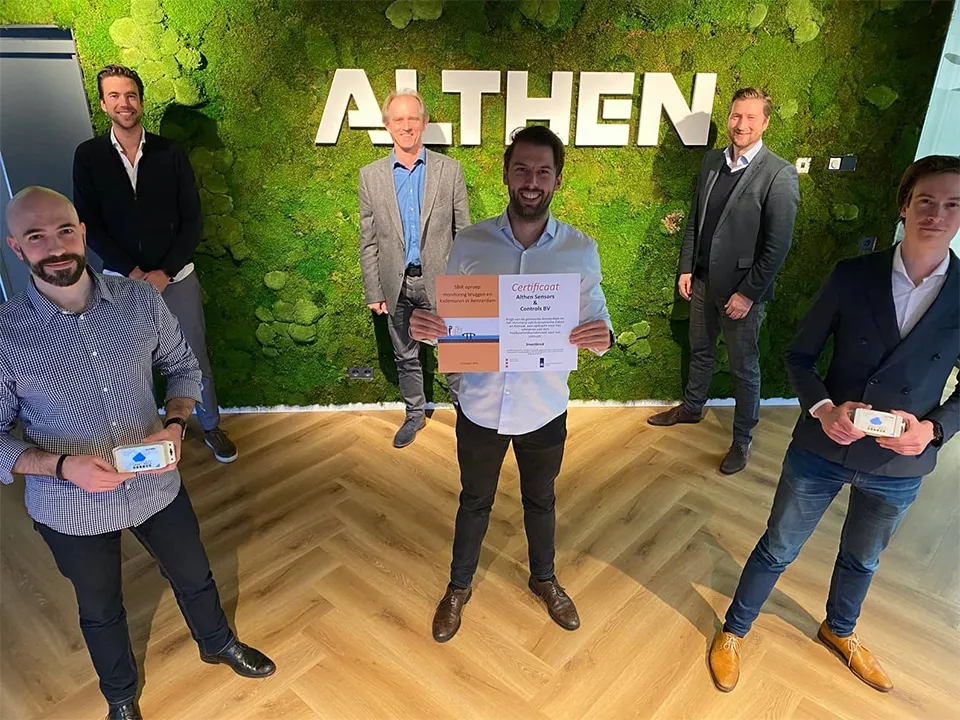
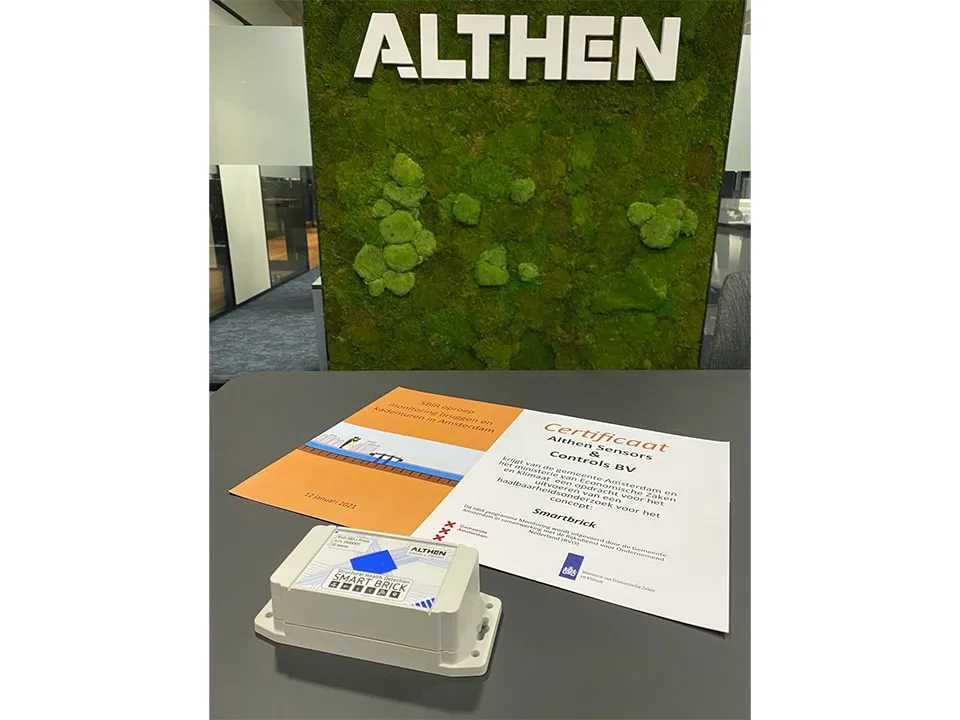
Smartbrick detects and monitors the key movements that a quay or bridge can undergo, transmitting the data wirelessly and directly to an online control centre. This makes it possible to set the right maintenance priorities. Althen has now built the first prototype and will continue developing it, making a tangible contribution to a safe and accessible Amsterdam.
Technical rigour and innovative impact
The selection criteria included potential, feasibility, innovation and applicability in an urban environment. Frits van Loenen, rail systems engineer at ProRail and a member of the assessment committee, says enthusiastically: “I was pleasantly surprised by the high standard of the proposals and the technical expertise. All the proposals focused strongly on collecting data. What is truly innovative is the use of advanced techniques such as photogrammetry, 3D laser scanning, distance measurements from a floating platform and satellite imagery to go beyond simply managing large volumes of data. The data contribute to technical inspections that should lead to a structural assessment, recommendations and risk predictions. My fellow committee member Agnieszka Bigaj-Van Vliet put it very aptly: ‘deepening, refining and improving the assessment of the risk profile’. I can only wholeheartedly agree. The challenge is to translate the technology in a way that enables others to make informed decisions about measures, such as more frequent monitoring, repair or renewal.”
Refining the risk profile
That is indeed one of the aspects assessed by Agnieszka Bigaj-Van Vliet, senior scientist integrator at TNO-TU Delft. “It goes beyond simply measuring,” she explains. “The solutions need to help the City of Amsterdam make informed statements about its asset base. The data need to be given meaning and contribute to risk assessment.” She says she is impressed by the diversity of the proposals, the extent to which the companies have immersed themselves in the Amsterdam context, and their capacity for innovation. “I also saw that they had thought carefully about what is realistic and which elements are critical. That gives us confidence in the innovation capacity and professionalism of the teams now undertaking the feasibility study.”
Interaction between industry and academia
These new solutions build on applied scientific research. “Academic innovations do not always reach the market quickly, and it can be difficult for market players to access scientific knowledge,” says Agnieszka Bigaj-Van Vliet. “This competition has encouraged industry to take steps to build on knowledge developed in academia. And you can see a two-way exchange taking place as knowledge is transferred between research institutions and industry. I think that is very positive.”
What happens next
The companies will begin work on their feasibility studies in early 2021, with support from the City of Amsterdam and RVO (Netherlands Enterprise Agency). They will complete the studies by mid-April and submit proposals for further development of their technologies. A new assessment round will then select four companies to continue testing their solutions and validate them at trial sites provided by the City of Amsterdam. Each will receive a budget of up to €100,000, including VAT. This is phase 2, which runs from June 2021 to June 2022.
About Althen Sensors & Controls
Confidence for visionary engineers: Althen Sensors & Controls gives its customers certainty and confidence. We make sure customers have nothing to worry about when it comes to sensors and measurement solutions. By working alongside our partners and customers as their sensor partner, we help build the technology of tomorrow. We supply standard and custom sensors, measurement systems and instrumentation for Test & Measurement, OEM and IIoT applications across all industries.
Althen has offices in the Netherlands, Germany, Sweden, France and the United States.
Question about this story? Ask your question
Companies in this story

Keep following this
Get an email when a new story is published. No account needed.
- ThemeExtending the life of roads and civil engineering structures
- SubjectNews
- CompanyFugro
- CompanyAlthen Sensors & Controls







