









World’s longest 3D-printed bridge rolls off the printer
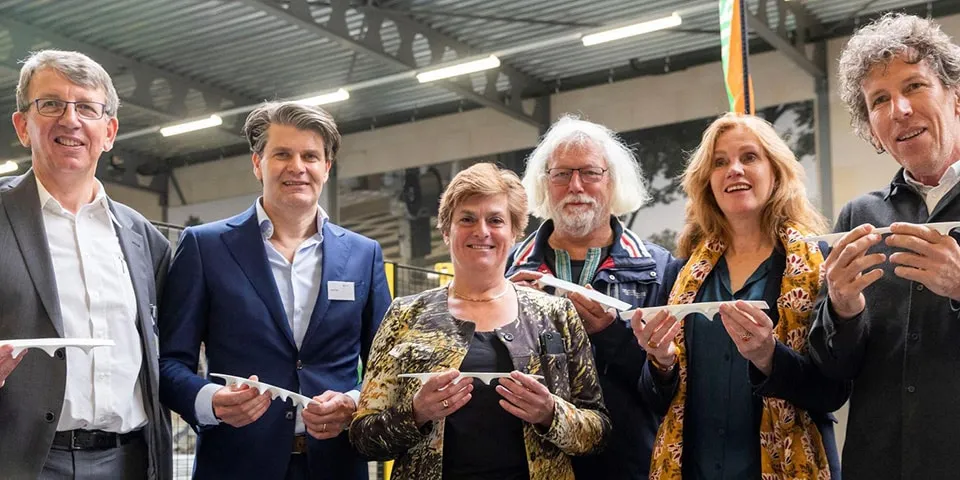
Printing has started this week on the world’s longest 3D-printed concrete bridge. Clients Rijkswaterstaat and the municipality of Nijmegen, along with dozens of curious residents of the Dukenburg neighbourhood, where the bridge will be built, visited the print factory of Saint-Gobain Weber Beamix and BAM Infra Nederland.
Over the coming weeks, specialists from BAM Infra and Weber Beamix will print almost one hundred bridge components designed to fit together like a jigsaw puzzle, complete with recesses for tensioning the concrete. After the summer construction holiday, all the elements will be transported to the site for assembly. The finishing work and final tests will follow.
From innovation to proven technology
The bridge was designed by architect Michiel van der Kley. Rijkswaterstaat and Nijmegen, as clients, have shown the courage to back this innovation. Together with Eindhoven University of Technology as a knowledge partner and Weber Beamix, BAM Infra, Summum Engineering and Witteveen+Bos as industry partners, they are turning this innovation into a proven technology.
“At Rijkswaterstaat, we aim to turn promising innovations into reality,” says Nelly Kalfs, Director-General of Rijkswaterstaat East Netherlands. “3D printing technology has the potential to make construction more affordable, faster, more sustainable and more flexible in form. Initially, this technology is likely to be of particular interest and use to municipalities and provinces.”
Alderman Harriët Tiemens: “Nijmegen has had a fantastic year as European Green Capital. It is wonderful that we can add a new, innovative, sustainable 3D-printed bridge to that. It is good that we are working with Rijkswaterstaat here in Nijmegen to shape the future. That is why I am especially pleased that today we have been able to see how the bridge is being printed with residents of Dukenburg.”
The benefits of 3D concrete printing
Using 3D printing technology creates opportunities for the design and construction of structural applications in the building industry. It offers design freedom, and changes are immediately recalculated in the 3D design environment. The design is translated into code that the printer uses to produce it. This digital design and construction process reduces the risk of errors and eliminates the need for drawings.
Pieter Bakker, 3D printing project manager at BAM Infra: “With an optimised design, less material is needed than for traditionally produced bridges built using formwork. The printer deposits concrete only where it is needed to provide the bridge’s structural strength. Savings of 30% are achievable. 3D concrete printing does not require formwork, saving labour and making it possible to build without residual waste. 3D printing technology has the potential to make construction more affordable, faster, more sustainable and more flexible in form. With this project, the parties involved are demonstrating that this is indeed possible.”
A business enquiry for Saint-Gobain Weber? Get in touch
Companies in this story

Keep following this
Get an email when a new story is published. No account needed.
- ThemeMaterials and techniques for infrastructure
- SubjectBridge construction
- CompanySaint-Gobain Weber







