









Treatment in the workshop and on site
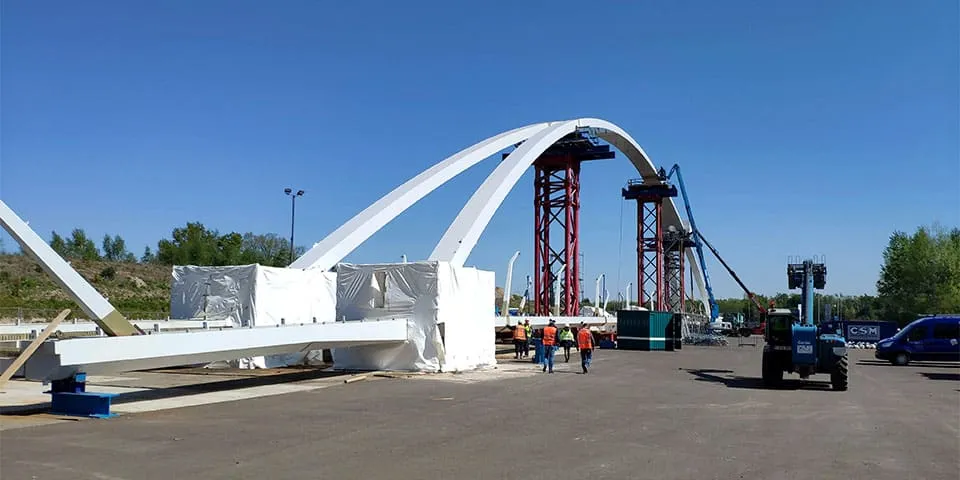
To future-proof Tegenbosch cycle bridge, all bridge components were first treated individually and then as a whole with high-quality protective coatings. Cuijpers Groep drew up a considered work plan and carried out every step systematically.
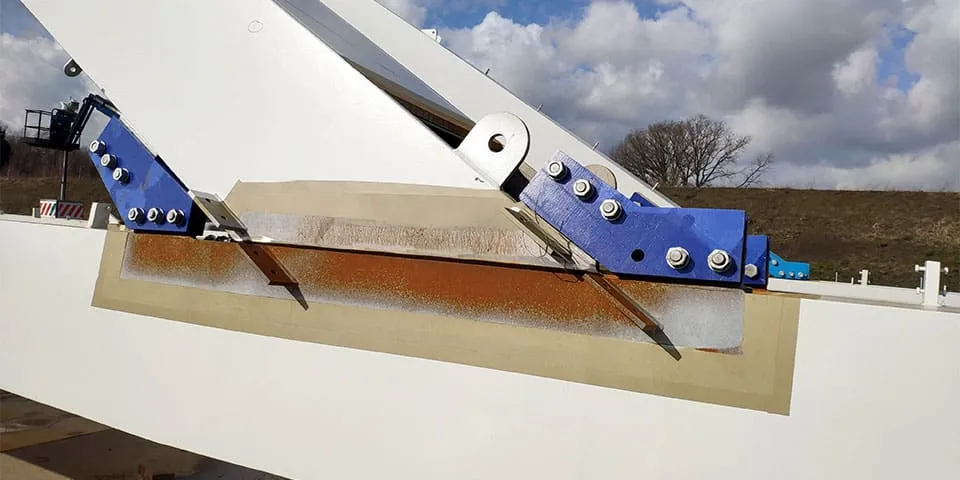
To protect the bridge as effectively as possible, all steel elements were shot-blasted, metallised, given two mist coats and then two coats of paint. The challenge was to keep the ends of the steel elements free of coatings until assembly was complete. These were treated after the bridge had been assembled in Eindhoven. For each coat, a strip was masked off for back-stepping, ensuring that the coatings applied at the assembly points overlapped with the layers already applied in the workshop. Applying the coatings after assembly using back-stepping resulted in an even system across the entire bridge.
Shot-blasting to SA 3
Thanks to this approach, almost all the work could be carried out at Cuijpers Groep’s workshop in Elsloo. Shot-blasting thoroughly cleaned the steel elements and also made them slightly rough, improving adhesion with the metallised layer. “The required standard was SA 3,” says Rob van Hengel of Cuijpers Groep. “This is the highest level of shot-blasting, at which all dirt is removed.”
Metallising
During metallising, also known as ‘thermal spraying’, the elements were coated with a molten zinc-aluminium alloy. This work was also carried out at Cuijpers Groep’s workshop. “The alloy was fed through a spray gun, heated until molten and applied to the surface,” says Stefan Dejalle. “This provided high-quality protection for the underlying layer.”
Mist coating: intermediate layers
“Because a thick metallised layer was required, we applied two mist coats to prevent pinholes, or holes in the coating caused by gas bubbles,” says Dejalle. Two intermediate coats were then applied to provide additional protection for the system, after which the elements were ready for transport to Eindhoven and assembly.
Working on site
Van Hengel: “The ends were treated in exactly the same way here. To deliver the same high standard and minimise environmental impact, shot-blasting was carried out in mobile containers and coating work in specially built enclosures. The bridge was then cleaned and given its topcoat.”
The craftsmanship of Cuijpers Groep and the care taken during treatment were closely monitored by quality inspectors. Quality tests of the shot-blasting, salt tests, dust tests, adhesion tests and coating thickness measurements showed that the work was carried out to a very high standard. Tegenbosch cycle bridge has been given a system that will protect it for many years.
Question about this story? Ask your question
Who worked on Tegenbosch
- treatmentCuijpers GroepIn this story
Keep following this
Get an email when a new story is published. No account needed.
- ProjectTegenbosch
- SubjectBridge construction
- CompanyCuijpers Groep







