









The Old Lady has had a rejuvenation!
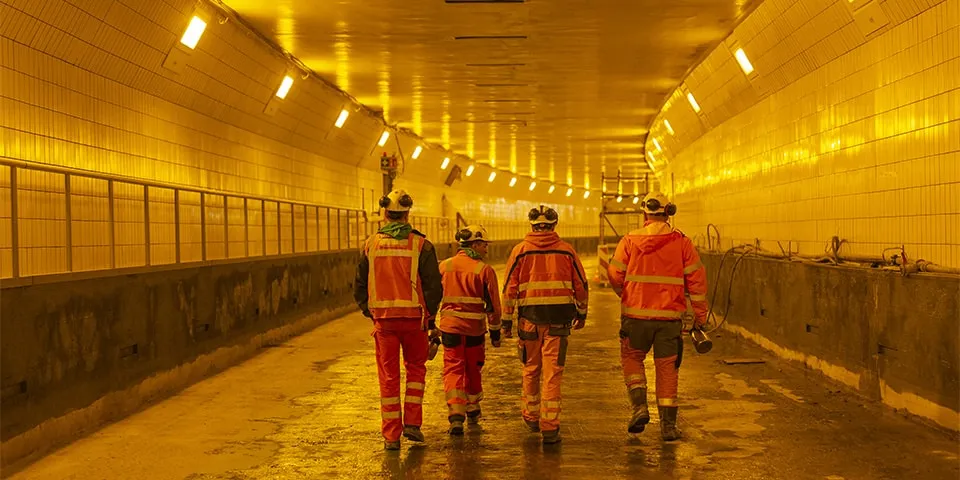
It is Monday morning, 19 August. At 4.30 am, I join the select group gathered in the specially erected marquee beside the entrance to the Maastunnel in Rotterdam. The mood is one of barely contained excitement. Today, after two years of intensive work and preparations that began with the construction partner as early as 2015, the renovated Maastunnel will finally be officially reopened.
Henriëtte Edens, Maastunnel Communications Manager at the Municipality of Rotterdam, glances anxiously at her watch. “We’re on a tight schedule. The vintage RET bus arrives at 5.00 am, carrying 22 Rotterdammers and their guests, who have won a competition. They will be the first to use the renovated tunnel, symbolically. After they have travelled back through the tunnel, we’ll welcome them with a celebratory breakfast in the marquee. Then our staff can make the final preparations to open the tunnel to morning traffic at 6.00 am.”
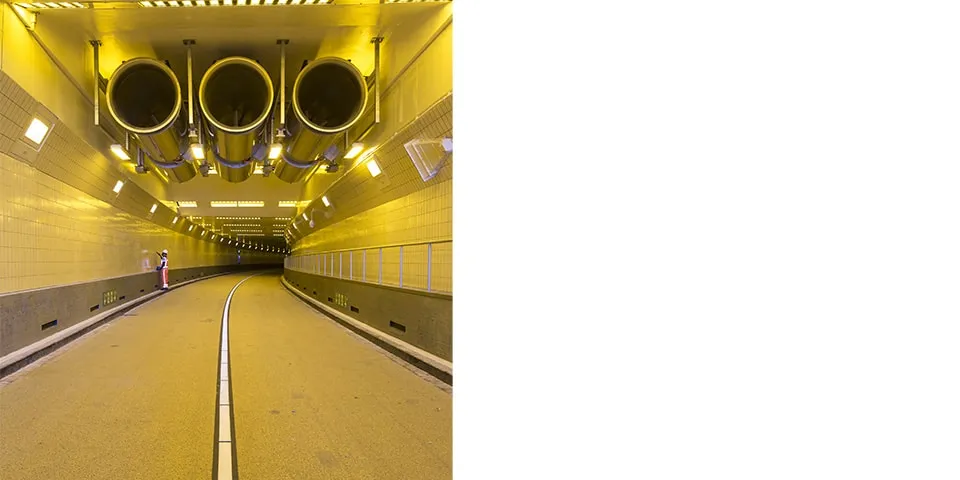
The wall cladding consists of 614,000 tiles. (Image: Carel van Hees)
A Rotterdam icon fully restored to its former glory
Ask a true Rotterdammer about their city and they’ll talk all day. The pride every Rotterdammer carries in their heart is infectious. The same pride is written on the faces of the 44 lucky people arriving in the vintage bus, before they get to be the first to travel through the tunnel. The bus idles at the red traffic lights. Expectant eyes are fixed on the tunnel entrance. Led with infectious enthusiasm by Loes Luca, they sing in an unmistakably Rotterdam style. Then the clock strikes 5.15 am, a whistle sounds, and the bus roars and smokes its way towards the tunnel entrance. Beside me, Henriëtte Edens breathes a sigh of relief. “There they go, right on time,” she says, sounding slightly emotional.
The same emotion is evident among the Maastunnel working group members and those involved from the construction consortium. Is there life after the tunnel? Edens: “Good question. It feels a little as though we’re all falling into a void. Remember, we’ve been preparing with a huge team since the end of 2015. More than 500 people in total have been involved in this project, from the Municipality of Rotterdam and our construction partner. There was a great deal of consultation and communication to be done, and our department really gave everything it had. We spoke to the people of Rotterdam and asked how they could help us. We discussed diversion routes with local residents. We made grateful use of social media, keeping everyone informed through Facebook, Twitter, YouTube and Instagram, in words and pictures. This generated unprecedented engagement and gave us a great deal of support and valuable input. This intensive communication with the people of Rotterdam helped build engagement and understanding of the project. And best of all, the Maastunnel has not only been restored to its full glory, it has once again become a true city icon that every Rotterdammer can be proud of.” Edens is still impressed by the partnership between the Municipality of Rotterdam and the construction consortium, comprising TBI companies Croonwolter&dros BV and Mobilis BV. “We were all pulling in the same direction, and everyone shared the same passion for the work. Let this way of working be a blueprint for future projects!”
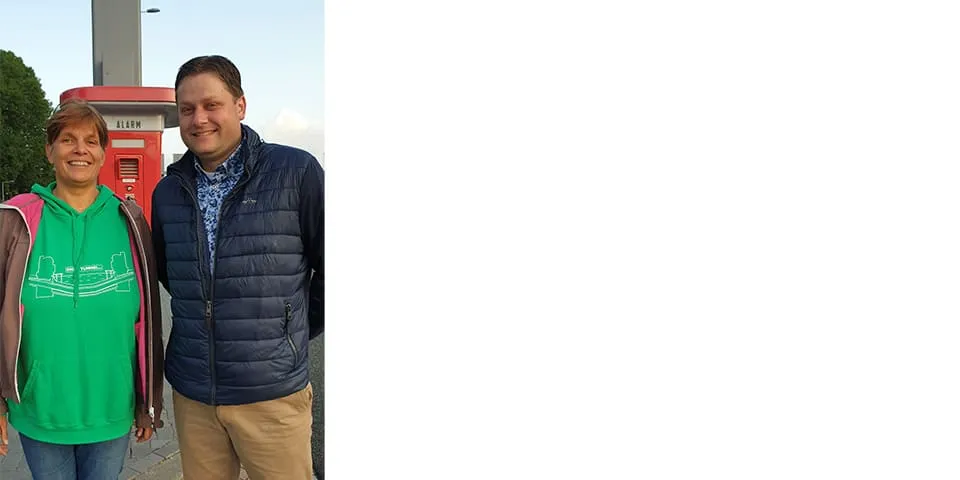
Henriëtte Edens and Benjamin Mooijaart look back on a wonderful collaboration.
The Maastunnel, a listed monument with its challenges
Benjamin Mooijaart, project manager of the ‘Combinatie Aanpak Maastunnel’ (CAM), also agrees with Edens about the collaboration. “We won the tender in 2015. The project became a true TBI undertaking, with Croonwolter&dros responsible for all tunnel systems and Mobilis for all civil engineering works. Aannemingsbedrijf Nico de Bont BV, also a TBI company, acted as our regular subcontractor for the building restoration,” he begins. CAM received the commission from Nico Bertens, who acted as the Craftsmanship Client. The major challenge for CAM? The fact that the Maastunnel is a listed monument. “That not only posed major challenges, it also led to some remarkably beautiful and innovative solutions,” says Mooijaart. He cites the LED lighting as an example. “The new tunnel regulations, not to be confused with the tunnel standard, require more lighting. To work sustainably, LED lighting was installed. To remain faithful to the original orange glow of the sodium lamps used back then (the tunnel dates from 1942, ed.), amber-coloured LED units were used. This works well for everyday traffic and is entirely in keeping with the original style, but more light is needed in an emergency. That is why the lighting can be switched instantly to bright white LEDs if needed. A brilliant solution!”
The Maastunnel’s nickname is ‘The Old Lady’. In her renovated form, however, she could more aptly be called a ‘young lady’. Mooijaart continues: “There are now considerably more systems in the tunnel than before. The new safety systems installed by Croonwolter&dros fully comply with the national tunnel regulations. These include the C2000 system (the C2000 cable has been painted to match the ceiling, preserving the original appearance),
the public address system (speakers colour-matched to the tiles), stopped-vehicle detection and cameras (with their brackets painted to match the tiles). A fibre-optic data transmission network connects all the systems. The power supply has been upgraded and renewed, with the emergency power supply fed through two incoming connections. If one connection fails, the other takes over the power supply. During the changeover, the No Break System keeps everything supplied with power for a short period.”
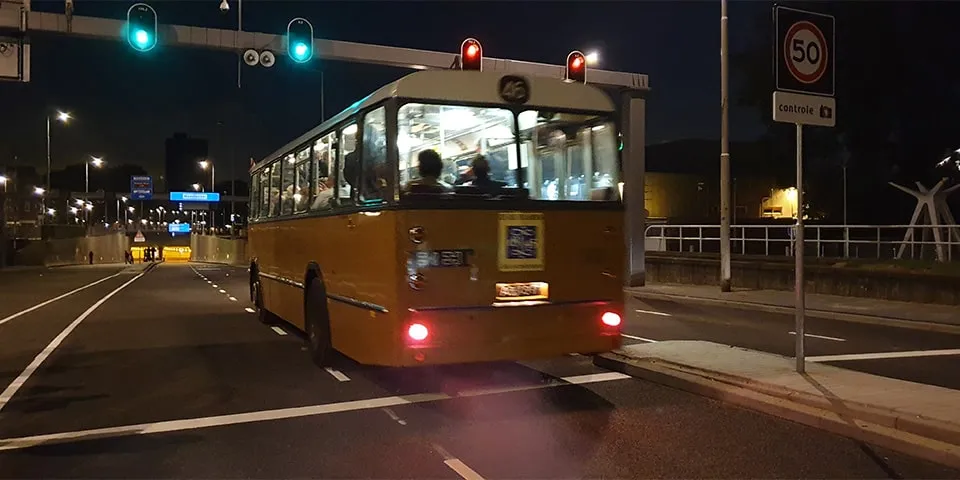
The lights turn green and the vintage RET bus (route 46 CHARLOIS Boergoense Vliet) is the first to enter the Maastunnel.
The monument’s character preserved down to the last detail
The wall cladding is a distinctive feature of the Maastunnel. It consists of 614,000 tiles. “Nico de Bont had 600,000 of them reproduced in Spain, while 14,000 original tiles could be reused. The result speaks for itself: it remains entirely faithful to the original appearance,” explains Mooijaart. “A refuge cabinet has been installed every 60 metres. These cabinets are concealed in the wall. To do this while preserving a seamless appearance, the tile dimensions were used as the basis for sizing the cabinets. Tile dimensions also determined the design of many components, including the signs above the refuge cabinets, the numbering of the escape doors and the air intake grilles for the system that measures air quality.”
A fresh breeze is blowing through the tunnel tubes again
“That’s true in both the literal and figurative sense,” says Mooijaart. “Among the civil engineering elements, the new ventilation system is another example of progress. The Maastunnel originally had transverse ventilation. It has now been converted entirely to longitudinal ventilation. Whereas transverse ventilation was designed to refresh the air, longitudinal ventilation has an additional function: extracting smoke in emergencies. To install the fans, we removed part of the tunnel tube ceiling, along with the walls above it separating the two supply ducts on either side from the extract duct in the middle. These were required for the old transverse ventilation. Finally, the roof was removed. A completely new roof was then cast to make room for the new longitudinal ventilation fans.”
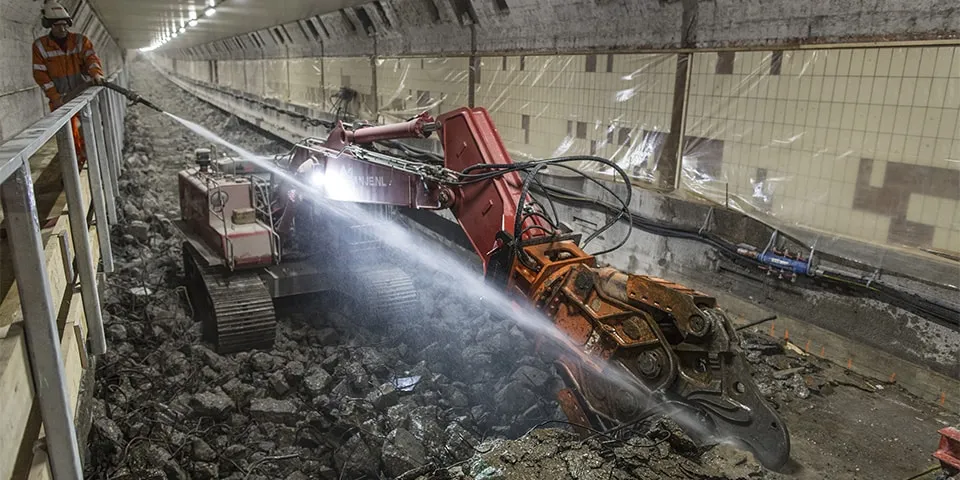
The road deck in the river tunnel is removed. (Image: Carel van Hees)
New road deck installed
The Maastunnel consists of a land tunnel section and a river tunnel section. The latter had suffered concrete cancer in the ducts beneath the road deck, which serve the transverse ventilation system. “The subfloor had been damaged by meltwater and de-icing salt. It was removed to a depth of 15cm using hydrodemolition. This method removed all the deteriorated concrete and rust from the reinforcing steel. The subfloor and the walls beneath the road deck were completely renewed, after which a new road deck was installed,” says Mooijaart.
“What is truly unique in the tunnel sector is that the work was carried out one tube at a time. The west tube was completed a year ago (in mid-2018, ed.). That means we also took over its maintenance a year ago. The east tube has now been added.” CAM’s maintenance period is relatively short and runs until the end of 2022. “After that, maintenance will be handed over to the Municipality of Rotterdam, unless other arrangements are made. The next task, now that the road tunnel has reopened, is to tackle the cycle and pedestrian tunnel. We’re busy with the preparations now, all of which fall within our contract with the Municipality of Rotterdam.”
CAM received the commission from Nico Bertens, who acted as the Craftsmanship Client.
A gift to the people of Rotterdam
Thanks to the intensive communication campaigns around the Maastunnel, Henriëtte Edens now knows that ‘her’ tunnel has rekindled a flame in the hearts of the people of Rotterdam. “It’s incredible how much appeal this monumental structure has. Take the tunnel’s birthday on 14 February this year, for example. Our Old Lady turned 77 on Valentine’s Day. To mark the occasion, we joined forces with two artists, who transformed the cycle and pedestrian tunnel into ‘the tunnel of love’. Visitor numbers were phenomenal: no fewer than 80,000 people came along. That gives us, as the communications department, plenty of inspiration! The tunnel lends itself to more events, not just in our opinion, but especially judging by the reactions of the people of Rotterdam.”
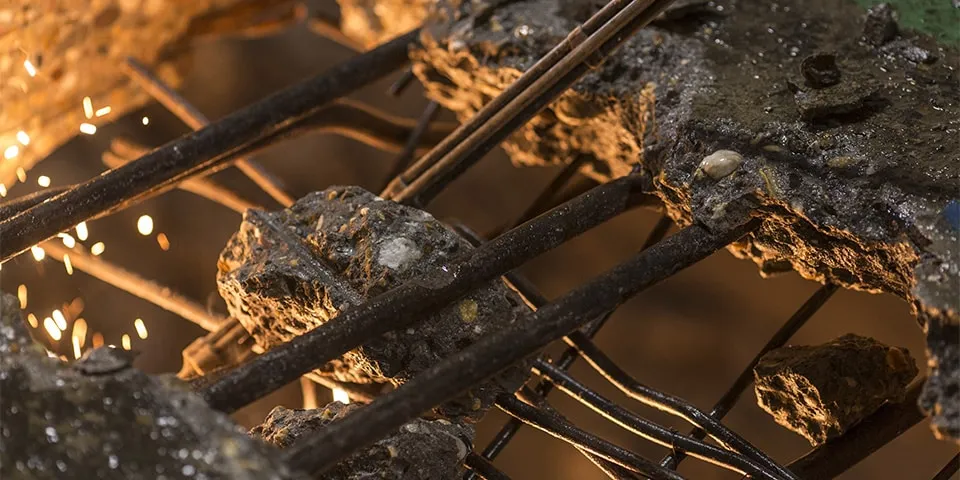
Deteriorated concrete and rust on the reinforcing steel in the subfloor were removed using hydrodemolition. (Image: Carel van Hees)
The first event around the Maastunnel will not be long in coming. “Put 5 October 2019 in your diary. That’s the day the Municipality of Rotterdam will officially give the Maastunnel back to the people of Rotterdam. It will be a real celebration, with an open day for and by Rotterdammers. We’ll just have to turn a blind eye to the fact that the tunnel will have to close once more,” says Edens, laughing.
As we continue chatting, we leave the marquee and head towards the pavement alongside the road leading to the tunnel entrance. The clock has struck 6.00 am. In the distance, we see the first headlights of the morning traffic appear. Before long, the first cars are driving through the tunnel as usual, honking loudly at the colourful group waving them on. Two years of intensive renovation work are over. The morning rush hour gets under way, and soon it seems as though the tunnel was never closed.
A business enquiry for Croonwolter&dros? Get in touch
Companies in this story


Keep following this
Get an email when a new story is published. No account needed.
- SubjectBridge construction
- CompanyCroonwolter&dros
- CompanyMobilis







