









The monumental Berlagebrug fit for the future again: ‘A great plan’
Text Ingrid KoenenImage Paul Poels fotografie
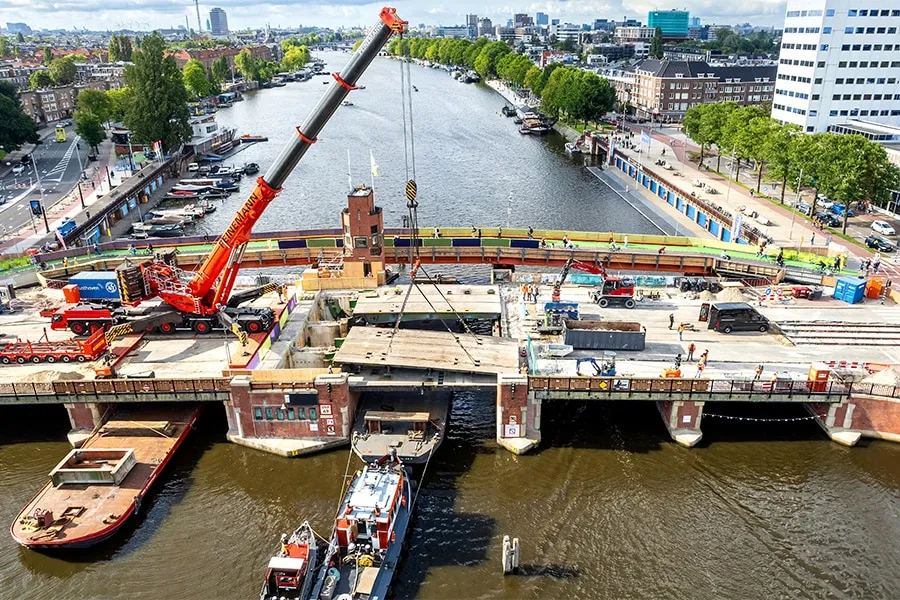
The iconic Berlagebrug connects East and West Amsterdam. The busy bottleneck is closed to all traffic for four months. Combinatie Berlagebrug, comprising Mobilis and Machinefabriek Rusthoven, needs every minute of that time to work on the monumental bridge near Amstelstation. The aim is to renovate and strengthen the bascule bridge. A complex job with a great plan.
The Berlagebrug was designed by architect Berlage in 1932 and immediately catches the eye with its robust appearance, distinctive pillars and brickwork. In the 1930s, the motor car was still a rarity. Today, the bridge carries not only cars but also pedestrians, cyclists, trams and freight traffic. There is plenty of activity below the bridge too, with vessels passing through. Bridge number 423 has a rich history, but was in urgent need of refurbishment to make it fit for the future.
Recovering materials
Mobilis project coordinator Paul Enter walks with a smile across the distinctive construction site above the Amstel. “Things are going well out here. I enjoy the hustle and bustle.” The Berlagebrug is completely closed for four months. Mobilis and Rusthoven are hard at work on the bridge deck. Struijk is also involved in the project, carrying out demolition work, “which we call recovering materials”, while Van Gelder is responsible for the road surface.
First, the monumental tram poles were carefully removed, and the roof of the bascule pit was cleared in the middle of the bridge. The 32 lighting and tram fittings are being refurbished in the restoration workshop at Smederij Oldenhave, where the monumental railings have also been taken.
Mobilis is no stranger to Amsterdam. It renovated Amstelstation, built Amstelstroomburg and is also working on Singelgrachtgarage and station Amsterdam Zuid (OVT). Paul has also been working in Amsterdam every day for several years, having previously worked on Amstelstroombrug, Brug 295 and the quay walls along the Singel. “Amsterdam is still Amsterdam. In a big city like this, everything is just a little different.”
Communication
Paul has just finished a construction meeting with the municipality. “Communication is particularly important on this project. We’re right in the middle of the city, so of course we take that into account. We can’t work continuously, and we pay attention to noise and disruption. Keeping everyone well informed is just as important as the work itself. We are guests here, after all.” Even the noise levels affecting fish have been measured.
The urban setting presents a logistical challenge, and there is no space for a site cabin. Detailed plans are needed for the replacement works, with close coordination required with the municipality and shipping. Access for the adjacent rowing club and marina has, of course, been taken into account. And every step and intervention has been agreed with Monumentenzorg, as the Berlagebrug is a Rijksmonument.
Orange work zones
The site has been carefully fenced off with cheerful Groene Bouwhekken, and work is also under way on the adjacent tram track and the Amsteldijk/Vrijheidslaan junction. Precise patterns of orange work zones have been marked out on the bridge to guide the work. The lines correspond exactly with the BIM design and method statement.
Cars and trams have to take a diversion during the closure. A temporary, circular-use footbridge has been built right beside the Berlagebrug for pedestrians, cyclists and emergency services. TBI-partners City Barging handled logistics by water, while Voorbij Funderingstechniek built the substructure for the temporary bridge.
Reference points
Almost two years of preparation preceded the renovation project. The design was surveyed in 3D and fully developed in BIM, with clash detection. The existing bridge was used as the starting point, with dozens of reference points marked on it. The brief is to carry out a thorough renovation and strengthening so the bridge can accommodate heavier traffic for decades to come.
That sounds relatively straightforward, but it involves a great deal of calculation and drafting, along with some real head-scratchers. The bridge’s monumental status adds extra complexity. It is important that the bridge continues to function as a major traffic artery for decades to come. However, its status as a Rijksmonument requires careful treatment of its history, with alterations kept to a minimum wherever possible.
Striking a balance
“It’s a matter of balancing competing interests,” says Paul, drawing on his day-to-day experience. For example, the new bascule leaf had to be made one and a half times as strong to carry heavier traffic. This meant the associated equipment would no longer fit in the existing pit. So what then? After much deliberation, the decision was made to use a hydraulic drive, which is more compact and does fit.
We take a look inside the cramped pit beneath the bridge. Paul points out a striking detail on the wall, the original instructions from the 1930s: ‘Extract from the Electrical Safety Decree 1938’ is written
there in thick black letters. These are the operating regulations, comprising twelve articles on how to operate the bridge. In the first phase, the pit is empty, but within a few months the 5 by 16 metre space will once again be filled with equipment and ballast boxes.
This part of the work is being carried out by Sissing Noord and Hydroton.
Splitting the lifting loads
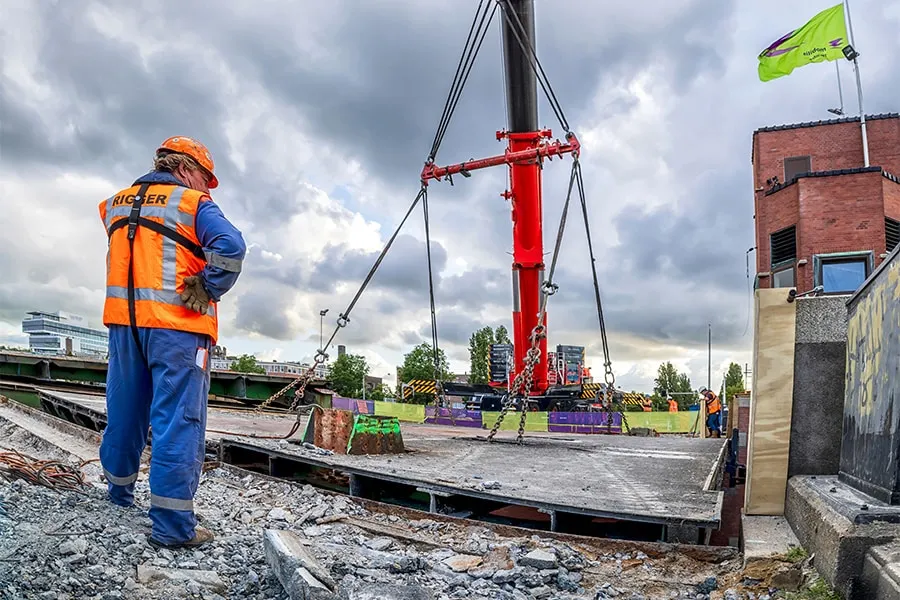
“These four months are the most critical part of the operation, with replacing the bascule leaf as the high point. The movable section consists of three parts, the middle one of which is designed for the tram. A large crane on the bridge is needed to lift out the old sections and put the new ones in place a month later. In fact, there are six lifts: three bascule leaves and three ballast boxes. To reduce the load on the monumental structure, the lifting loads have been split, and the ballast boxes disconnected from the bascule leaves. The bridge is continuously monitored during these lifting operations.”
Paul: “It’s a delicate and challenging job, and we’ve done a lot of preparation. Phasing, coordination and communication are extremely important here. With the surrounding community, and of course during the work itself with the people on site. We have a great plan and a good script. You can rely on that.” From mid-November, the Berlagebrug will be back in use as a traffic artery from East to West, with tram 12 once again running down the middle of the bridge.
Berlagebrug (1932)
Project: renovation and major maintenance
Features: Bascule bridge (bridge 423)
Client: Gemeente Amsterdam
Contractor: Combinatie Berlagebrug Mobilis and Machinefabriek Rusthoven
Special feature: Rijksmonument
Awarded: September 2021
Planned construction period: 2022 to Dec 2023
Contract value: 12 million euros
Temporary bridge: 8 by 100 metres
Read more about the history of the gateway between East and West.
Have a business enquiry for Mobilis? Get in touch
Who worked on it
Berlagebrug in Amsterdam, renovation
- Contractor
 Mobilis
- Machine factoryMachinefabriek Rusthoven
- clientGemeente Amsterdam
- waterborne logisticsCity Barging
- demolition workStruijk
- road surfaceVan Gelder
Keep following this
Get an email when a new story is published. No account needed.
- ProjectBerlagebrug
- SubjectBridge construction
- CompanyMobilis
- CompanyMachinefabriek Rusthoven
- CompanyGemeente Amsterdam
- CompanyCity Barging
- CompanyStruijk







