









Spikerpadbrug: truss construction using plate steel
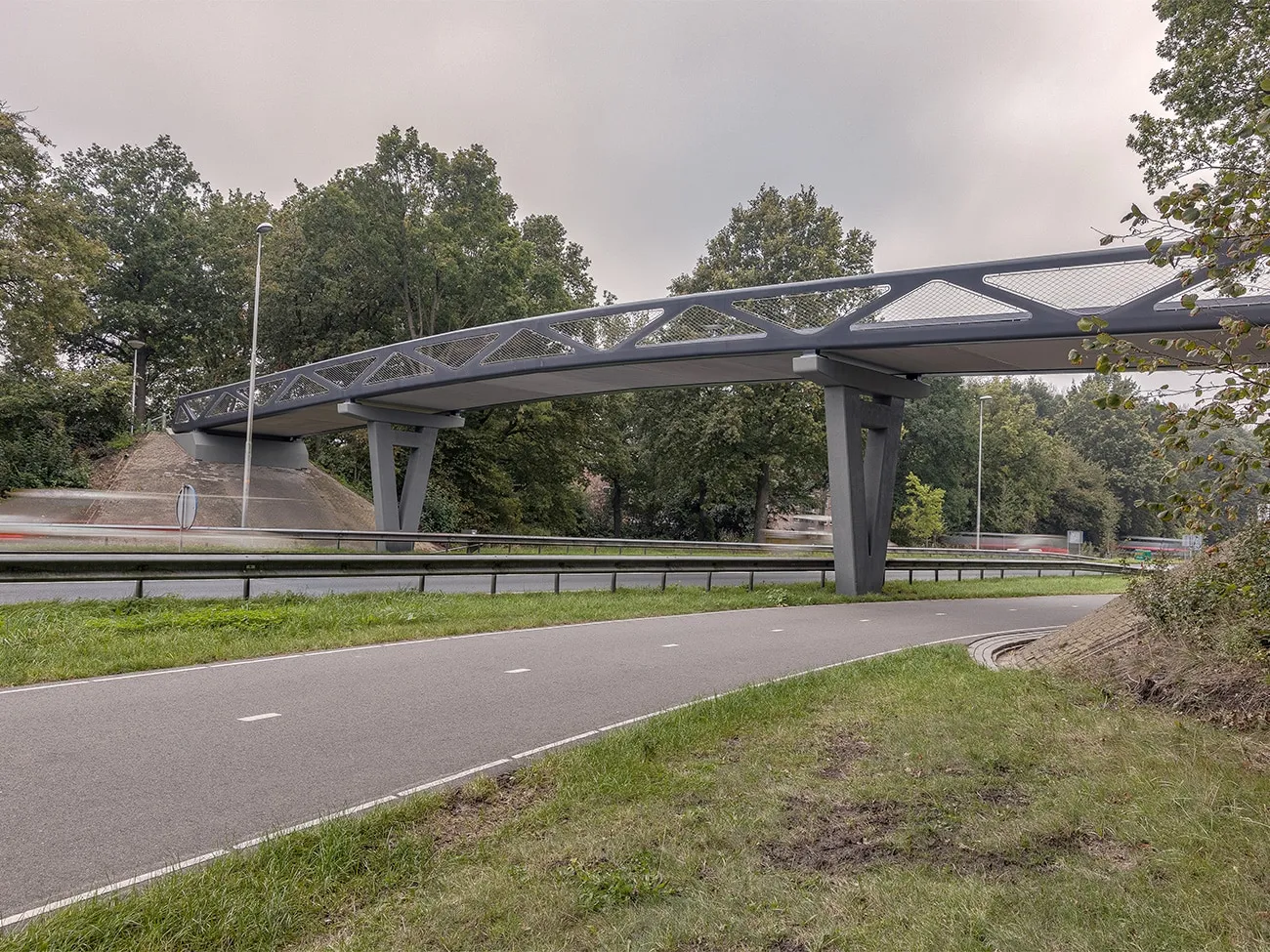
On the N348 Den Elterweg between Zutphen and Warnsveld, the existing Spikerpadbrug has been replaced with a completely new bridge. The new bridge is wider, virtually maintenance-free and also sits higher on the existing concrete supports. Rijnstaal Nieuwegein bv prefabricated the two steel truss girders for the new bridge entirely in-house from 20 and 25 mm thick plate steel, and installed them.
The new Spikerpadbrug consists of two independent steel truss girders connected by a deck made of precast ultra-high-performance concrete (UHSB) slabs. “The deck is just 11 centimetres thick. That is quite unique for a bridge almost 45 metres long and 4.84 metres wide,” says Anton Gorter, project manager at Rijnstaal. “For Knipscheer Infrastructuur, we translated ipvDelft’s steel design into a construction design, including all the welding details and finishes, so that we could manufacture both truss girders at our production facility. One important principle was that all connections were to be treated as full-penetration welds.”
Complex structure
Both truss girders were cut from S355 steel plate in J2 quality, Gorter explains. “Given that the design also includes radii of varying sizes, you can imagine that it was quite a complex structure to manufacture. Based on the construction design, we first produced all the plate layouts, including the weld preparations. The plates were then cut, and the plates for the truss structure were rolled to create the smooth outer edge. Each truss girder essentially consists of three sections: one between the abutment and the support (at each end), and one between the two supports.” The supports and abutments were retained after the existing deck was demolished, raised slightly and fitted with crossheads by Knipscheer Infrastructuur to carry the new bridge. “Under the RAW specification, we were allowed to approximate the radius in the central section using six segments, which, naturally, also all had to be fully welded, just like the rest of the structure.”
Stringent requirements
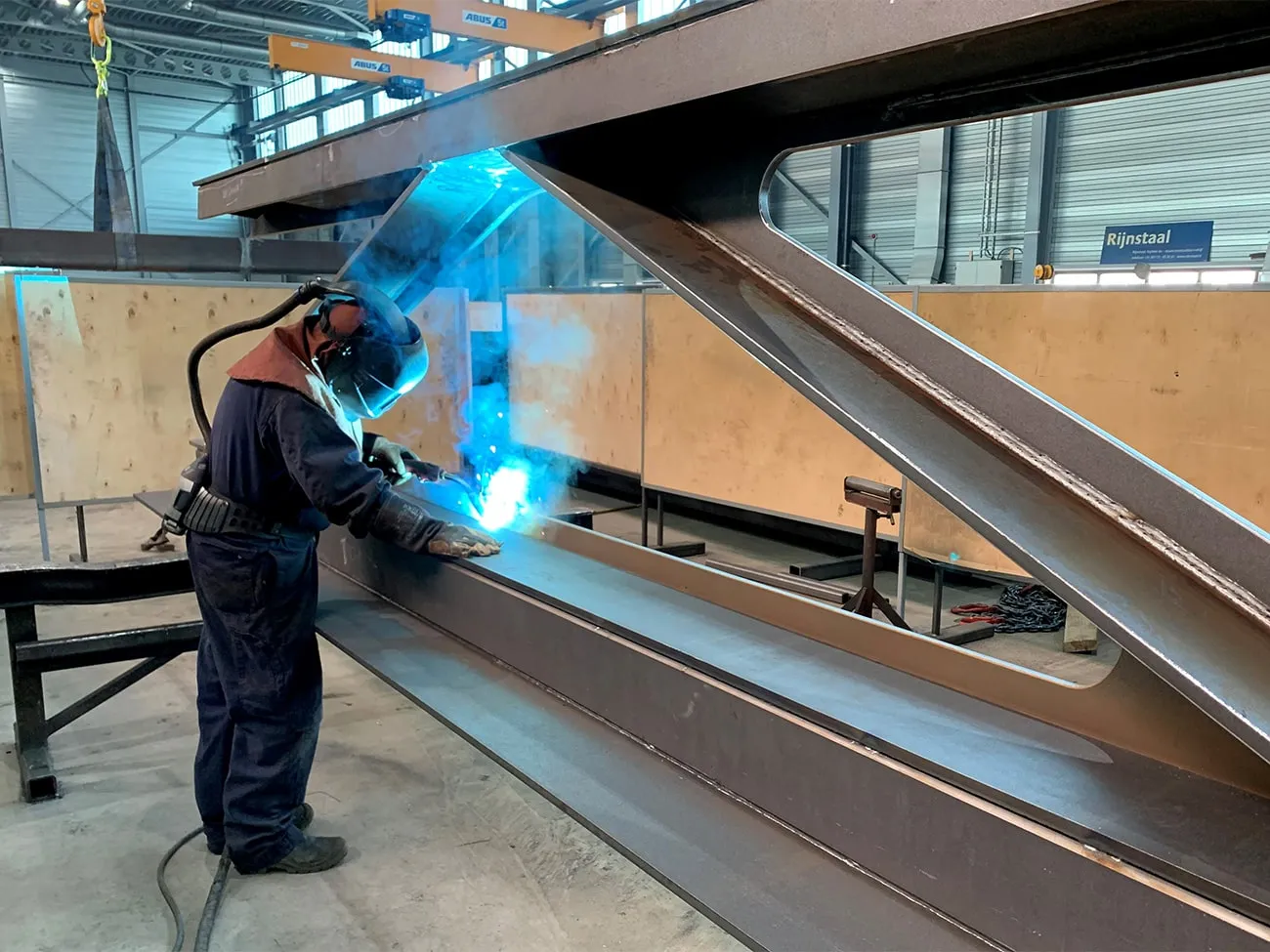
A 45-metre-long truss structure is not easy to handle. Rijnstaal chose to divide the girders in two lengthwise. “So, in effect, we assembled four 22.5-metre girders at our factory and fully welded them. Rijnstaal is certified to execution class 4. Our specialist welders enjoy this type of structural work. The specification set stringent requirements for visual appearance and the finish, because the truss remains fully visible and also serves as a parapet. Stainless steel frames were fitted into the bays. We prepared these entirely at our factory too, and fitted each one individually into the truss girders. Following a thorough quality inspection, the four sections were transported to JC Straaltechniek in Vlissingen and given a protective coating system. We then joined the sections there to form two large truss girders. The specification also allowed this to be done on site, but we thought it better to carry it out in controlled conditions. The girders were then transported by ship from Vlissingen to Mammoet in Schiedam for final adjustments, such as fitting the stainless steel frames and mesh by a subcontractor.”
During a weekend road closure, the two fully assembled truss girders were transported from Schiedam to Zutphen under special transport arrangements and lifted into place using a 200-tonne crane. Knipscheer Infrastructuur then installed the UHSB concrete slabs and poured the in-situ joints. By the end of the weekend, the new Spikerpadbrug was complete.
Question about this story? Ask your question
Keep following this
Get an email when a new story is published. No account needed.
- ThemeMaterials and techniques for infrastructure
- SubjectBridge construction







