









Specialists in horizontal and vertical transport
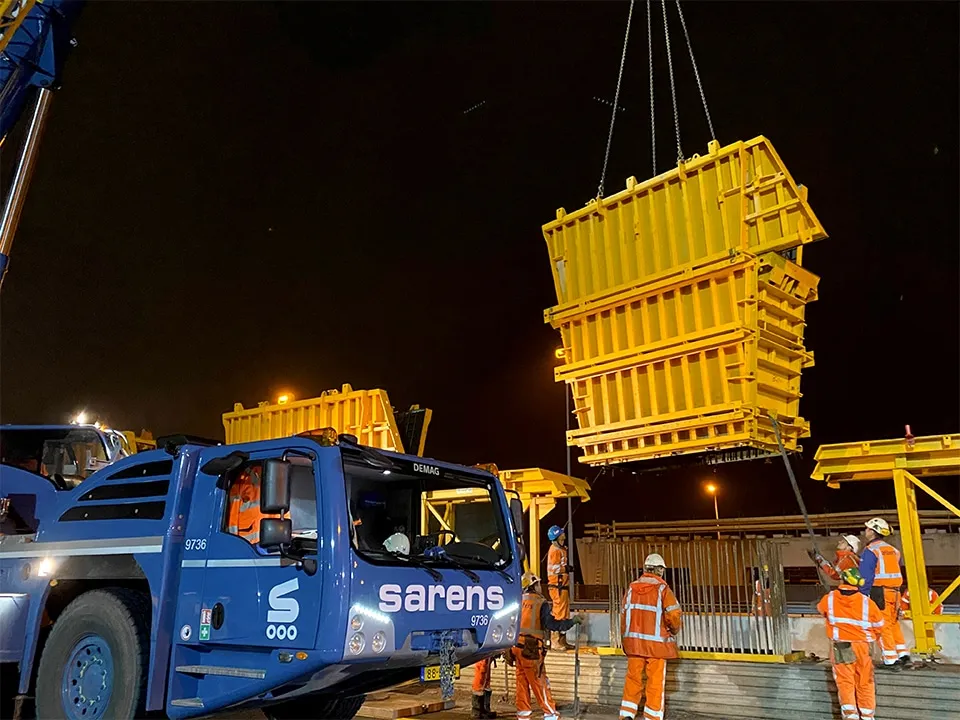
The Voltooiing Dubbele Rijbaanstelsel project, and in particular construction of the new viaduct over the A4, requires considerable crane capacity.
As a full-service provider of horizontal and vertical transport, with its own engineering department, Sarens has a solution for every logistics challenge. This is particularly valuable in a complex environment such as Schiphol, with its many height restrictions.
Sarens is a Belgian family business by origin and has been active in the Dutch market since 1986. “After taking over an existing crane company in the Netherlands, we have had a physical presence in the country for more than thirty years,” says Hildo Boelsma of Sarens Nederland. “We now operate from three locations in the Netherlands (Dordrecht, Amsterdam and Europoort), serving a wide range of clients. Heijmans is a regular client and, after completing the widening of the Wilhelminasluis in Zaandam, we ‘moved’ to Schiphol with part of the Heijmans team to tackle the challenges of horizontal and vertical transport there.”
A well-oiled machine
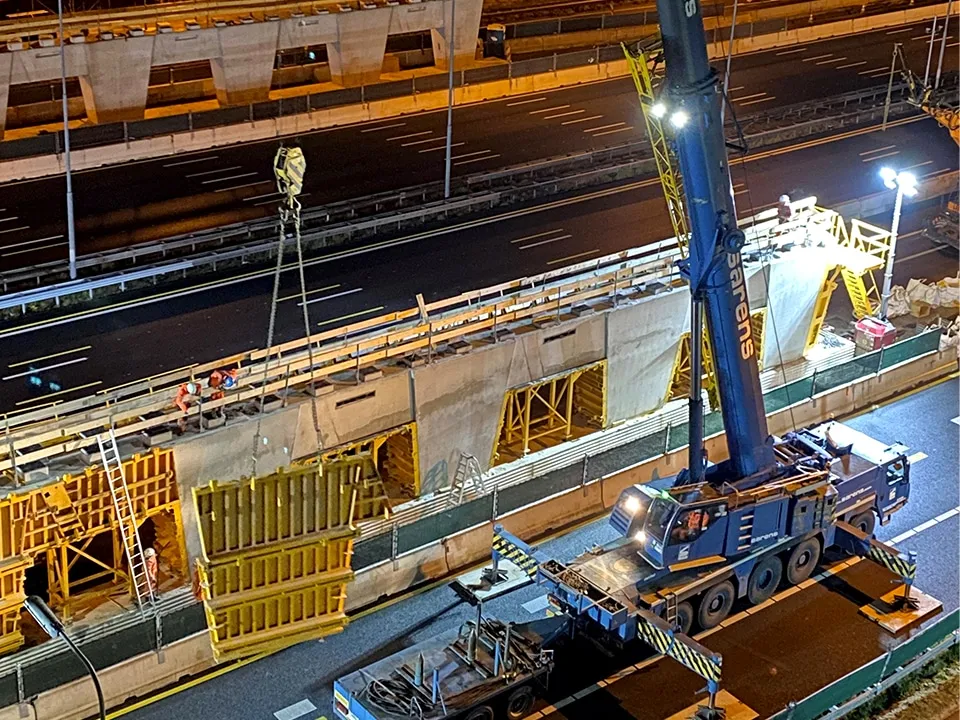
Sarens was initially brought in to move the pier formwork from the assembly area to its final position. “This required specialist transport, albeit over a short distance,” says Boelsma. “We are also responsible for placing the precast concrete beams for the viaduct. This is where our in-house engineering department has really proved its worth, particularly when spanning the A4.” His colleague Wesley van Gameren adds: “We will install forty beams across the A4 during each of four short but intensive overnight road closures. It is therefore essential that the process runs like a well-oiled machine. Any overrun is ‘not an option’ and would affect accessibility. The remaining viaduct beams are installed during the day as usual.”
Restricted working height
All lifting operations are subject to a restricted working height because of aircraft approach paths and sightlines from the control tower, as well as the fact that the airport remains operational at all times. Boelsma explains: “Depending on the maximum permitted height, we sometimes have to use several cranes to make the planned lift. We also have to take into account aircraft landing, taking off and taxiing around the cranes in position. The range of equipment used is extensive, including mobile cranes and ballast trucks with capacities of up to 400 tonnes. We have all of this in-house, along with a specialist crew who attach the beams to the lifting gear straight from the transport vehicle, position them and place them on the future structure. Finally, we carry out the necessary ‘smaller’ lifting work, for example turning reinforcement into position, installing platforms and closing the formwork.”
A business enquiry for Sarens? Get in touch
Companies in this story
Keep following this
Get an email when a new story is published. No account needed.
- SubjectBridge construction
- CompanySarens







