









Restoring a remarkable bridge calls for very special timber
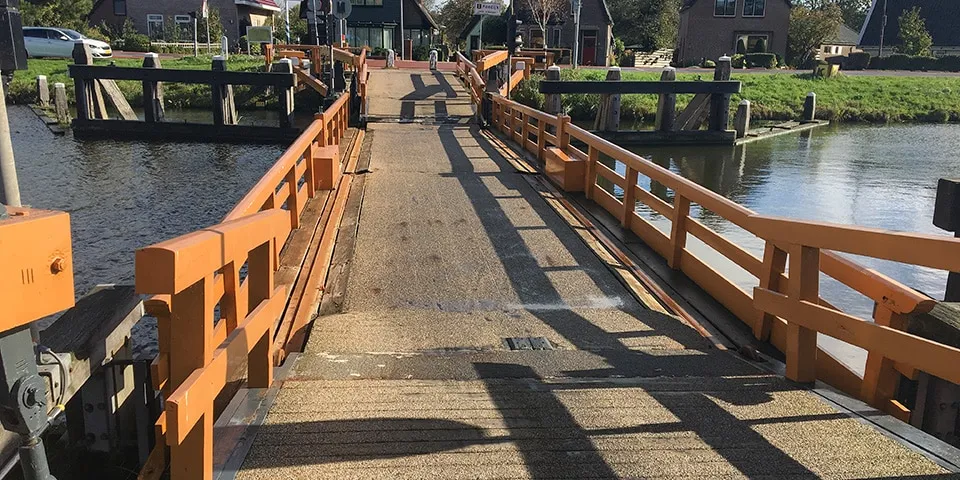
A few historic pontoon bridges can still be found in the Netherlands, on the Noordhollandsch kanaal. These bridges serve as fixed crossings for cyclists and pedestrians, but can be opened to shipping using an ingenious winch system. Approach bridges, known as cow bridges, cow flaps and regulated balance mechanisms are in place to allow users to travel on and off the bridge.
The pontoon bridge takes its name from the pontoons on which it floats. Of the five remaining bridges, one is still in an almost original state: De Koedijkervlotbrug. Stadswerk 072 from Alkmaar commissioned Koninklijke Holman Beton & Waterbouw to replace the pontoons of this bridge, which dates from 1824. It was no easy task, given the requirements involved. The two pontoons had to be recreated as faithfully as possible.
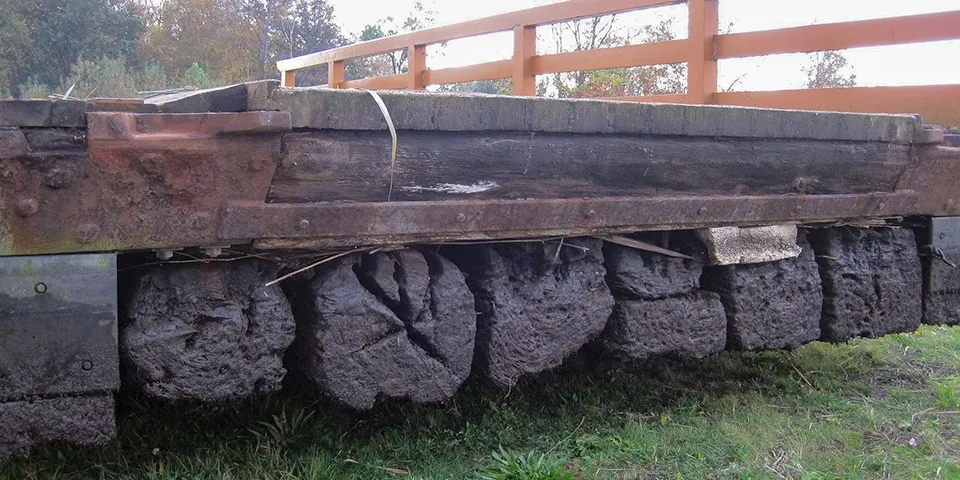
Indeed, it was in urgent need of replacement.
Historic timber structure
To remain faithful to the original, identical timber species had to be used, in the original dimensions. The bottom layer consists of spruce floats with a cross-section of 50×50 cm, topped with Bilinga crossbeams with a cross-section of 24×32 cm. Next comes the 11 cm-thick deck, also made of Bilinga. When awarding the contract, the client supplied a 3D model of the bridge, showing its construction and the positions of the steel components on the timber structure. This gave Oosterhof Holman BV the go-ahead to start purchasing the timber, bearing in mind the longer lead time, particularly for the lower floating beams.
Given the highly specialised nature of the timber, Oosterhof Holman BV called on the expertise of Hupkes Houthandel BV in Dieren. Stefan Meinhardt, owner and director, explains: “Sourcing the right timber was quite a challenge. The bridge is made of Norway spruce (softwood), Bilinga and Azobé (tropical hardwoods). The softwood comes from the Black Forest and is PEFC-certified. The hardwoods carry the FSC label. To saw 50×50 cm sections in lengths of 14.5 metres, trees of a suitable size were specially selected in a German forest for this project.”

The new beams mean the bridge is ready to stand the test of time again.
Sawing expertise
All the round logs were sawn at the Dieren sawmill. “It is worth bearing in mind that there are now hardly any sawmills in the Netherlands capable of sawing round timber in these sizes,” Meinhardt continues. “The softwood trees had diameters of between 850 mm and 1,030 mm, which is very large by European standards. Even for Hupkes, this is not everyday work, but we can draw on decades of expertise.”
The largest logs are 180 years old or even older. Meinhardt says with a laugh: “Those trees date from the time when Mark Twain wrote his famous ‘Oliver Twist’ and Ludwig I was King of Bavaria.” Sawing Bilinga and Azobé is not a challenge for Hupkes, whose expertise dates back 100 years in 2018. “We specialise in large sections, long lengths and anything complex,” says Meinhardt.

The pontoons are already beginning to take shape.
SKH inspection confirms very high quality
Before delivery, the timber ordered by Oosterhof Holman BV was inspected by SKH at Hupkes. Meinhardt says: “The inspection showed that all the timber was of exceptionally good quality. Everything was delivered to Harlingen in mid-October, and work could begin on manufacturing the timber structure. This requires a high level of craftsmanship, given the dimensions of the timber and the final weight of the pontoons. Each pontoon weighs no less than 25 tonnes. The substructure is now complete, and the railing posts are being fitted, after which the deck and railing boards will be installed.”
If all goes according to plan, the bridge will be out of service for a week before Christmas so the new pontoons can be installed. Meinhardt concludes: “This was a rewarding project, in which all parties demonstrated the expertise they have to offer. Good communication is an absolute must.”
Question about this story? Ask your question
Who worked on it
Koedijkervlotbrug in Alkmaar
- clientStadswerk 072
Keep following this
Get an email when a new story is published. No account needed.
- ProjectKoedijkervlotbrug
- SubjectBridge construction
- CompanyStadswerk 072







