









Precision work on the seabed of the Dardanelles
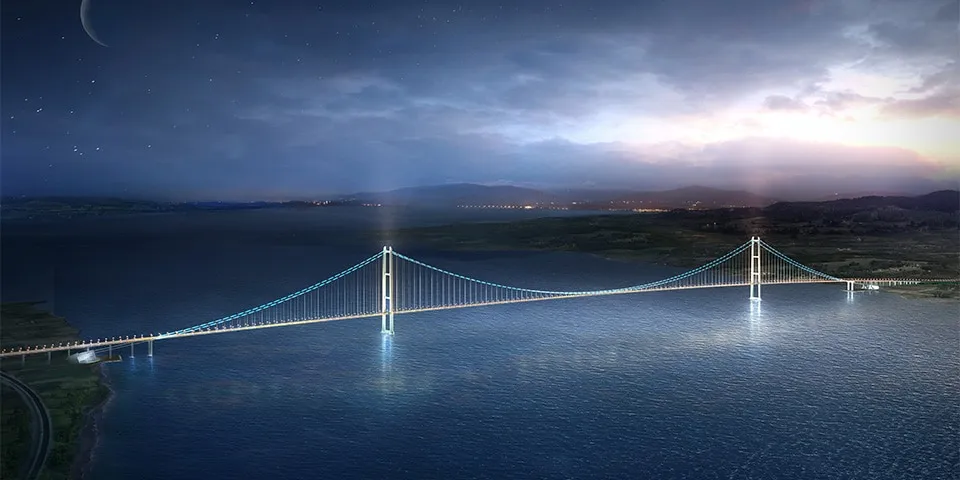
You may already have read about the construction of the Çanakkale 1915 Bridge in Turkey in an earlier issue of this magazine. A bridge of phenomenal proportions, it is part of the Çanakkale-Tekirdağ-Kınalı-Balıkesir motorway project. Once completed, this suspension bridge over the Dardanelles will replace a number of ferry services and connect the cities of Gallipoli, on the peninsula of the same name in Europe, and Lapseki in Anatolia, Asia. Both towns are in Çanakkale province.
Construction began in March 2017 and is due to be completed in 2023. The bridge will then be 3,563 metres long, with a clearance of 69 metres. The main span between the two pylons will be 2,023 metres. The joint venture responsible for delivering this masterpiece comprises two Turkish and two Korean companies, which in turn enlisted the services of Dutch company Strukton Immersion Projects to lay the literal foundations for the structure.
Expertise required down to the last millimetre
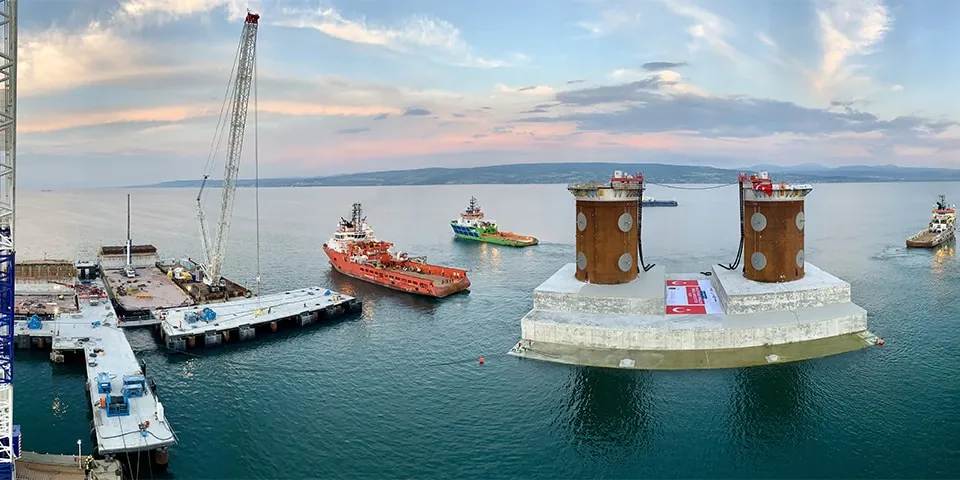
Strukton Immersion Projects has now completed its work. Peter van Westendorp, operations director at Strukton Immersion Projects, can look back on the project with satisfaction. We spoke to him about the challenges Strukton had to overcome. “We were brought in for this project by main contractor Dealim, who already knew us from a project in South Korea. We won the tender following the request for proposals, and had to move quickly because of the items that had to be cast into the deck slabs. Although the plan was largely carried out as designed, the design process involved a great deal of fine-tuning in light of new insights,” Van Westendrop begins. “The client added a further challenge by insisting, in the final stage of the tender process, that the caissons be positioned much more accurately than originally envisaged.”
Strukton developed a plan and pursued two options for constructing the floor. Van Westendorp: “Should we build the jacking system into the guide structure, or incorporate the jacks on or in the caisson? We kept both options open until the very last moment, having steel plates cast into the floor and anchors fitted into the nose of the caissons. In the end, we went with the second option, alongside the guide structure.
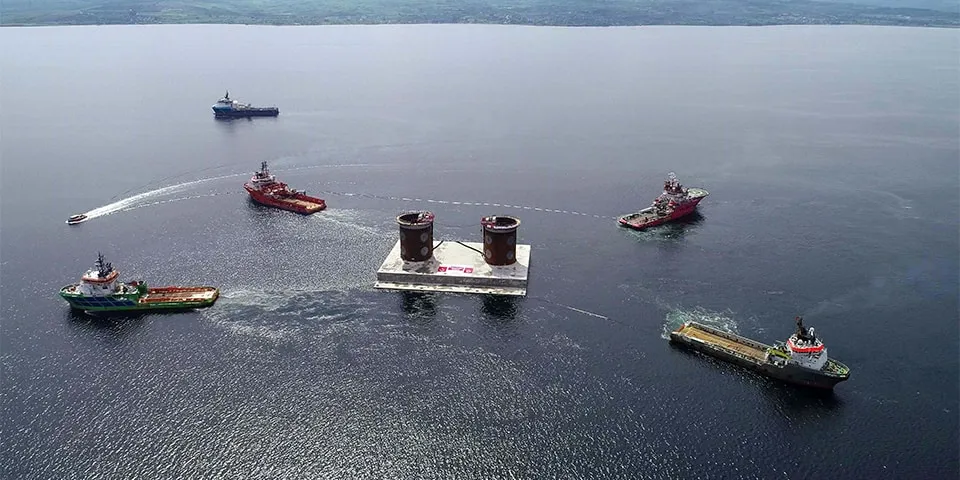
Four tugboats positioning the caisson.
Dynamic positioning
Strukton had a number of extra piles installed alongside the caissons for the guide structure. “This allowed us to optimise the set-up. At each position, we used one pile with one guide structure. Under the original plan, we would use four tugboats, anchored to pre-laid anchors, to pull the caissons into position. However, an extensive cable route on the south side of the caissons prevented us from anchoring there. We therefore opted for Dynamic Positioning (DP), with the tugboats held in position using GPS measurements. And bear in mind, to within 20 cm!” says Van Westendorp.
The precision work came in the final centimetres of lowering, which made the guide system indispensable. “With the current, you could never achieve accurate positioning otherwise,” explains Van Westendorp. “The caissons were lowered using a ballast vessel positioned alongside them under DP, with two floating pipelines. It took hours of pumping before the caissons had taken on enough water to sink. The guide structure formed an L alongside the caissons. When they were 2 metres above the seabed, the tugboats moved them towards the guide structure. Once they made contact with the guide, they were secured in the corner. At 75 cm above the seabed, the jacks were deployed and used to push the caissons into the correct position. Shaft inclination played a major role, as we were working at a depth of 45 metres. We are proud to say that we succeeded in placing both caissons on target to within 10 mm.”
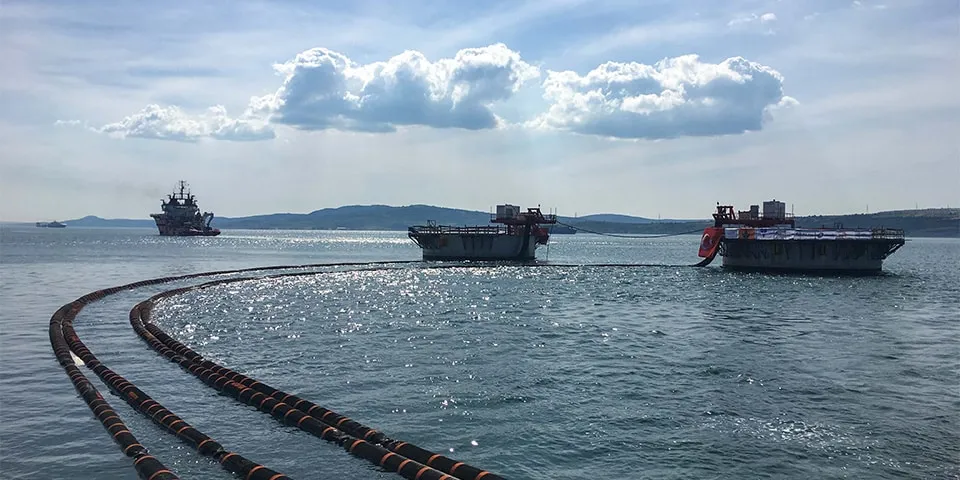
On the way to the seabed.
The foundations are in place
The ballast and deballast controls, which independently filled and emptied the caissons’ 29 cluster compartments, were specially developed for the project. “Each of the two shafts had a manifold container with a valve system and pumps. Once on the seabed, everything was permanently filled and the shafts were cleared of equipment. The final operation was to fill the shafts themselves. Divers then removed the jacks and guide structures. We finished last May, allowing work to continue on installing the inner and outer shaft walls, which would then be filled with concrete. At the end of last month, the two shafts were connected by means of a precast beam, the foundation for the pylons,” concludes Van Westendorp.
A business enquiry for Strukton Civiel? Get in touch
Who worked on it
Çanakkale 1915-brug in Çanakkale
- the foundation
 Strukton
- main contractorDealim
Keep following this
Get an email when a new story is published. No account needed.
- ProjectÇanakkale 1915-brug
- SubjectBridge construction
- CompanyStrukton Civiel
- CompanyDealim







