









Integration testing for Spijkenisserbrug renovation successfully completed
Text Sarah De Preter Beeld VSE, Yunex Traffic, ifs audiovisueel
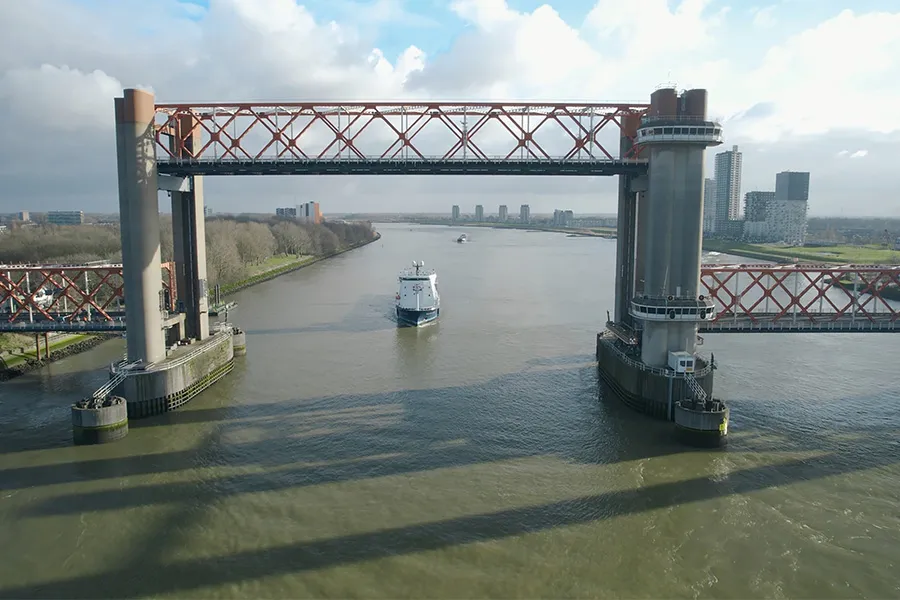
To ensure the Spijkenisserbrug over the Oude Maas can continue to be safely controlled, operated and monitored, all electrical installations and systems are being renewed. Extensive testing of the control systems, virtual commissioning and the use of the 3B-Bouwblok automation standard are minimising project risks. The integrated Factory Acceptance Test (iFAT) was recently held at Yunex Traffic in Zoetermeer. This is a milestone in this challenging project, for which VSE is supplying the drive systems for the bridge leaves.
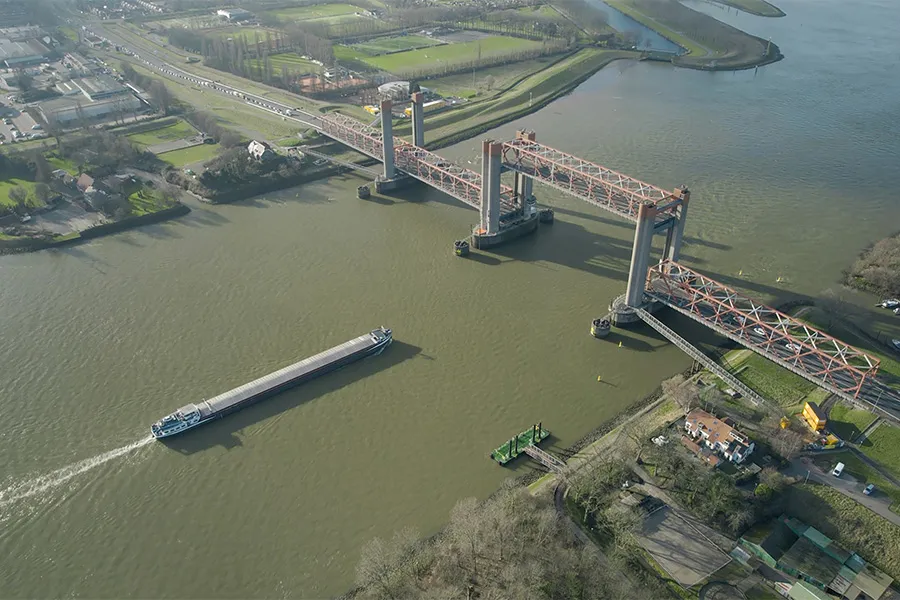
The Spijkenisserbrug is an important link for road traffic and shipping. It has two bridge leaves and opens around 7,000 times a year to allow large vessels to pass. Spare parts are barely available for the traffic and bridge engineering installations, and the control systems for the bridge leaves, which are several decades old. Faults can no longer always be rectified quickly. The Yunex Traffic–Heijmans joint venture won Rijkswaterstaat’s (RWS) European tender to renew the technical systems and installations. Minimising disruption, professional transition management and optimising system integration were key EMVI criteria. The project officially got under way in September 2023.
3B-Bouwblok: high availability
The bridge is being equipped with 3B-Bouwblok, an automation standard developed by Yunex Traffic on behalf of RWS to control, operate and monitor (3B) all the bridge’s dynamic functions. These include the signals and barrier gates. Seven bridges in the South Holland region are being equipped with the standard in stages. This makes bridge management less complex and more efficient for RWS, contributing to high availability and therefore smooth traffic flow.
Stakeholder management
A large stakeholder management team has been assembled for the renovation of the Spijkenisserbrug. “We have a lot of stakeholders to deal with,” says Patrick Hoet, who works for Heijmans and is project manager for the joint venture. “They include two local authorities, the Province of South Holland, Havenbedrijf Rotterdam, road and shipping traffic, local residents and associations. The ports of Dordrecht and Moerdijk also depend on this bridge. Everyone needs to be pulling in the same direction, and a lot of permits have to be arranged.”
One bridge leaf always available
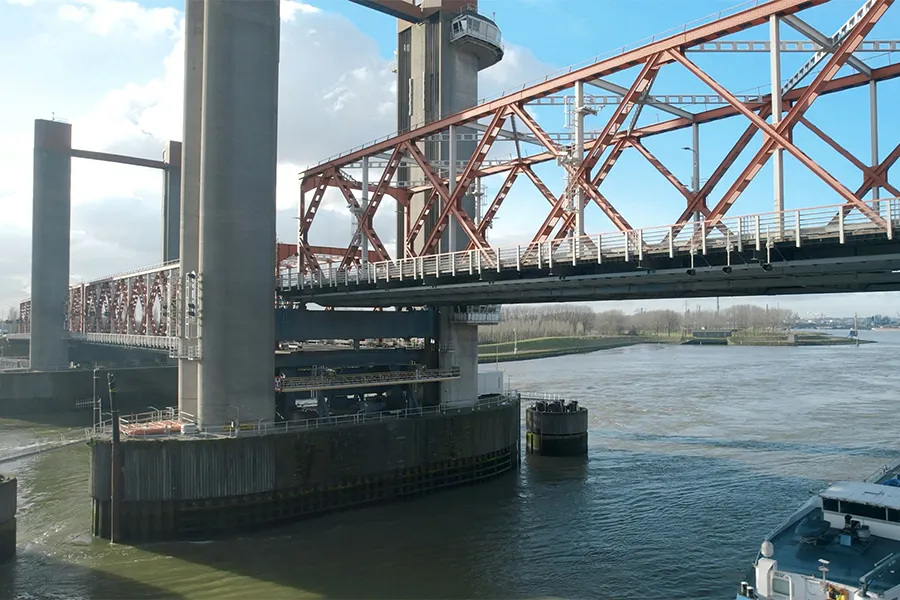
The logistical challenge is also considerable. Nothing less than the bridge’s “brain” is being replaced. Robbert Geers, technical adviser at RWS, explains how this can be done without bringing shipping to a complete standstill. “The existing electrical systems and installations are in the central pier of the bridge, while the new installations are being housed in the two outer piers. This allows us to build the new installations in parallel. The bridge also has two lifting leaves, so we can convert one while keeping the other in operation. During the summer holidays, when commercial traffic is light, we will convert the leaf on the Hoogvliet side, and during the autumn holidays we will convert the leaf on the Spijkenisse side.”
Collaboration day
From the outset, RWS and the joint venture have held regular collaboration days to discuss, among other things, differing interpretations of the requirements. Patrick Hoet: “At the start, contract partners are often separate islands that need bridges between them. As the first designs came in and we began discussing solutions, collaboration became easier and easier.”
Drive systems
The Yunex Traffic–Heijmans joint venture brought VSE on board midway through the detailed design stage as a partner for the drive systems for the lifting leaves. “Given the current shortage of skilled labour, we don’t have enough engineers for this ourselves,” says René Prins, technical manager at Yunex Traffic and for the joint venture. “Siemens is supplying the drive components, and VSE has extensive experience with them as a Siemens partner. We met at Vakbeurs Energie in 2023 and hit it off straight away. They knew exactly what they were talking about and were able to get up to speed quickly.”
Specialist work
Radboud van Dusseldorp, commercial manager at VSE: “Our engineers specialise in building high-end control solutions, and that’s exactly what they enjoy doing. We were keen to take on a challenge like the Spijkenisserbrug. We’re delighted with our collaboration with Yunex Traffic.” René Prins agrees: “We sit around the table as fellow engineers and would like to work together more often in future. I’d rather invest a little more in a partner who knows what they’re doing than have to solve the problems myself afterwards.”
Siemens technology
The winches for the lifting leaves are driven by SIMOTICS 1-PH8 squirrel-cage motors with SINAMICS S120 variable frequency drives. VSE used a Siemens Drive Controller to calculate, control and monitor the motion profile, and a Siemens Safety Controller to operate the installation safely. ′
Testing and simulation
To minimise disruption and meet the agreed time windows, all installations and systems are designed and extensively tested in advance at the factory using simulation software, BIM and 3D models. Patrick Hoet: “Renovating while keeping the business running always brings limitations. For example, we can’t simply switch off a barrier gate to carry out a test, quite apart from the limited space available for the replacement work.” Robbert Geers: “We don’t want to find outstanding issues during the Site Acceptance Test (SAT) on site that could put the handover date at risk. That’s why we test as much as possible at the factory. It’s also quicker than testing on site.”
Minimising risks
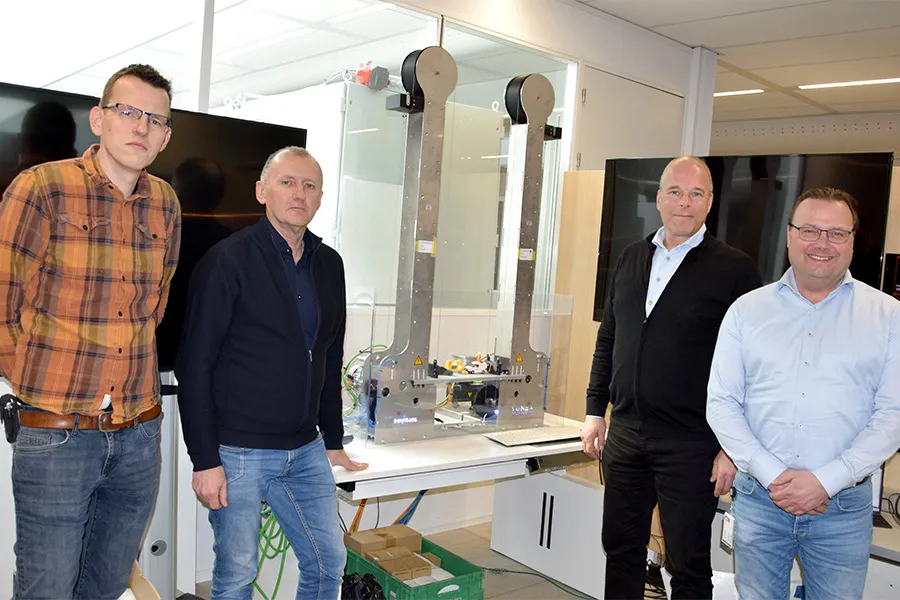
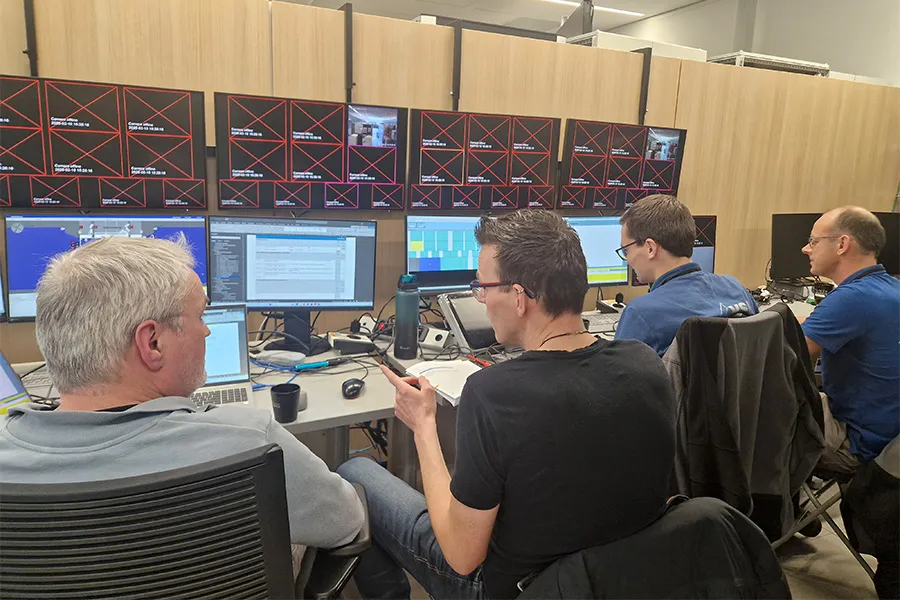
VSE used Siemens NX MCD design software and SIMIT to simulate and virtually commission the drive system. During the iFAT, the control cabinets for the first bridge leaf were connected to a scale model of the bridge. From that point, the project became very tangible for everyone involved. “The great thing about a scale model is that you can see it move,” says René Prins. “It’s an investment, but you need it to carry out extensive testing without running the risks you’d face on site. Working with simulations and models is safe, time-efficient and cost-effective.” Radboud van Dusseldorp: “Once the control cabinets for the first lifting leaf had been tested on a scale model, we only had to test the software for the second leaf virtually.”
Integration testing
For the iFAT at Yunex Traffic, all systems were connected: the drive system and the traffic and bridge engineering installations (cameras, barrier gates, lighting, …). Robbert Geers: “A model is useful, but when you connect the actual hardware that will also be installed outside, you get even closer to the real situation.” Following a successful iFAT, the contract partners can confidently prepare for the physical conversion. The VSE technicians who connected the equipment inside the cabinets will also do the work outside, helping everything to run smoothly. The eastern lifting leaf of the Spijkenisserbrug, on the Hoogvliet side, has now been disconnected from the existing systems and will be connected to the new systems during the summer holidays. In the meantime, the leaf will remain in the lowered position so road traffic can continue to cross it. The western lifting leaf will be converted during the autumn holidays. The steel cables and electric motors used to raise the leaves are also being replaced as the new installations are fitted.
Peak shaving and emergency power
An additional power supply is being built on the Hoogvliet side to make the bridge less vulnerable to power outages. The initial plan was to use Siemens UltraCaps as a power supply, but the decision was ultimately made to use them only for peak shaving, smoothing out the energy drawn from and fed back into the grid. “UltraCaps are relatively new and are now being used on large bridges for the first time,” says Robbert Geers. “VSE advised us to use the UltraCaps only for peak shaving and proposed alternatives for the emergency power supply. This has made the installation more robust and improved its availability.”
Brug over de Noord
As well as the Spijkenisserbrug, the tender covers the renovation of the Brug over de Noord. By having the same team work on two bridges in succession, RWS aims to improve efficiency. Robbert Geers: “It takes a little while to get used to working together, but once you’ve built up a rapport, processes get faster and faster. Around 30 to 40 per cent of the efficiency on the Brug over Noord comes from retaining the team.” Patrick Hoet: “We’ve now got into our stride and worked well together during the test days. The enthusiasm of everyone involved is energising. The way we’re working together now feels just like a construction team. We’ll take the lessons learned from the Spijkenisserbrug with us to the Brug over Noord. By embedding them in our working methods there too, we’ll achieve significant efficiencies.”
A business enquiry for Yunex Traffic B.V.? Get in touch
Who worked on it
Spijkenisserbrug
- Technical systems and installations
 Yunex Traffic
- drive system for the bridge leavesVSE
- drive componentsSiemens
Keep following this
Get an email when a new story is published. No account needed.
- ProjectSpijkenisserbrug
- SubjectBridge construction
- CompanyYunex Traffic B.V.
- CompanyVSE
- CompanySiemens







