









Eleven pipe jacks beneath Antwerp’s E34 and E17
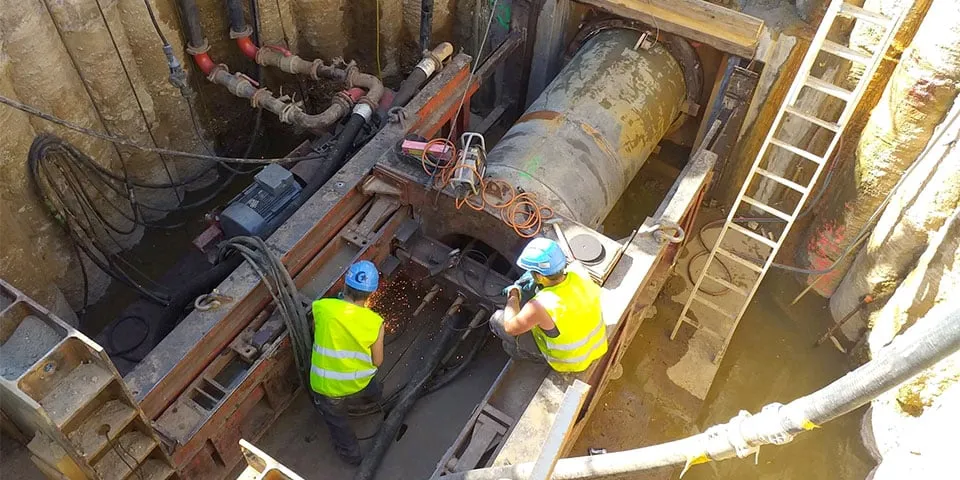
Work to improve traffic flow on the Ring in Antwerp will continue until 2025. Oosterweel is an ambitious, large-scale and complex project designed to complete the Ring around Antwerp, while also creating more space for other forms of transport, nature and the surrounding area. The sewer system alongside the motorway is also being renovated and upgraded. To this end, Smet-Tunnelling is carrying out no fewer than eleven pipe jacks beneath the E34 and E17 using state-of-the-art technology.
“The existing sewer system runs on both sides of the E34 and E17 and no longer meets requirements,” says Jan Vaessens, project manager at Smet-Tunnelling. “The system provides drainage for the motorways and connects the surrounding villages to the wastewater treatment plant. To upgrade the existing sewer system, connections need to be made between the systems on either side of the motorway. To avoid having to close the motorways for this work, THV Rinkoniên, comprising Stadsbader, Artes, CIT Blaton and Mobilis and responsible for the Oosterweel Linkeroever/Zwijndrecht project, decided to use pipe jacking.” Smet-Tunnelling was brought in to carry out the pipe jacks.
Microtunnelling
“We have now successfully completed eight pipe jacks at various locations,” says Vaessens. “We used microtunnelling, in other words pipe jacking with a closed-face boring shield. A laser aligned with the theoretical axis of the boring shield enables us to see, to the nearest millimetre, whether it is deviating from the planned alignment, and to correct it if necessary. The longest distance we had to cover on this project was 358 metres. The bores, with an external diameter of 1.50 metres, were completed in a straight line approximately 2.5 metres beneath the motorway, with an accuracy of 3 centimetres. Some of the bores passed through an area contaminated by industry. Because we work from watertight shafts without lowering the groundwater level, the groundwater pumped out does not need to be treated. This is an added benefit of pipe jacking compared with open-trench techniques.”
Smet-Tunnelling also carried out a pipe jacking operation right alongside the E34. Vaessens says: “Another unique feature of this pipe jack was that it had to follow a radius to avoid existing underground infrastructure. By using state-of-the-art technology with motorised theodolites that survey one another, we can determine the exact position of the boring shield. This enables us to carry out pipe jacks along a radius successfully too, as we have demonstrated here in Antwerp.”
Question about this story? Ask your question
Companies in this story

Keep following this
Get an email when a new story is published. No account needed.
- SubjectBridge construction
- CompanyMobilis







